Research Projects
FANTOM
Research Overview
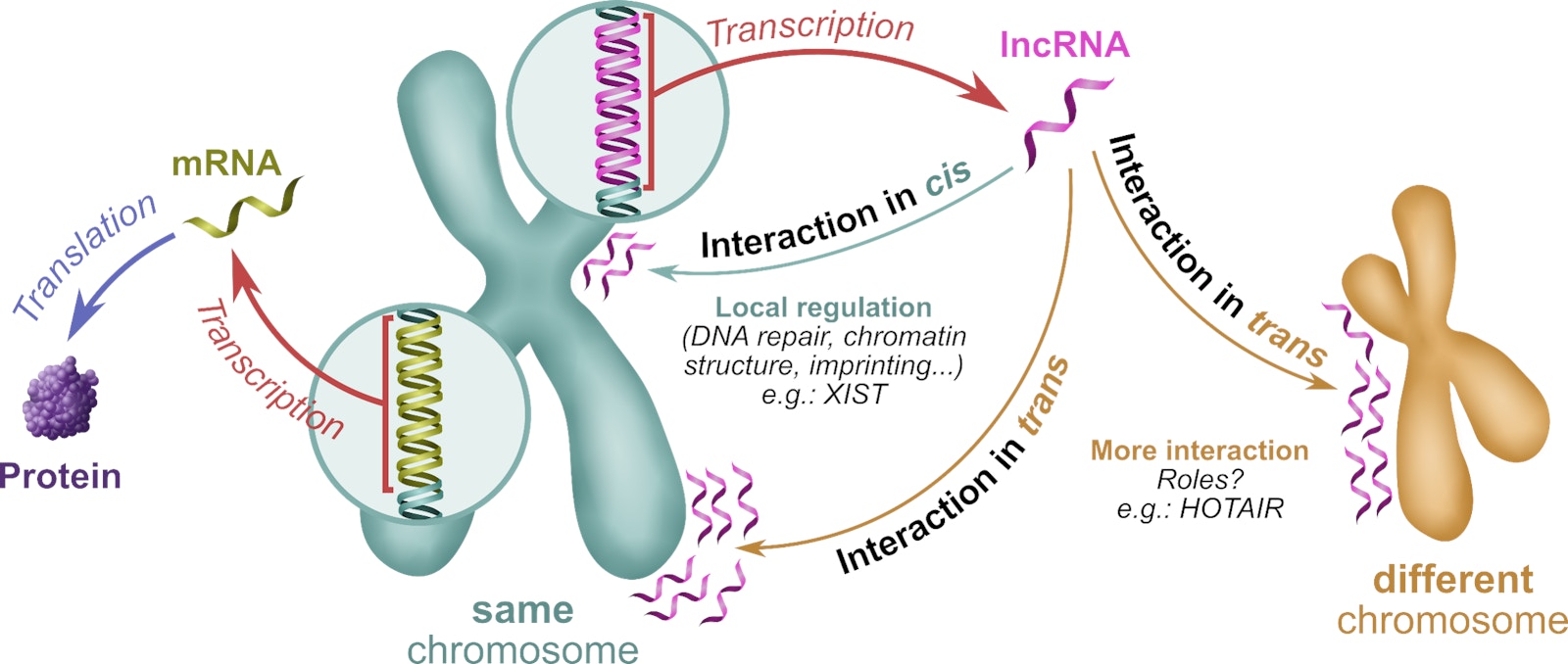
Roles of chromatin-interacting lncRNAs
The FANTOM6 project aims to elucidate genome regulatory mechanisms mediated by RNA–chromatin interactions.
FANTOM was launched in 2000 at RIKEN as an international collaborative initiative and has elucidated the mechanisms of mammalian genome regulation, with a particular focus on non-coding RNAs. In its sixth phase, FANTOM6, more than 70 research institutions are participating with the goal of exploring the roles of non-coding RNAs in genome regulation using comprehensive RNA–chromatin interaction maps.
In this project, analyses have been conducted on 16 different human cell types using nine diverse whole-genome technologies, including original technologies developed by consortium members. Through these efforts, thousands of novel transcripts have been identified, enabling precise analyses of cell-type-specific RNA–chromatin interactions as well as their dynamic changes during cellular differentiation.
For example, during neuronal differentiation, the project has revealed that RNAs directly coordinate enhancer–promoter communication (Sahlén et al., bioRxiv, doi.org/10.64898/2025.12.15.694370) and that nuclear RNAs actively contribute to shaping the three-dimensional architecture of the genome (Kang et al., bioRxiv, doi.org/10.1101/2025.03.13.641826). In addition, short tandem repeats were shown to function as SNP-modulated transcription start sites and to be involved in the distal regulation of genome function (Grapotte et al., bioRxiv, doi.org/10.1101/2025.04.10.648102). Furthermore, a framework has been established to decipher the dynamic changes in cis-regulatory element (CRE) activity during cell differentiation (Cassan et al., bioRxiv, doi.org/10.1101/2025.05.14.653995).
Collectively, the effort has led to a series of discoveries elucidating the relationships between RNA and DNA, and its outcomes promise to make significant contributions to human health.