Research Projects
Structural Cell Biology
Research Overview
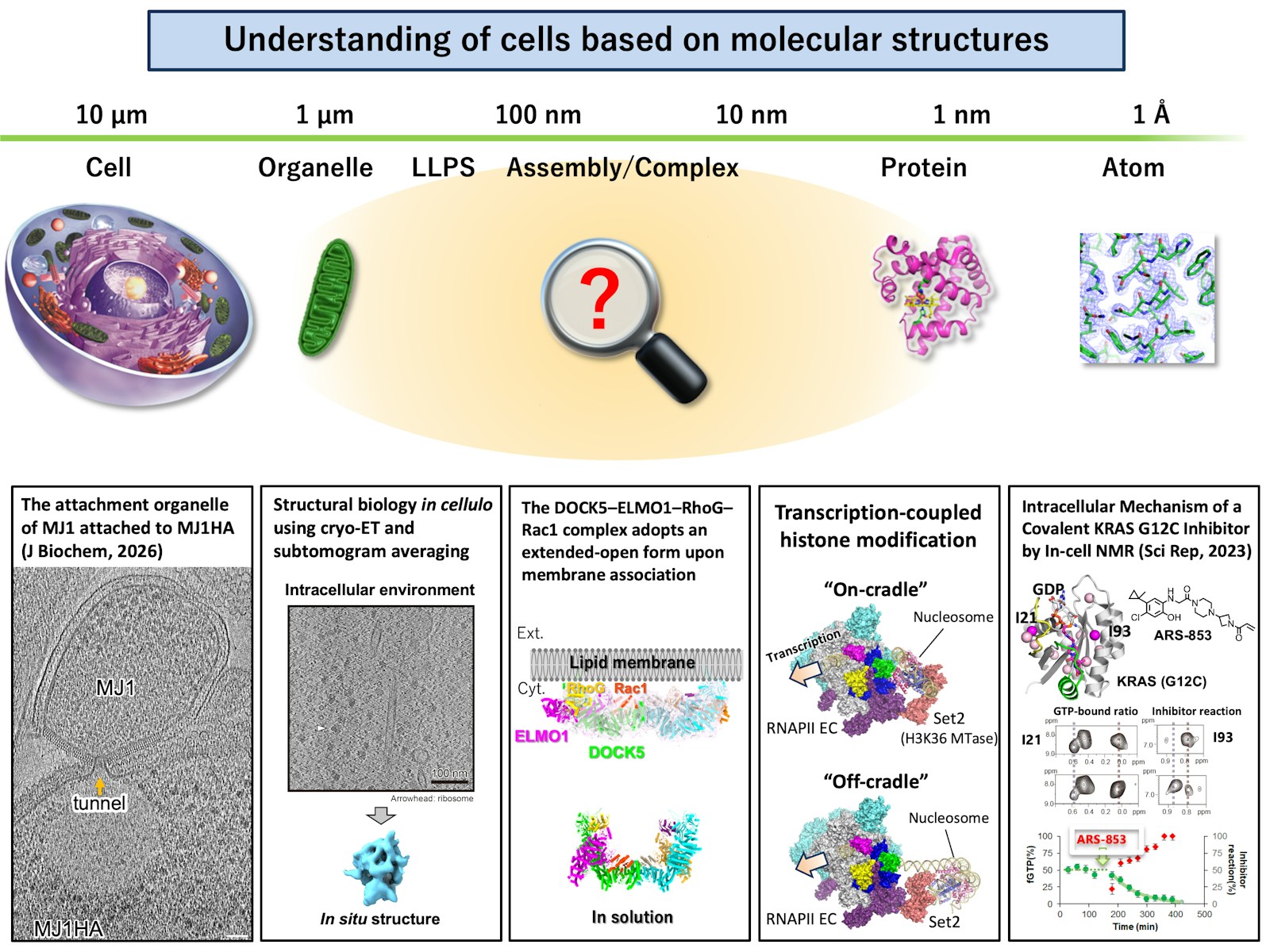
Living organisms are multi-layered systems comprising molecules, cells, tissues, and organs. All biological functions or phenomena are ultimately based on the structure and activity of biological macromolecules, such as proteins and nucleic acids. Therefore, understanding of life and biological principles requires the investigation of the structure of biomolecules in relevant biological contexts. To this end, we analyze structure and dynamics of biomolecules by various structural biology methodologies, such as cryo-EM, NMR, and X-ray crystallography. By integrating these structural biology methodologies with other complementary technologies, we bridge the gap in knowledge between molecules and cells, advancing our understanding of fundamental principles of life and contributing to drug development and medicine.
In IMS, five laboratories are dedicated to the structural cell biology research, by employing multiple approaches toward understanding of structure and mechanisms of biological macromolecules or macromolecular complexes constituting cells. In the in vitro approach, we isolate biomolecules from cells, identify their components, and determine their structures, interactions, and dynamics at high resolution, for example with cryo-EM. In the in cellulo approach, we advance the technology of cryo-electron tomography (cryo-ET) and in-cell NMR technologies to directly visualize the three-dimensional structure and dynamics of biological entities within cells. Integrating these approaches will enable cross-hierarchical insights into biological systems, linking molecular mechanisms to cellular functions.