Research Projects
Synthetic Biology for Reconstruction of Life
Research Overview
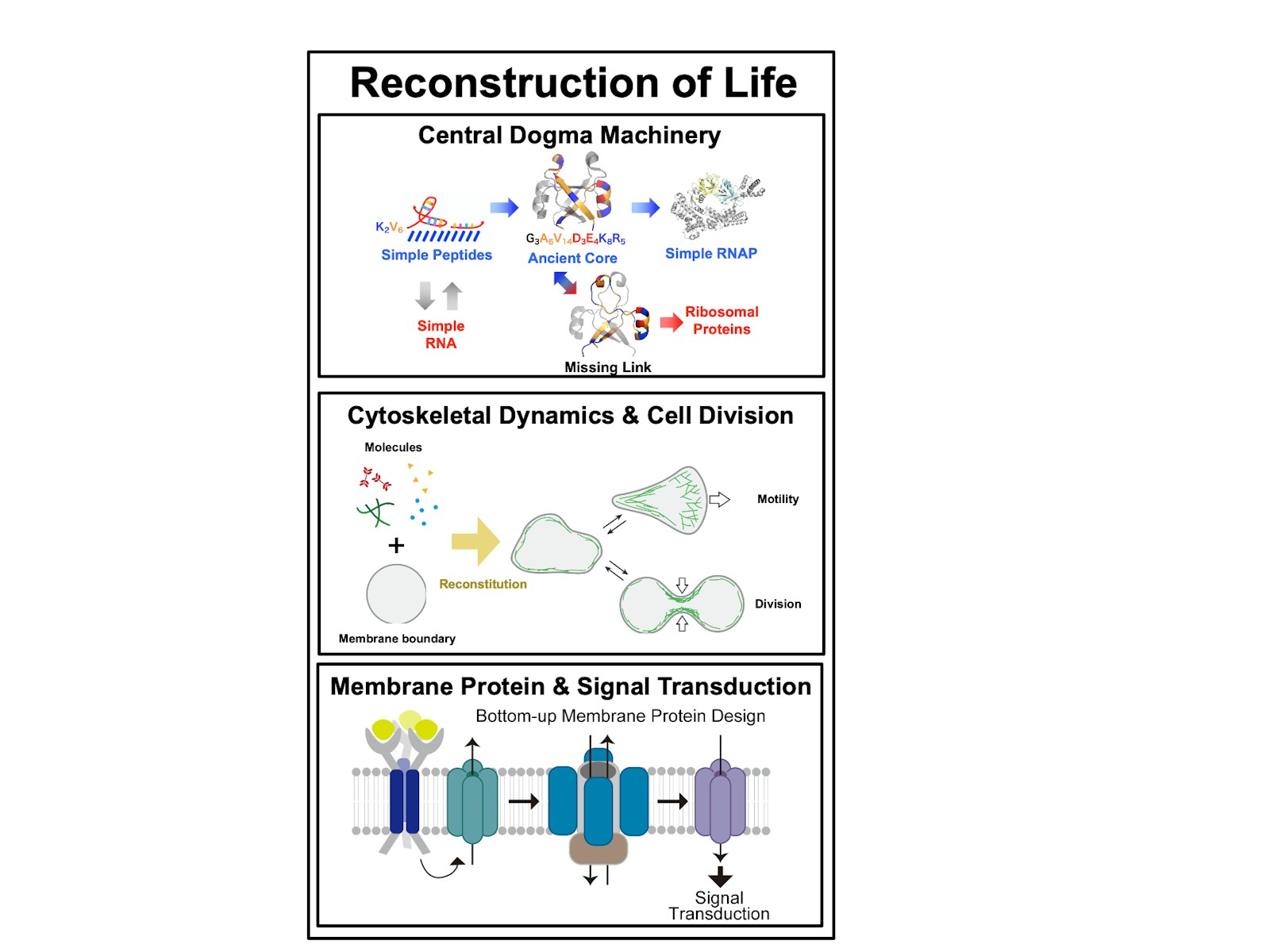
Reconstructing life from its individual components is one of the ultimate goals of biology. This research program aims to reconstitute fundamental biological apparatuses—including genetics, cellular architecture, and signaling—and to integrate them into a unified system. At the interface of chemistry and biology, we investigate how complex genetic information systems originated and evolved, particularly by reconstructing primitive analogs of the central dogma machinery. We have shown that simple peptides can enhance ribozyme activity, that self-organizing peptides can adsorb and concentrate RNA, and that short peptides with limited amino acid repertory can reconstitute core fold of RNA polymerase, illuminating early steps in the emergence of the genetic replication and expression system.
In parallel, we focus on the reconstruction of cytoskeletal dynamics and cell morphogenesis, including cell motility and division mechanisms. By combining biophysical reconstitution and advanced imaging, we reassemble minimal cytoskeletal modules and elucidate how collective filament behavior and mechanical coordination generate force and shape cell architecture. This work sheds light on the physical principles underlying cell integrity and dynamic morphological transformations.
Complementing these efforts, we further explore the reconstruction of membrane protein function and signal transduction. We decipher how membrane proteins are integrated, folded, and regulated within bilayers, and how their conformational changes propagate signals across membranes. Together, these programs chart a bottom-up path toward re-creating the essential systems of life in vitro, advancing our understanding of biological origins and enabling new synthetic biology technologies.