Research Projects
Atopic dermatitis
Research Overview
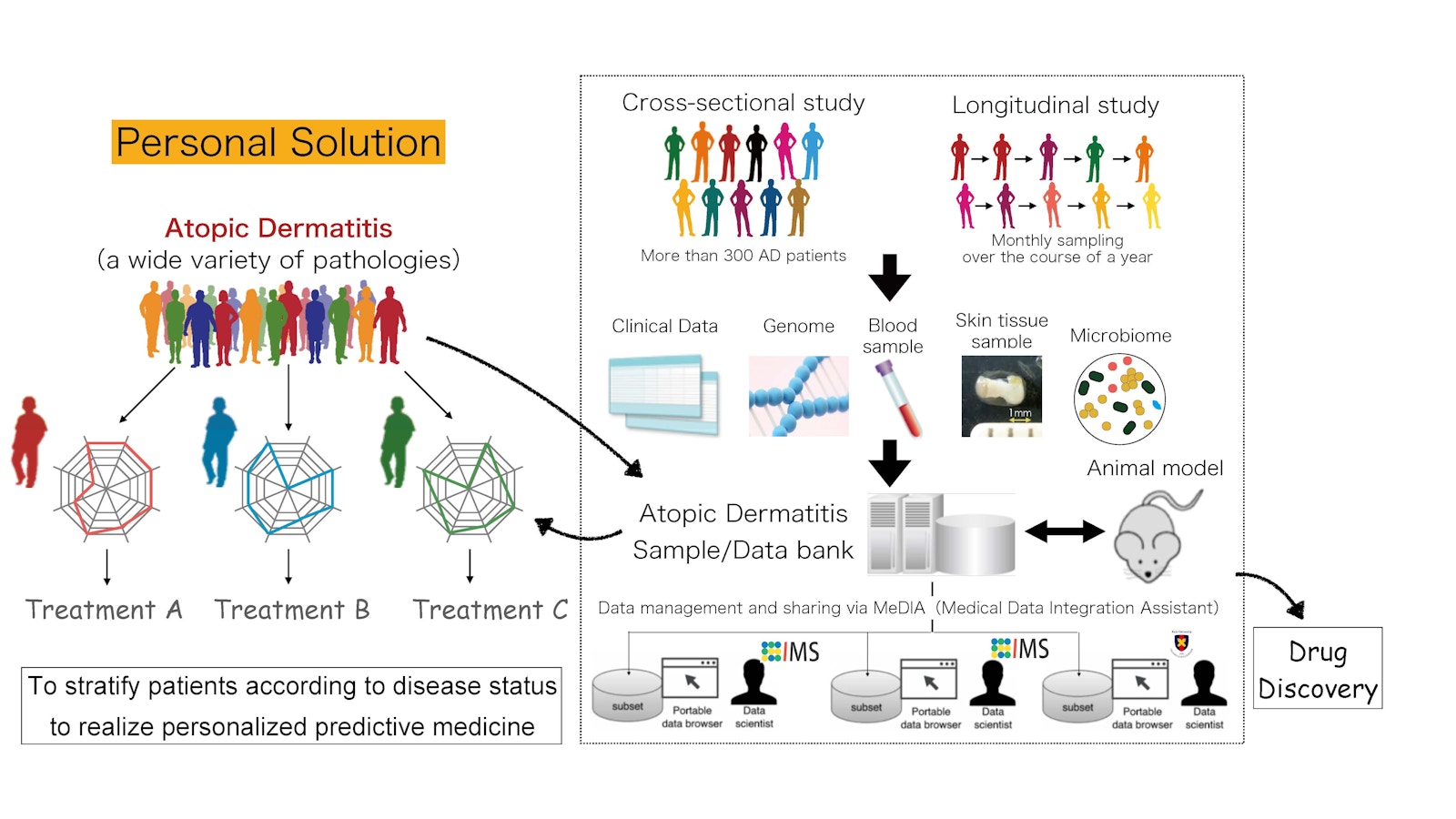
Data-driven and translational framework for atopic dermatitis.
The project integrates a large cross-sectional cohort and monthly longitudinal sampling with multimodal acquisition of clinical data, genome, blood, skin tissue, and microbiome. These data are stored and shared through the MeDIA platform and analyzed to stratify patients, identify biomarkers for disease monitoring and treatment-response prediction, and nominate therapeutic targets. Integration with animal models supports mechanistic validation and drug discovery, including the development of new targeted therapies such as OSM/OSMR-directed inhibitors.
Atopic dermatitis (AD) is a heterogeneous and multifactorial disease. Our project seeks to clarify the diverse pathophysiology of human AD by integrating genomic, transcriptomic, blood biomarker, microbiome, animal model, and multimodal clinical data, and to establish a foundation for personalized predictive medicine and drug discovery.
Human omics platform and prior foundation
Our earlier multi-tissue transcriptome study using PBMCs and skin tissue showed that phenotype-endotype associations in AD can be interpreted at the molecular level (Sekita et al., Nat Commun. 2023). In parallel, Ohta et al. (Allergology International. 2024) described the research database and data-integration platform (MeDIA) that supports data management and sharing across collaborating institutions. These studies established the clinical and analytical infrastructure for our current human cohort, which combines cross-sectional and longitudinal sampling and supports stratification, biomarker development, and translational research. We are also continuing genomic analyses to identify previously unreported AD-associated variants and to characterize the clinical features of patients carrying these variants.
Major achievement in 2025: unbiased whole-skin transcriptomics
A major recent advance was our unbiased whole-skin transcriptome study (Fukushima-Nomura et al., Nat Commun. 2025), which analyzed 951 AD skin samples obtained by minimally invasive 1-mm punch biopsy, together with psoriasis and healthy control samples. Using non-negative matrix factorization on full-thickness skin RNA-seq data, we identified disease-associated metagenes reflecting epidermal barrier dysfunction, type 2 inflammation, type 17 inflammation, type 1 inflammation, immediate-early-gene activation, and extracellular-matrix (ECM) organization. This data-driven framework enabled molecular stratification of AD skin beyond the conventional lesion/non-lesion dichotomy.
The study further showed that distinct skin phenotypes are linked to distinct molecular programs. Type 2- and type 17-associated signatures were linked to major inflammatory phenotypes such as erythema and papulation/induration, lichenification was associated with altered terminal differentiation, and lichen amyloidosis exhibited a characteristic type 1/interferon-related signature. Importantly, even clinically non-lesional AD skin showed weaker but significant barrier and inflammatory abnormalities, indicating that molecular pathology extends beyond visible lesions. Integration with blood biomarkers showed that circulating cytokines are connected to multiple skin metagenes, providing a bridge between skin-defined endotypes and less invasive blood-based monitoring.
The longitudinal dupilumab analysis provided clinically actionable insights. Dupilumab strongly suppressed type 2-related skin signatures and partly restored barrier- and ECM-related programs, whereas type 17-related signatures were more resistant. Baseline lesional ECM-related genes and type 17-related genes, non-lesional immediate-early-gene signatures, and blood IL-22/IL-18 levels were associated with subsequent treatment outcomes. Patients with poor responses showed persistent type 17 signatures in lesional skin and sustained immediate-early-gene activation in non-lesional skin during treatment. These findings provide candidate skin and blood biomarkers for endotype assessment, longitudinal disease monitoring, and prediction of therapeutic response, and they also point to rational alternative therapeutic strategies for patients inadequately controlled by IL-4Rα blockade.
Blood biomarkers for monitoring dupilumab-treated AD
We extended this line of work by analyzing blood cytokines in 170 Japanese AD patients, including 24 patients longitudinally profiled during dupilumab treatment (Fukushima-Nomura et al., Allergy. 2026). Among candidate blood biomarkers, IL-22 and IL-18 were more informative than the conventional marker CCL17 for monitoring disease activity once dupilumab treatment had begun. Although CCL17 decreased rapidly after treatment initiation, its range of variation became compressed and its correlation with contemporaneous disease severity weakened after the early phase. In contrast, IL-22, and to a lesser extent IL-18, retained measurable variability throughout treatment and consistently tracked residual disease activity. These results complement the 2025 skin transcriptome study and suggest that residual non-Th2 inflammation, especially type 17/22-associated activity, can be followed not only in skin tissue but also in peripheral blood during biologic therapy.
Current translational effort toward OSM/OSMR-targeted therapy
In parallel with human cohort studies, we are advancing translational drug discovery based on AD model mice. In our former animal study, we identified several candidate signaling molecules, including Oncostatin M (OSM), and showed that genetic perturbation of OSM ameliorated AD phenotypes in mice. We further found that OSM and its receptor OSMR are upregulated in the skin of a subset of AD patients. On this basis, we screened a cyclic peptide library and identified a cyclic peptide that efficiently inhibits OSM-mediated signaling by binding to OSMR. This inhibitor ameliorated AD-like phenotypes in mice expressing human OSM and human OSMR, providing a preclinical proof of concept for OSM/OSMR-targeted therapy. Together with our human omics studies, this work illustrates a bidirectional translational pipeline in which human molecular stratification informs target discovery and preclinical validation in animal models supports the development of novel therapeutic modalities.
Overall, our current program integrates cross-sectional and longitudinal human cohorts, monthly sampling over extended follow-up, genome, blood, skin tissue, microbiome, and detailed clinical phenotyping, while linking these human datasets with the MeDIA platform, machine-learning-based stratification, and animal-model-based drug discovery. Through this integrated framework, we aim to realize personalized predictive medicine in AD and accelerate the discovery of new treatment modalities.