Research Projects
KEIO-RIKEN IMS HuMED
Research Overview
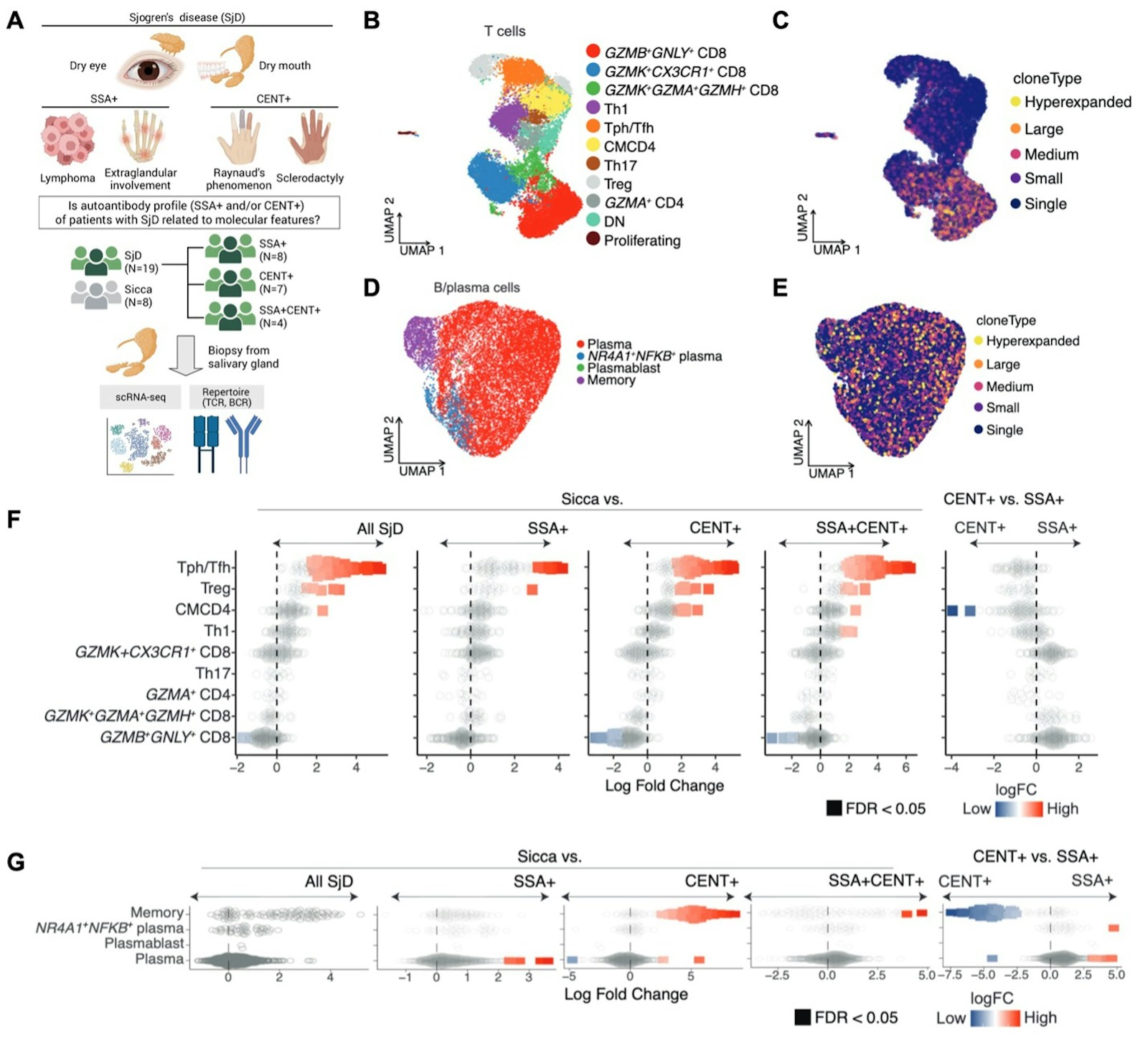
Distinct lymphocyte population dynamics in anti-SSA–positive and anti-centromere–positive Sjögren’s disease.
A) Clinical overview of Sjögren’s disease (SjD) and study rationale (Ref. 2). The upper panel summarizes the major clinical manifestations of SjD, while the middle panel classifies patients according to autoantibody status (SSA+ and/or CENT+) and associated clinical features. The lower panel outlines the sample collection, processing, and single-cell analysis workflow. B) Composition of T-cell subsets in salivary gland biopsies. C) Clonal expansion of T-cell populations. GZMB⁺GNLY⁺ CD8 T cells represent the most prominently expanded T-cell subset across patient groups. D) Composition of B-cell subsets in salivary gland biopsies. E) Clonal expansion of B-cell populations, showing no marked bias toward expansion of any specific B-cell subset. F) Differential abundance analysis of T-cell populations across SjD subtypes. Tph/Tfh cells and regulatory T cells (Tregs) were enriched in SjD compared with Sicca controls. G) Differential abundance analysis of B-cell populations across SjD subtypes. Memory B cells were enriched in the CENT+ subtype compared with Sicca controls, whereas plasma cells were more abundant in the SSA+ subgroup.
In 2021, RIKEN IMS and Keio University School of Medicine launched the Keio–RIKEN IMS Human Biology and Medicine Program (HuMED) to integrate cutting-edge genomics with clinical research and accelerate the translation of scientific discoveries into tangible benefits for society. A joint laboratory was established on Keio University's Shinanomachi campus and is currently led by Dr. Chung-Chau Hon, providing a platform for long-term strategic collaboration between the two institutions. By combining RIKEN IMS’s expertise in advanced single-cell and genomic technologies with Keio’s strengths in clinical medicine and patient cohorts, HuMED promotes both academic excellence and translational research. The program focuses on large-scale, single-cell studies of human diseases to uncover their cellular and molecular mechanisms. Major ongoing projects include the profiling of colon biopsies from patients with ulcerative colitis and Crohn’s disease (n = 300), as well as the characterization of iPSC-derived motor neurons from an ALS cohort (n = 150). Furthermore, in collaboration with Dr. Ho Namkoong (Department of Infectious Diseases, Keio University School of Medicine) and Dr. Kazuyoshi Ishigaki (RIKEN IMS / Keio University School of Medicine), the joint laboratory plays a key role in the international Human Immunome Project (Ref. 1) by characterizing cell-type specific immune responses in a large influenza vaccine cohort at Keio University. Beyond these flagship studies, HuMED encompasses more than ten active collaborative projects spanning diverse disease areas. These include investigations of colon transplantation, spatial transcriptomic analyses of brains affected by Alzheimer’s disease and schizophrenia, skin biopsies from patients with atopic dermatitis, characterization of gut T cells, and studies of therapeutic interventions in short bowel syndrome (Ref. 2), among others. A notable recent achievement is the comprehensive single-cell characterization of salivary gland biopsies from patients with Sjögren’s disease, conducted in collaboration with Dr. Masaru Takeshita (Division of Rheumatology, Keio University School of Medicine) (Figure A; Ref. 3). Our analyses revealed that GZMB⁺GNLY⁺ CD8 T cells represent the most prominently expanded immune cell population across patients with different autoantibody profiles (Figures B, C, and F), highlighting their central role in disease pathogenesis. In contrast, enrichment of memory B cells was particularly evident in anti-CENT–positive patients (Figures D, E, and G), suggesting distinct immunological features associated with specific serological subgroups. Overall, through this partnership, RIKEN IMS and Keio University are establishing a model of synergistic collaboration in which fundamental science and clinical medicine intersect. By generating high-resolution genomic datasets and applying them to clinically relevant questions, the HuMED program advances our understanding of human disease while contributing to the development of next-generation diagnostic and therapeutic strategies.
Contributed by Dr. Chung-Chau Hon
Reference:
1. https://www.humanimmunomeproject.org/
2. Kudo Y, Miyamoto K, Suzuki S, Chida A, Tojo A, Hasegawa M, Shigehara A, Koya I, Ando Y, Sato M, Kondo A, Kumagai T, Deguchi H, Sugiyama Y, Ito Y, Shirosaki K, Yamagishi S, Maeda Y, Kanamori H, Kano M, Kato M, Tsujikawa H, Yoshimatsu Y, Takabayashi K, Okabayashi K, Kanai T, Hosoe N, Kato M, Moody J, Hon CC, Kuroda T, Yamada Y, Fujino A, Sujino T. Longitudinal single-cell analysis of glucagon-like peptide-2 treatment in patients with short bowel syndrome. JCI Insight. 2025 Aug 7;10(18):e194497.
3. Inamo J, Takeshita M, Suzuki K, Tsunoda K, Usuda S, Kuramoto J, Moody J, Hon CC, Ando Y, Sasaki T, Yoshitake K, Mitsuyama S, Asakawa S, Kanai Y, Takeuchi T, Kaneko Y. Comparative single-cell and spatial profiling of anti-SSA-positive and anti-centromere-positive Sjögren's disease reveals common and distinct immune activation and fibroblast-mediated inflammation. Nat Commun. 2025 Sep 22;16(1):8299.