Research Projects
Human Translational Genomics
Research Overview
IMS has elucidated human biology of various diseases and phenotypes through genetics and genomics contributing to personalized medicine. Our research spans disease areas and methodological themes, including hereditary cancer (Momozawa), cancer genome sequencing (Nakagawa), pharmacogenomics (Mushiroda), cardiovascular diseases (Ito), autoimmune diseases (Yamamoto), functional genetics (Ishigaki), integrated analysis of all data and phenotypes (Terao), and biobank-scale statistical genomics (Okada Y). To uncover the biological mechanisms underlying genetic associations, we integrated our results with noncoding regulatory annotations and single-cell sequencing data obtained by laboratories of the FANTOM and Human Cell Atlas projects.
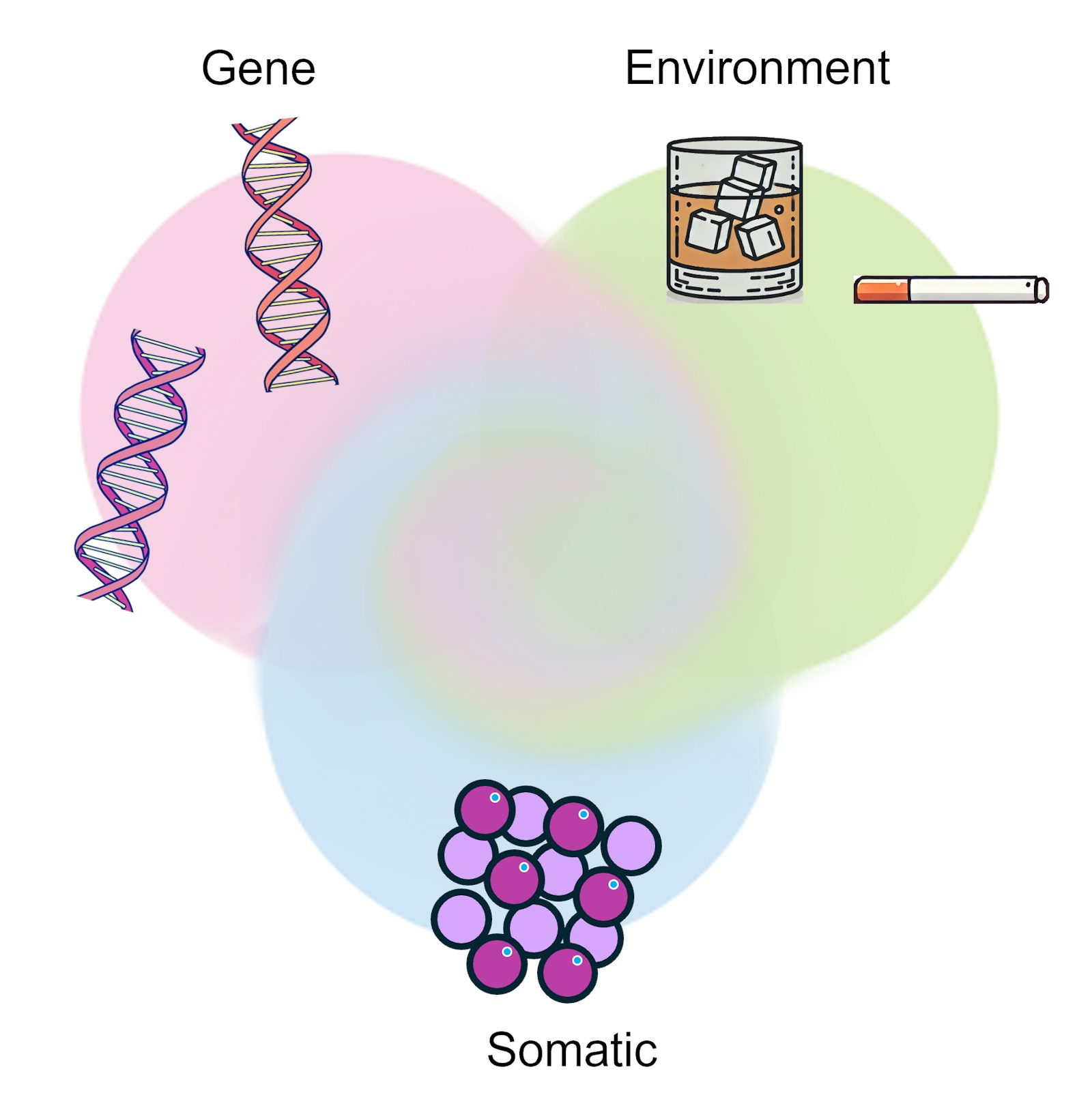
A key finding in 2025 was new insight of complex gene–environment–somatic interactions (Fig.), as reported by Usui Y et al. from the Laboratory for Genotyping Development (Blood Cancer Discov. 2025; 6:298-306). It is well established that acetaldehyde accumulation is substantially increased through interactions between genetic susceptibility and environmental factors, particularly alcohol consumption in individuals carrying the Lys allele of rs671 in ALDH2. In this study, an excess risk of myeloid neoplasm–specific mortality was observed through interactions between TP53-mutant clonal hematopoiesis (TP53-CHIP) and acetaldehyde exposure. Mediation analysis using a counterfactual framework supported the interpretation that TP53-CHIP, which was not primarily driven by acetaldehyde exposure, modified the effect of this exposure on myeloid neoplasm–specific mortality. These findings provide new insight into the architecture of disease risk.