Research Highlights
Chung Chau Hon, Jay W. Shin
The Asian Immune Diversity Atlas: a multinational single-cell reference atlas of circulating human immune cells
A multinational team of leading genomic scientists has generated a single cell reference atlas of circulating immune cells, which underscores the critical importance of integrating human diversity into biomedical research and will provide an invaluable multi ancestry resource for advancing precision medicine.
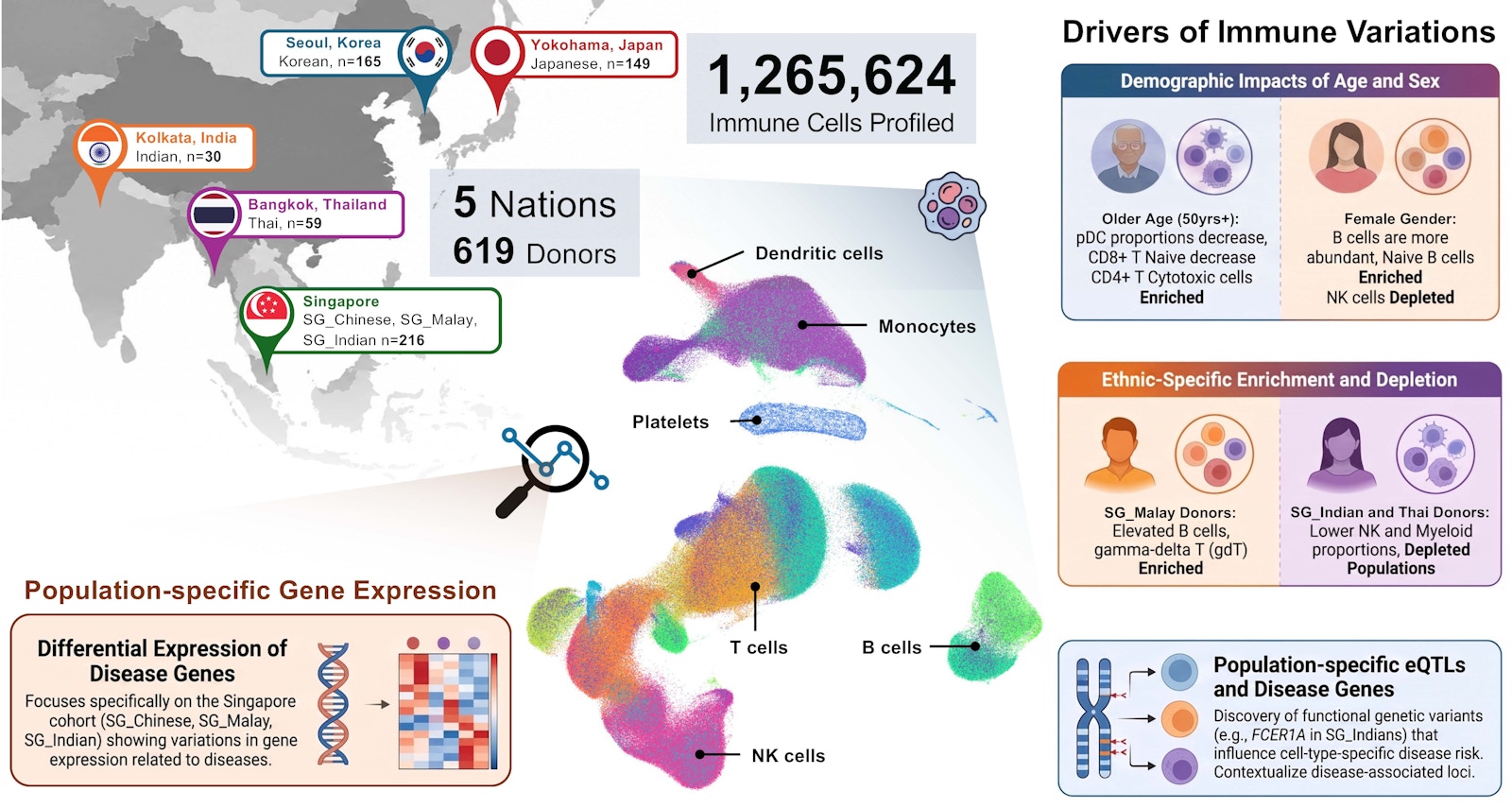
Graphical Summary of the Asian Immune Diversity Atlas (AIDA). This figure outlines the scope and key findings of the AIDA project, a multi-national single-cell RNA sequencing (scRNA-seq) reference atlas. The cohort includes 619 healthy donors spanning seven population groups across India, Japan, Singapore, South Korea, and Thailand. The central UMAP plot visualizes the 1,265,624 profiled immune cells, identifying major populations such as T cells, B cells, NK cells, and myeloid cells. The right-hand panels detail the drivers of immune variation, showing that age and sex significantly influence cell proportions, such as the depletion of CD8+ T naive cells with age and higher B cell abundance in females. Additionally, the atlas identifies ethnic-specific enrichment or depletion and population-specific eQTLs, which help contextualize disease-associated genetic variants and differential expression of disease-relevant genes across diverse Asian populations.
Overview
The relationship between human diversity and disease susceptibility has long been appreciated. Early large scale efforts, particularly Genome-Wide Association Studies (GWAS), sought to link genomic single-nucleotide polymorphisms (SNPs) with disease risk and yielded numerous clinically meaningful biomarkers. As technology advanced—especially with the emergence of single-cell analytical methods—these correlative approaches have become far more powerful and informative. A major limitation remains, however: most studies have focused on a single country and, at most, two population groups. Global representation is still limited; for example, individuals of European ancestry make up only ~15% of the world’s population, yet account for ~86% of participants in recent large GWAS and gene expression datasets.
To address this imbalance, a consortium of leading Asian genomic scientists, including Drs. Chung Chau Hon and Jay W. Shin from IMS, launched an ambitious initiative to perform single-cell RNA sequencing (scRNA-seq) on peripheral blood mononuclear cells (PBMCs) from healthy donors across seven population groups in five Asian countries. This was a wide-ranging and complex undertaking, with 619 donors from Japan, South Korea, Thailand, and India, as well as Singaporean donors who self-identified as Chinese, Malay, or Indian. The cohort was balanced by sex and included a broad range of adult ages. In total, more than 1.2 million cells were profiled, enabling detailed analyses of how human diversity shapes cellular and molecular variation across numerous immune cell types. The result of this work is the Asian Immune Diversity Atlas (AIDA).
Initial analyses from the AIDA have already yielded interesting patterns. Genetic ancestry, self-reported ethnicity, and sex had comparable effects on cell subtype proportions, while the variance explained by age, body mass index, and smoking status was typically lower. One specific example is the lower proportion of regulatory T cells (Tregs) observed in Korean donors, a difference that may have implications for population-specific disease susceptibility. A key message emerging from the AIDA is the importance of moving beyond broad continental categories to examine diversity at finer, sub continental scales.
The AIDA is likely to be of value on multiple fronts. First, it has already generated novel biological insights about aging through its initial analyses. Second, as a striking proof of the principle that integrating human diversity into biomedical research is essential. Finally, the datasets—publicly available through data portals—are already being used for algorithm development related to human diversity and for disease pathway analyses of immune disorders. They will continue to serve as a rich resource for future discoveries and meeting the clinical needs.
Original paper
Kian Hong Kock, Le Min Tan, Kyung Yeon Han, Yoshinari Ando, Damita Jevapatarakul, Ankita Chatterjee, Quy Xiao Xuan Lin, ....Kazuyoshi Ishigaki, Yukinori Okada, Kazuhiko Yamamoto, Piero Carninci, John C. Chambers, Chung-Chau Hon, Ponpan Matangkasombut, Varodom Charoensawan, Partha P. Majumder, Jay W. Shin*, Woong-Yang Park*, Shyam Prabhakar* (* Corresponding authors.) Asian diversity in human immune cells. Cell 188, 2288-2306.e24 (2025). doi: 10.1016/j.cell.2025.02.017