Research Highlights
Masayuki Amagai
Reprogramming Pathogenic T Cells into Antigen-Specific Regulatory T Cells
A longtime aspiration of immunologists has been to develop safe, autoantigen-specific immunotherapies for autoimmune diseases. Recent studies from IMS have shown that pathogenic T cells can be converted into functionally stabilized regulatory T cells that show such therapeutic efficacy.
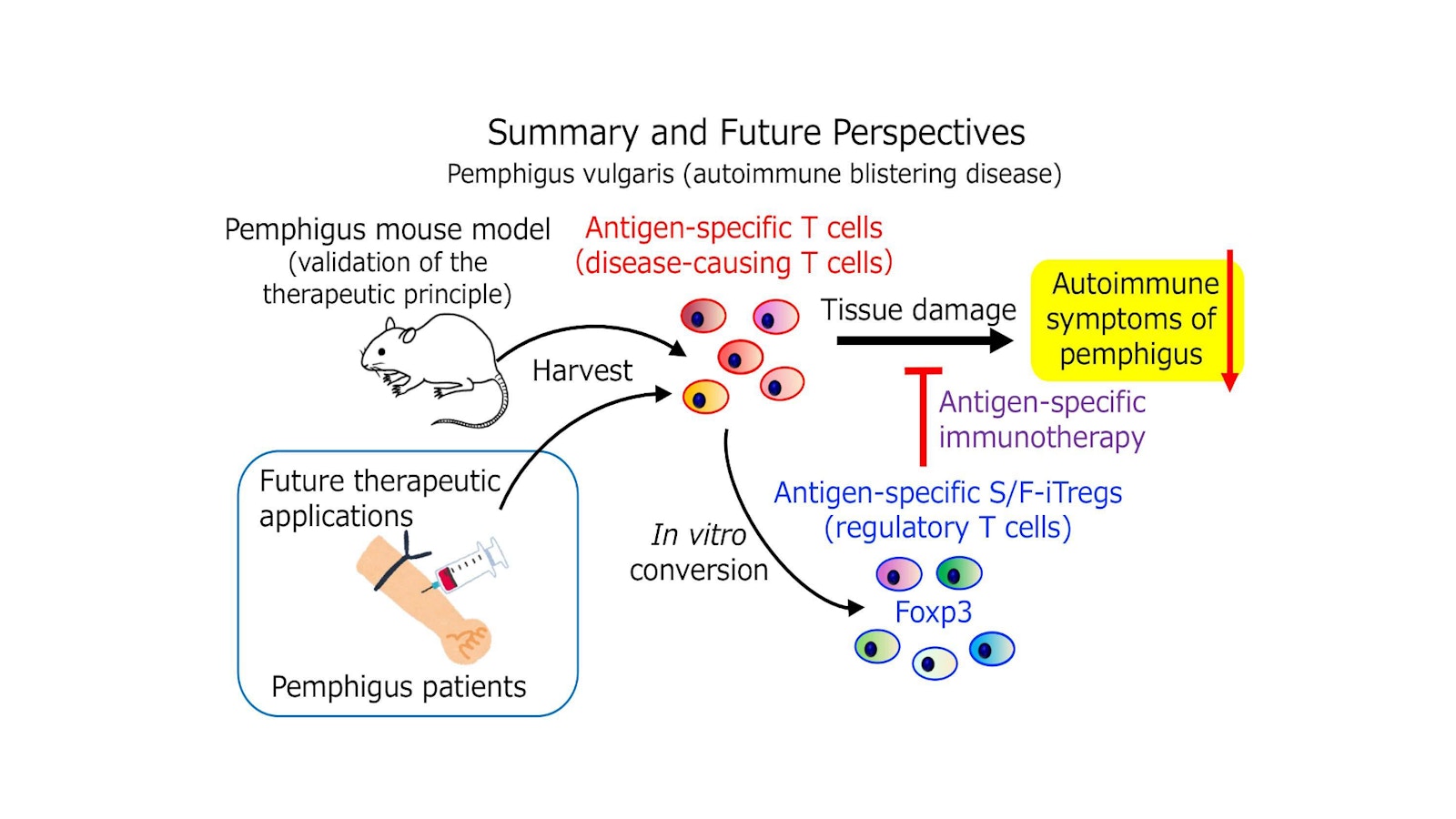
Antigen-specific immunotherapy strategy through conversion of pathogenic T cells into regulatory T cells in pemphigus vulgaris.
A schematic illustration of the proposed antigen-specific immunotherapeutic approach for pemphigus vulgaris (PV), an autoimmune blistering disease. Disease-causing antigen-specific T cells were isolated from a validated pemphigus mouse model and shown to mediate tissue damage and autoimmune manifestations of pemphigus. These pathogenic T cells were subsequently converted in vitro into antigen-specific stable/functional induced regulatory T cells (S/F-iTregs) expressing Foxp3. The converted antigen-specific regulatory T cells suppress autoimmune responses in an antigen-specific manner, thereby reducing tissue damage and disease manifestations. This strategy highlights the potential future therapeutic application of antigen-specific Treg-based immunotherapy for patients with pemphigus.
Overview
The immune system's ability to mount cell- and antibody-mediated protection against pathogens is well documented. Although the idea that immune system balance would also require antigen-specific suppression has been around for decades, the convincing identification of the cellular and molecular mechanisms responsible for this activity is relatively recent. Shimon Sakaguchi discovered regulatory T cells (T regs) in 1995 and, in 2025, received the Nobel prize for this discovery, together with Mary Brunkow and Fred Ramsdell, for their collective roles in identifying Foxp3 as the master transcriptional regulator of Tregs.
The therapeutic potential of Tregs to suppress autoimmune disease was quickly recognized; it became more promising with the discovery that conventional CD4 T cells (Tconv) could be converted into antigen-specific Tregs upon antigen stimulation in the presence of the cytokines TGF-β and IL-2. However, a major stumbling block was the instability of these so-called induced Tregs – they would quickly revert to potentially pathogenic Tconv in vivo. The studies reported here by Dr. Amagi and colleagues describe the production of stable and functional induced Tregs (S/F-iTreg) that are immunosuppressive in pemphigus vulgaris, an antibody-mediated autoimmune disease affecting the skin and certain mucosal tissues. The well-defined autoantigen is desmoglein 3 (Dsg-3), a cadherin-type cell adhesion molecule expressed by cells in the target tissues.
The stable conversion of iTregs was achieved by pharmacological induction of Foxp3, combined with costimulation-dependent installation of Treg-specific epigenetic changes. These S/F-iTregs showed antigen-specific immunosuppression in vitro and, in an animal model of pemphigus vulgaris, inhibited production of anti-Dsg-3 antibodies, with no off-target effects on bystander B cells. Importantly, human S/F-iTregs with similar in vitro functions could be generated from peripheral blood T cells of patients with pemphigus vulgaris.
OriginalPaper
Mukai N, Takahashi H, Kubo Y, Asahina Y, Iriki H, Nomura H, Kamata A, Ito H, Kurebayashi Y, Yamagami J, Mikami N, Sakaguchi S, Amagai M. Conversion of pathogenic T cells into functionally stabilized Treg cells for antigen-specific immunosuppression in pemphigus vulgaris. Sci Trans Med 17, eadq9913 (2025). doi: 10.1126/scitranslmed.adq9913