Multi-omics Platform
Genomic and Transcriptomic Unit
Activities
Unit Leader
Yukihide Momozawa
In 2019, we established a sequencing platform within the Laboratory for Genotyping Development to began providing support for next generation sequencing. In 2021, we expanded this effort by launching a Genome Platform, enabling integrated support that encompassed not only sequencing but also library preparation and data analysis. In April 2025, the Genomic and Transcriptomic Unit, the Advanced Multi‑Omics Technology Division was established to provide comprehensive support for experiments involving next generation sequencing.
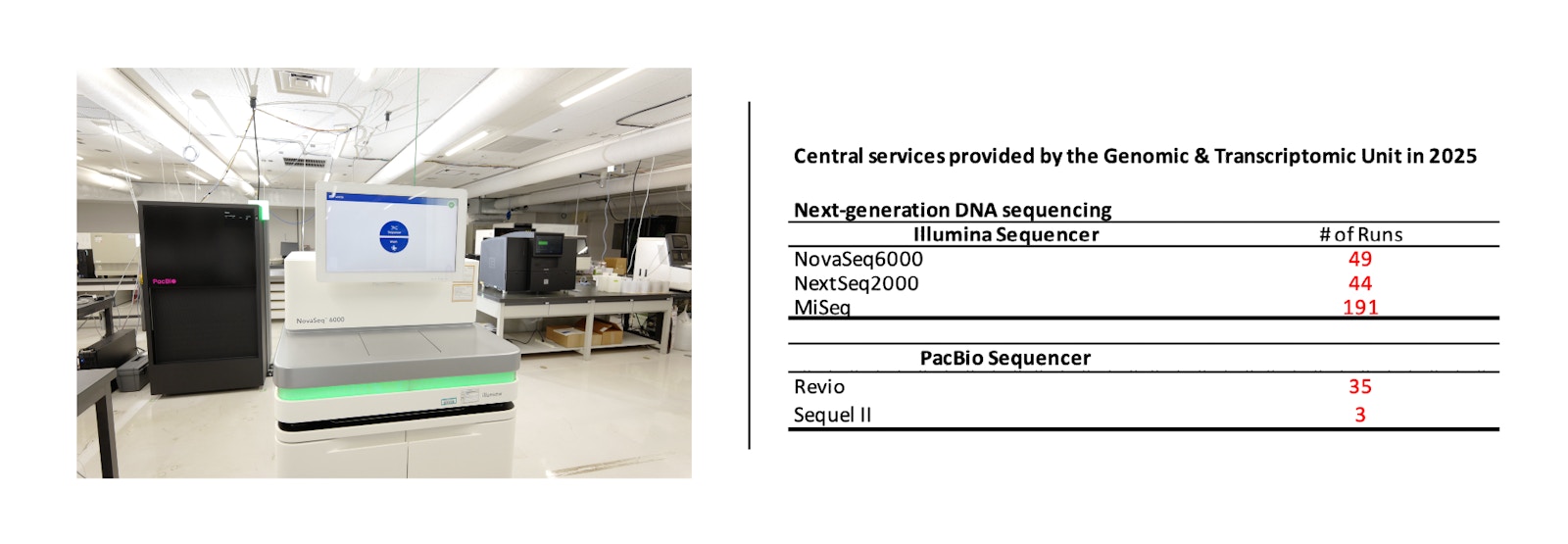
This Unit enables users in IMS and RIKEN to obtain DNA libraries, sequence data and analysis data quickly at a reasonable cost, thus empowering their research. We support library preparation (whole-genome sequencing, whole-exome sequencing, targeted sequencing, CAGE, single-cell RNA-seq, and bulk RNA-seq), sequencing (Illumina NovaSeq6000, NextSeq2000, MiSeq, and PacBio Revio runs), and data analysis (whole genome sequencing, whole exome sequencing, targeted sequencing, CAGE, single-cell RNA-seq, bulk RNA-seq, Chip-Seq, and ATAC-seq). In addition, we also support the registration of data in public databases.
In 2025, we began supporting the NET‑CAGE method, which enables highly sensitive detection of enhancer activity through eRNA profiling with the help of Dr. Murakawa. The Unit also strengthened its data delivery infrastructure by utilizing both the HOKUSAI SR and HOKUSAI CalmLake platforms. HOKUSAI CalmLake functions as a research grade storage system that allows large scale data to be stored securely, rapidly, and over long periods, while maintaining flexible integration with computational resources. To further advance IMS research, both the AVITI24 and MiSeq i100 Plus systems have been introduced. AVITI24 offers high quality sequencing and cell profiling capabilities, while the MiSeq i100 Plus will be utilized in collaboration with the Spatial Omics Collaborative Project. We are working to ensure that all RIKEN researchers can access our supports by utilizing R‑COMS (the RIKEN Core Facilities Management System).
This year, we are working on 111 projects. The achievements in sequencing are shown in Table 1.We expect that the intramural interactions will greatly enhance IMS and RIKEN basic and translational research activities. We also provide broad support for research conducted at institutions and universities outside RIKEN through AMED‑BINDS.