Lab Activities
Laboratory for Human Immunogenetics
Research Activities
Team Director
Kazuyoshi Ishigaki
Our laboratory aims to elucidate the genetic basis of autoimmunity, with a focus on three major research themes. The first theme centers on the T cell receptor (TCR). We previously developed a novel analytical pipeline for TCR repertoire analysis and demonstrated that HLA risk alleles influence thymic selection, resulting in an increased frequency of autoreactive TCRs. We have since extended the framework to systematically investigate TCR features across multiple autoimmune diseases. In parallel, we are developing a high-throughput experimental platform for TCR repertoire analysis that enables the sequencing of thousands of samples and the identification of cognate epitopes recognized by disease-associated TCR clonotypes. The second theme focuses on functional genetics. Our laboratory has established a state-of-the-art genome-editing platform based on prime editing in primary human T cells and has developed UNIChro-seq, a targeted chromatin accessibility assay that digitally quantifies accessible chromatin molecules at predefined loci. UNIChro-seq enables accurate, sensitive, and efficient measurement of allelic effects compared with conventional approaches. Using this method, we systematically evaluated the effects of 57 autoimmunity-associated risk alleles on chromatin accessibility, providing experimental validation of the molecular functions of fine-mapped variants (Kono & Hatano et al., medRxiv, 2025). The last theme is large-scale multi-omics study using clinical samples. By analyzing one of the largest single-cell transcriptomic datasets in systemic lupus erythematosus (SLE)—comprising approximately 2.1 million peripheral blood mononuclear cells from 232 SLE patients and 114 healthy controls—we performed fine mapping of cellular and molecular pathology and identified previously unrecognized disease-relevant cell states. Through integrated multimodal in silico analyses, CRISPR-based perturbation experiments, and functional cellular assays, we further identified cell-state-specific transcriptional regulators that play key roles in SLE pathogenesis (Nakano & Kono et al., medRxiv, 2025). Collectively, these research activities advance our understanding of the genetic and cellular mechanisms underlying human autoimmune diseases.
Our experimental fine mapping strategy of autoimmunity causal variant
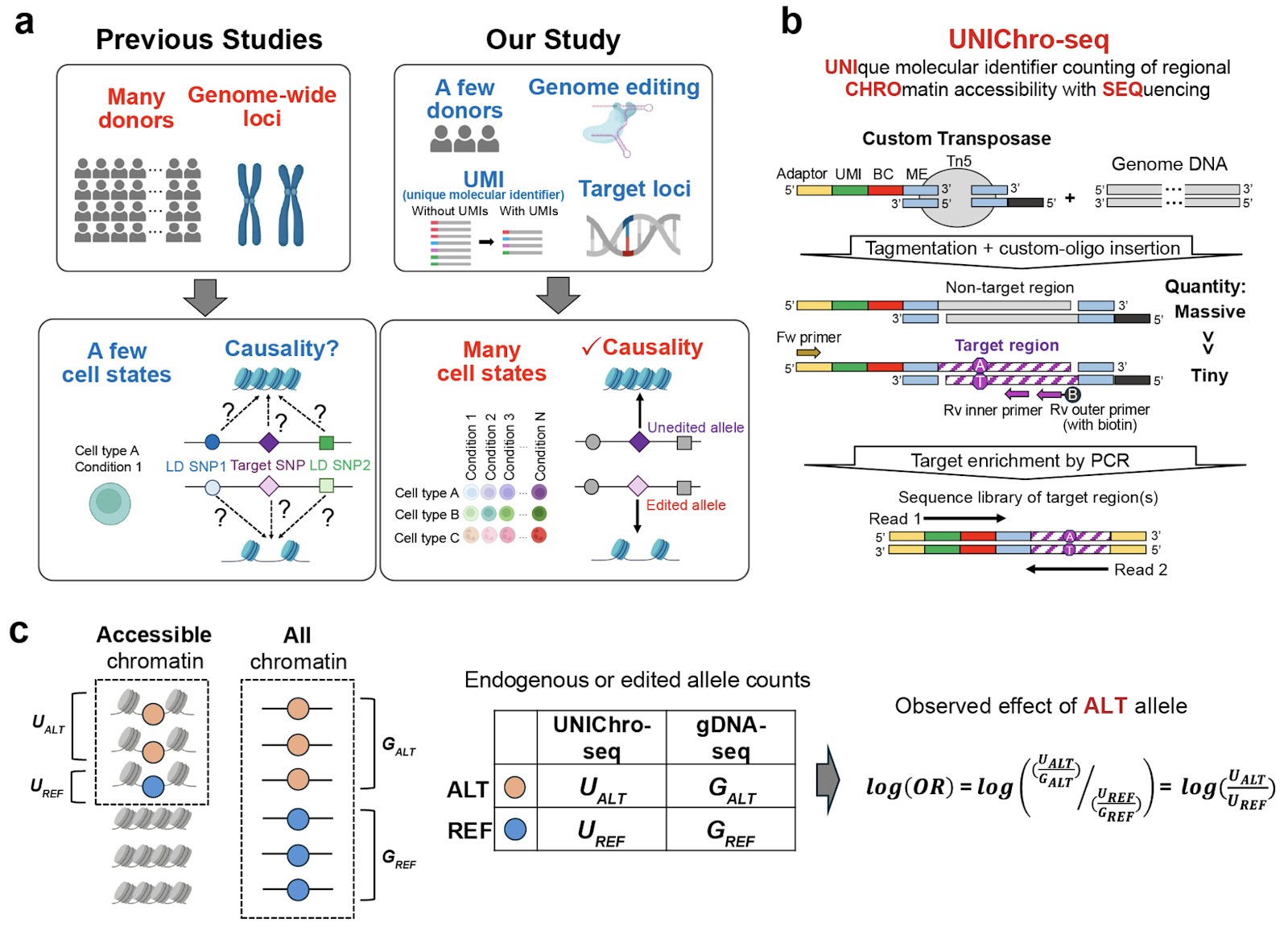
a, We propose a shift from conventional genome-wide analyses across many donors to targeted locus-specific analyses in fewer donors, leveraging CRISPR genome editing and allele-specific analysis. While traditional approaches are limited by linkage disequilibrium (LD) structure and have constraints in confirming causality, our proposed strategy overcomes these limitations. Furthermore, the efficiency of allele-specific analysis enables exploration across a broader range of cell states, expanding the search space for functional insights. This panel was created with Biorender.com. b, We developed UNIChro-seq, which selectively amplifies specific accessible chromatin regions, accurately quantifies allelic imbalance using unique molecular indexes (UMIs), and allows us to pool multiple libraries using transposase with custom barcode (BC) adaptors. ME, mosaic end; Fw, forward; Rv, reverse. c, The basic strategy for estimating allelic effects using UNIChro-seq. UNIChro-seq yields UMI-corrected values (UALT and UREF) representing chromatin accessibility, while genomic DNA sequencing (gDNA-seq) provides read counts (GALT and GREF) representing editing efficiency (when using endogenous heterozygous alleles, we assumed GALT = GREF). The effect size on the chromatin accessibility of the alternative allele (ALT) compared with the reference allele (REF) is defined as the natural logarithm of the odds ratio, which can be intuitively understood from a 2 × 2 table using these values.
Recent Major Publications
Ishigaki K. Big Data Science on T Cell Receptor-mediated Immune Regulation. JMA Journal 8, 338–344 (2025)
Koide R, Abe T, Harimoto T, Kamada AJ, Saito Y, Guerrini M, Fujii A, Parrish E, Horie M, Kiyonari H, Yamamoto K, Tomonaga K, Parrish NF. Interferon and TLR genes, but not endogenous bornavirus-like elements, limit BoDV1 replication after intracerebral infection. PLoS Pathog 21, e1013165 (2025)
Kock K, Tan L, Han K, Ando Y, Jevapatarakul D, Chatterjee A, Lin Q, Buyamin E, Sonthalia R, Rajagopalan D, Tomofuji Y, Sankaran S, Park M, Abe M, Chantaraamporn J, Furukawa S, Ghosh S, Inoue G, Kojima M, Kouno T, Lim J, Myouzen K, Nguantad S, Oh J, Rayan N, Sarkar S, Suzuki A, Thungsatianpun N, Venkatesh P, Moody J, Nakano M, Chen Z, Tian C, Zhang Y, Tong Y, Tan C, Tizazu A, Loh M, Hwang Y, Ho RC, Larbi A, Ng T, Won H, Wright FA, Villani A, Park J, Choi M, Liu B, Maitra A, Pithukpakorn M, Suktitipat B, Ishigaki K, Okada Y, Yamamoto K, Carninci P, Chambers JC, Hon C, Matangkasombut P, Charoensawan V, Majumder PP, Shin JW, Park W, Prabhakar S. Asian diversity in human immune cells. Cell 188, 2288-2306.e24 (2025)
Invited Presentations
Ishigaki K. "Comprehensive analysis T cell receptors reveals CDR3 patterns associated with autoimmunity and T cell fate." The 54th Annual Meeting of the Japanese Society for Immunology, Himeji, Japan, December 10–12 (2025)