Lab Activities
Laboratory for Gene Structure and Regulation
Research Activities
Team Director
Yasuhiro Murakawa
The body-wide transcriptome is generated by the spatiotemporal orchestration of cis-regulatory DNA elements such as promoters and enhancers. In particular, enhancers are distal cis-regulatory elements that are crucial for the establishment of cell- type-specific function and identity in health and disease. We aim to decipher the cis-regulatory code that governs the transcriptional landscapes of malignancies, thereby gaining fundamental insight into cancer development and maintenance.
To investigate the cis-regulatory code, we developed a new method, native elongating transcript-cap analysis of gene expression (NET-CAGE), to determine globally the 5′ ends (or transcription start sites) of nascent RNAs. This method permits sensitive detection of even unstable transcripts, including enhancer-derived RNAs. Thus, NET-CAGE enabled ultra-sensitive detection of a number of enhancers at nucleotide resolution as well as the genes that are regulated by them (Hirabayashi et al. Nature Genetics, 2019). More recently, we have developed a new 5′ single-cell RNA sequencing (5′ scRNA-seq) approach to investigate functional enhancers from heterogeneous cell types within a given tissue/cell (Oguchi et al., Science, 2024). We believe in the importance of developing novel disruptive technologies that can define paradigms and resolve otherwise unsolvable problems in biomedicine.
We are applying our new methods such as NET-CAGE and 5′ scRNA-seq to describe the active cis-regulatory landscape across hundreds to thousands of human samples including various types of tumors and immune cells, to comprehensively catalog cell-type specific enhancers, genes and long non-coding RNAs. Furthermore, by integrating large-scale human disease genomics data with clinical information, we study disease-relevant genetic elements that can be exploited to develop novel molecular therapeutic targets and predictive biomarkers. Our ultimate long-term goal is to revolutionize drug discovery, medicine, and healthcare.
Building an atlas of transcribed enhancers across the human body for decoding human diseases
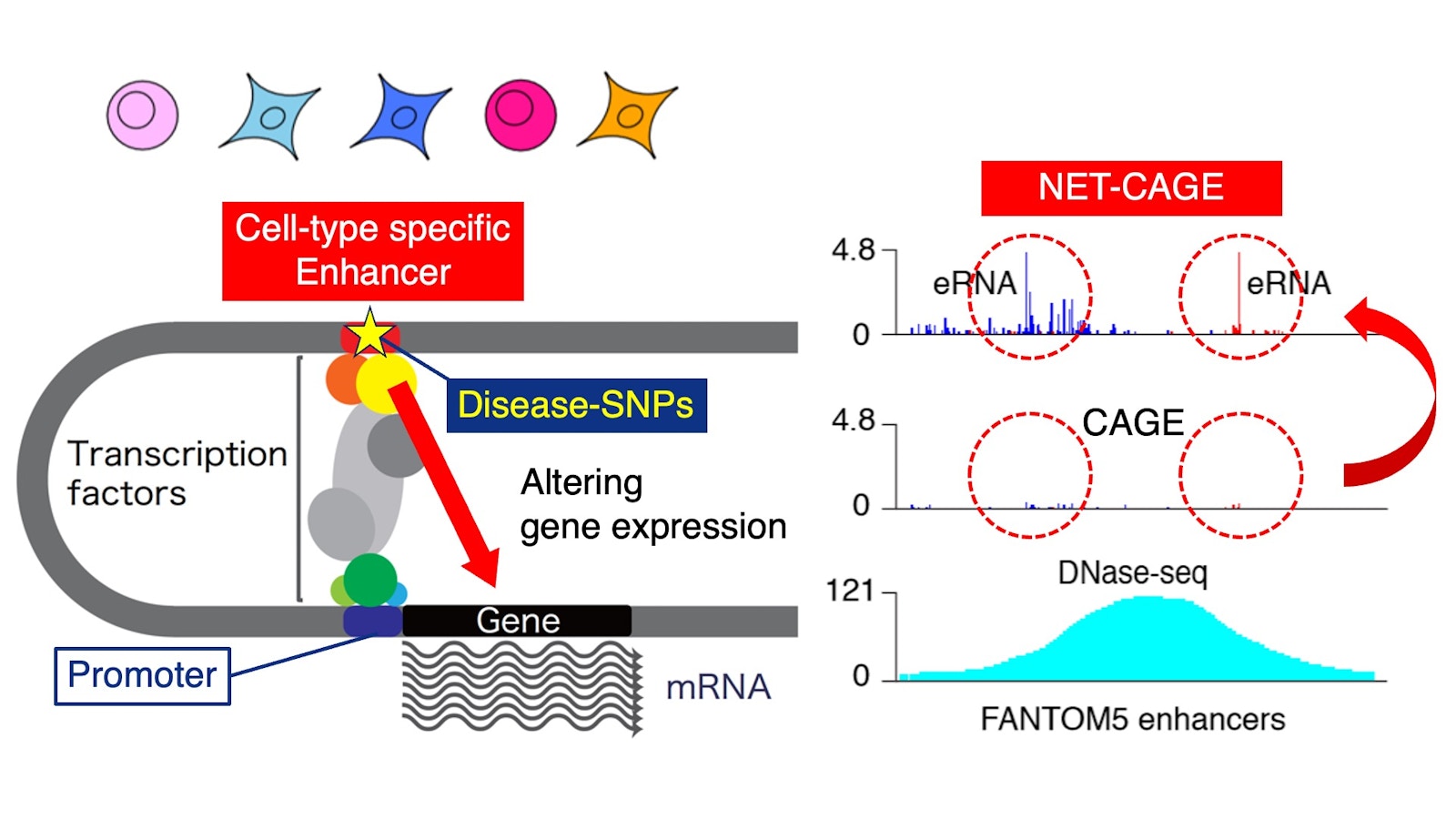
Enhancers are small segments of DNA, cis-regulatory elements that significantly enhance the expression of target genes and play key roles in the establishment of cell-type-specific function and identity. Single nucleotide polymorphisms associated with human diseases (GWAS-SNPs) are highly enriched in enhancer regions and are thought to alter disease susceptibility by changing the expression levels of target genes. We have developed original methods such as NET-CAGE to detect enhancer RNAs transcribed from active enhancers with high sensitivity and are studying the relationship between enhancers and human diseases.
Recent Major Publications
Sugino Y, Bao X, Sekito S, Miyachi S, Kageyama T, Sasaki T, Nishikawa K, Tanaka T, Kato M, Shimada Y, Takano K, Son R, Zang L, Nakayama K, Watanabe M, Murakawa Y, Inoue T. Zebrafish Xenograft Model for Predicting Cisplatin Efficacy in Muscle‐Invasive Bladder Cancer. Cancer Sci 116, 3376–3387 (2025)
Takehara T, Nakanishi M, Son R, Suemori H, Murakawa Y, Teramura T. Acetylation of lysine 49 on Ctnnb1 drives naïve pluripotency in murine stem cells by modulating Nanog function. PNAS Nexus 4, pgaf297 (2025)
Masuo Y, Murakami A, Akamine R, Iri O, Uno S, Murata K, Nishitani K, Ito H, Watanabe R, Fujii T, Iwasaki T, Nakamura S, Kuriyama S, Morita Y, Murakawa Y, Terao C, Okada Y, Hashimoto M, Matsuda S, Ueno H, Yoshitomi H. Stem-like and effector peripheral helper T cells comprise distinct subsets in rheumatoid arthritis. Sci Immunol 10, eadt3955 (2025)
Onagi H, Son R, Oguchi A, Sano K, Sasa K, Hasegawa N, Akaike K, Kubota D, Takagi T, Hayashi T, Ishijima M, Yao T, Suehara Y, Murakawa Y, Saito T. Potential Involvement of Myostatin in Smooth Muscle Differentiation in Pleomorphic Leiomyosarcoma. Int J Mol Sci 26, 7676 (2025)
Murakami A, Akamine R, Tanaka S, Murata K, Nishitani K, Ito H, Watanabe R, Fujii T, Iwasaki T, Masuo Y, Iri O, Nakamura S, Kuriyama S, Morita Y, Murakawa Y, Terao C, Okada Y, Hashimoto M, Matsuda S, Ueno H, Yoshitomi H. Human CD4+ T cells regulate peripheral immune responses in rheumatoid arthritis via insulin-like growth factor–like family member 2. Sci Immunol 10, eadr3838 (2025)
Invited Presentations
Murakawa Y. “Advancing single-cell transcriptomics: sharing 5' scRNA-seq tools and data to empower the community” 2025 Human Cell Atlas General Meeting (Singapore) June 202
Murakawa Y. “Decoding human transcriptome architecture with Oxford Nanopore full-length RNA sequencing” The 30th Annual Meeting of the RNA Society (San Diego, U.S.A.) May 2025
Murakawa Y. “A compendium of human RNA structures and modifications” London Calling 2025 (London, UK) May 2025