Lab Activities
Laboratory for Pharmacogenomics
Research Activities

Team Director
Taisei Mushiroda
Pharmacogenomics (PGx) is a research field that aims to identify genetic factors associated with drug responses, including efficacy and adverse drug reactions. Although PGx testing remains limited in routine clinical practice, recent research has focused on generating robust evidence to support its clinical utility and promote its implementation.
In 2019, our research team identified the NAT2 gene as a risk factor for anti-tuberculosis drug–induced liver injury (ATDILI) through a genome-wide association study (GWAS). This association is explained by the mechanism whereby individuals with genetically reduced NAT2 activity accumulate hydrazine—a toxic metabolite of the anti-tuberculosis drug isoniazid—thereby increasing their risk of ATDILI.
In the present study, conducted as part of an international collaborative research project with the Thai Ministry of Public Health, we investigated the impact of NAT2 genotypes on the efficacy of tuberculosis treatment. The results demonstrated that treatment efficacy was significantly lower in NAT2 extensive metabolizers. Although these patients have a lower risk of ATDILI due to reduced blood concentrations of isoniazid, the findings suggest that treatment efficacy may be inadequate, potentially leading to an increased risk of mortality. Therefore, genotype-guided dosing—namely, increasing the isoniazid dose in NAT2 extensive metabolizers and reducing it in poor metabolizers to prevent ATDILI—may be necessary. Based on these findings, we are currently preparing an international, multicenter, prospective randomized controlled trial in Thailand. This trial is supported by the AMED Research Program on the Challenges of Global Health Issues and JICA Technical Cooperation Project For Accelerating Social Implementation of Science and Technology (TCP/ASIST) and aims to compare the incidence of ATDILI and the rate of initial treatment failure between a standard treatment group and a genotype-guided intervention group in order to evaluate the clinical utility of NAT2 genetic testing.
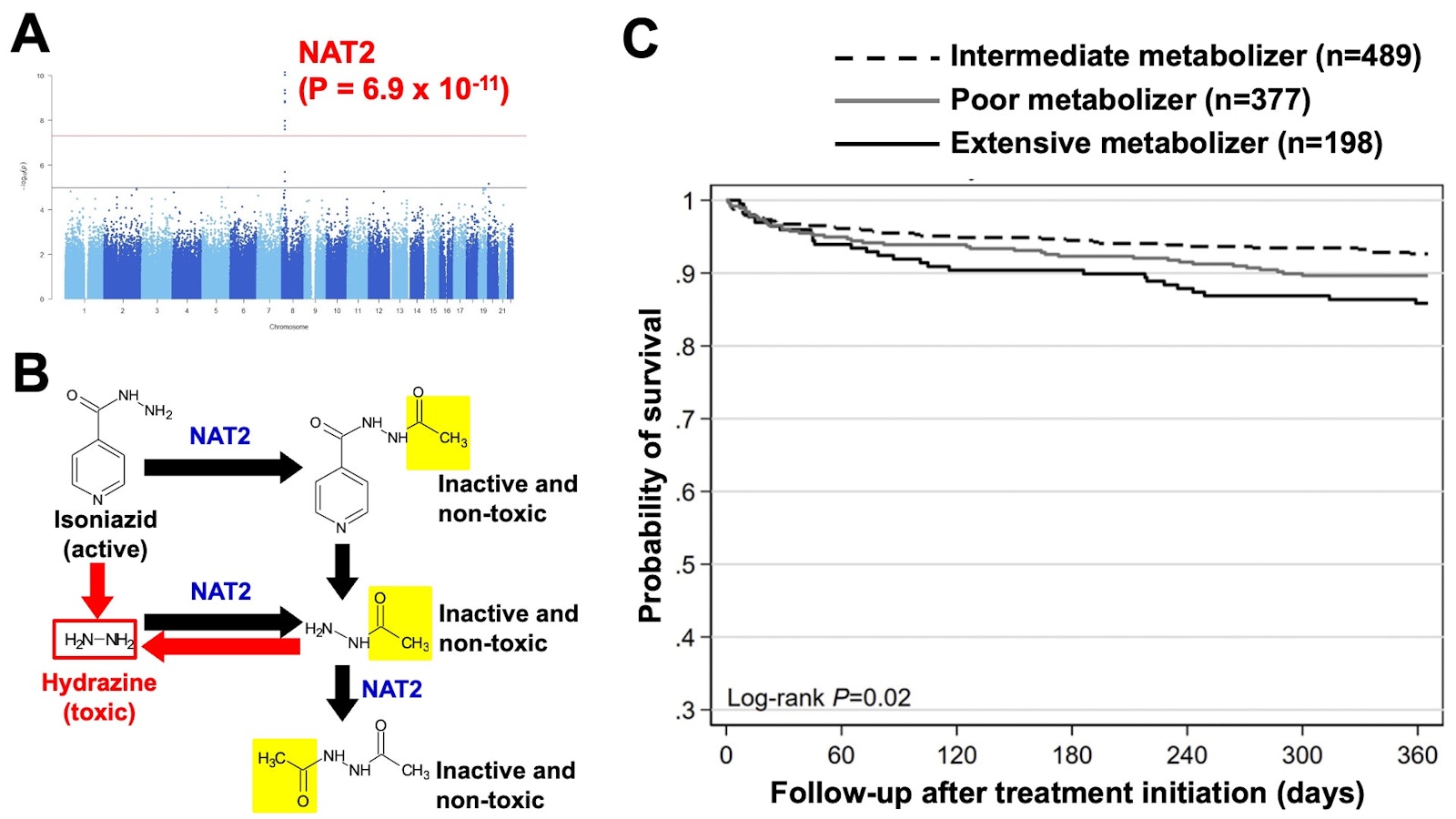
(A) GWAS of Thai tuberculosis patients with ATDILI (79 cases versus 239 tolerant controls). (B) Metabolic pathways of isoniazid in human. (C) Kaplan‒Meier survival curve for one-year overall survival by NAT2 genotype. The differences in survival curves were assessed using the log-rank test. Patients with NAT2 extensive metabolizer-type had a 1.7-fold higher hazard of all-cause mortality within one year compared to NAT2 intermediate metabolizers.
Recent Major Publications
Uchiyama S, Ishikawa Y, Ikari K, Honda S, Hikino K, Tanaka E, Kamatani Y, Gono T, Genovese G, Kuwana M, Terao C. Mosaic loss of chromosome Y characterises late-onset rheumatoid arthritis and contrasting associations of polygenic risk score based on age at onset. Ann Rheum Dis 84, 1313–1323 (2025)
Uno Y, Fukunaga K, Mizukami K, Aoi T, Mushiroda T, Momozawa Y, Yamazaki H. Genetic variants in dog cytochrome P450 2B6 and their relevance to interindividual variability of oxidations of probe drug propofol. Drug Metab Dispos 53, 100189 (2025)
Uno Y, Fukunaga K, Ushirozako G, Murayama N, Mizukami K, Aoi T, Tomiyasu H, Honnami M, Tsujimoto H, Sakaguchi M, Hisasue M, Mushiroda T, Momozawa Y, Yamazaki H. Genetic variants of cytochrome P450 2C21 identified by screening 6344 dogs influenced oxidations of the probe drug omeprazole. Biochem Pharmacol 242, 117394 (2025)
Kasamatsu A, Miyahara R, Yoneoka D, Toyo-Oka L, Chiyasirinroje B, Imsanguan W, Suvichapanich S, Yanai H, Wattnapokayakit S, Nedsuwan S, Boonbangyang M, Palittapongarnpim P, Tokunaga K, Mushiroda T, Mahasirimongkol S. One-year mortality of tuberculosis patients on isoniazid-based treatment and its association with rapid acetylator NAT2 genotypes. Int J Infect Dis 155, 107895 (2025)
Sambe T, Imamura C, Fukunaga K, Mushiroda T, Kobayashi S. Lack of effects of S-equol-containing supplement on the pharmacokinetics of oral hormone therapy drugs for breast cancer. Cancer Chemother Pharmacol 95, 123 (2025)
Furutani M, Fukunaga K, Mushiroda T, Shigemizu D. Identification of a Risk Allele at SLC41A3 and a Protective Allele HLA-DPB1*02:01 Associated with Sarcopenia in Japanese. Gerontology 71, 376-387 (2025)
Winter TD, Jahagirdar O, Hikino K, Terao C. Using Mendelian randomization to investigate etiologic heterogeneity across renal cell carcinoma subtypes. Int J Epidemiol 54, dyaf177 (2025)
Hikino K, Ozaki K, Liu X, Ishikawa Y, Mushiroda T, Terao C. Unraveling time-dependent genetic components underlying alcohol response. Neuropsychopharmacology 50, 1665-1673 (2025)
Hikino K, Fukunaga K, Liu X, Terao C, Mushiroda T. Analysis of factors influencing the relationship between voriconazole plasma concentrations and adverse effects in a paediatric population. Br J Clin Pharmacol 91, 2020-2027 (2025)