Lab Activities
Epigenome Dynamics RIKEN ECL Research Team
Research Activities
ECL Team Leader
Shihori Yokobayashi
Our life begins as a single cell containing one set of genome information. Epigenome states add an additional layer of information to the genome and enable the generation of various types of cells that form our body. Epigenome states are dynamically regulated during the development of an individual and throughout their life, but to what extent diversity (e.g., cell-to-cell heterogeneity and inter-individual differences) emerges during the establishment and maintenance of an epigenome state is not well understood.
Our research team aims to understand the molecular basis of epigenome heterogeneity that emerged in the human genome. We have previously explored epigenome heterogeneity existing among different human induced pluripotent stem cell (iPSC) lines. Most of the observed heterogeneity was present in regions of low transcriptional activity or non-coding regions, such as repressed promoters, intergenic regions, or repeat elements, with little effect on transcriptional profiles or cell types. In our research, we use such human iPSC lines as a model to assess the behavior of epigenome diversity existing within the same cell type, i.e., considered “epi-polymorphisms.” We aim to understand 1) how epigenome heterogeneity relates to chromatin/nuclear dynamics, 2) how the cellular environment affects epigenome heterogeneity, and 3) how epigenome heterogeneity impacts the changes in cell fate and vice versa. We set out to analyze genomic features, variations, and architecture using long-read sequencing and chromosome conformation capture techniques, and to integrate these data with epigenome states. We, in particular, focus on understanding the behavior of human sex chromosomes. In addition, we investigate how epigenome states in the iPSC-state influence the dynamics of epigenetic reprogramming during differentiation toward the germ cell fate. Our study provides insights into understanding the properties of epigenomic diversity among individuals at a molecular level, which will contribute to our understanding of phenotypic diversity and disease susceptibility.
Epigenome heterogeneity in human iPSC lines and research concept
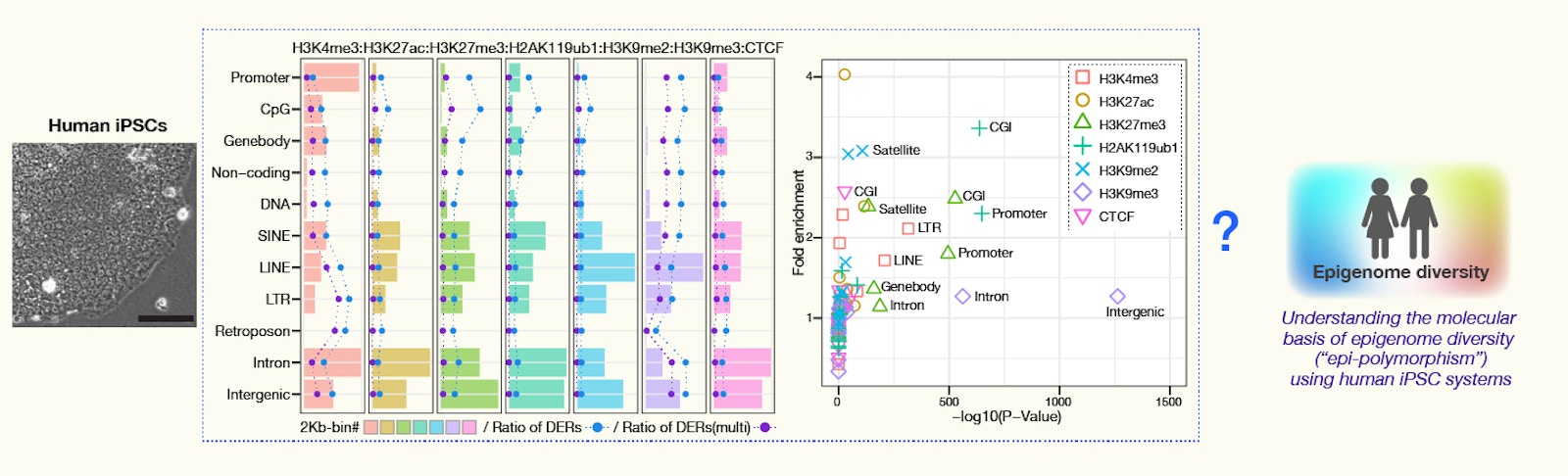
Comparative epigenome analysis of seven epigenetic marks on seven human iPSC lines and genomic features overrepresented in differentially enriched regions (DERs).
Invited Presentations
Yokobayashi S. Understanding epigenome heterogeneity embedded in repressive chromatin in the human genome. RIKEN HAKUBI-ECL Symposium 2025, Wako, Japan, January (2025)
Yokobayashi S. Epigenome reprogramming dynamics of human in vitro germline. RIKEN Pioneering Project – KAKENHI Mobile Genome Joint Symposium "Genome Architecture and Function", Yokohama, Japan, November (2025)