Lab Activities
Laboratory for Immunotherapy
Research Activities

Team Director
Shin-ichiro Fujii
Our laboratory has two primary objectives based on fundamental research in cancer immunology and translational research (TR) in immunotherapy. Generally, immunotherapy exerts its effects by either stimulating the activity of specific components of the immune system or counteracting immunosuppressive signals produced by cancer cells. Considering the current success of immunotherapy has been believed as a clinical turning point, its efficacy remains limited.
We have advanced several research projects in immunotherapy by focusing on augmenting innate immunity. First, we have developed a unique cellular drug platform, an artificial adjuvant vector cells (aAVCs), which is composed of an NKT cell ligand/CD1d complex and viral antigen or tumor-associated antigens. In the current fiscal year, we have confirmed research data demonstrating efficacy against SARS-CoV-2 variants in preclinical studies using aAVC-CoV-2” vaccine targeting SARS-CoV-2. Based on the evidence obtained from these studies, the clinical trial has been launched in immunocompromised high-risk patients who do not achieve sufficient immunity by the conventional vaccines under the framework of Vaccine and New Modality Research and Development Program in the Japan Agency for Medical Research and Development”. In addition, as part of our basic research efforts, we are investigating the tumor microenvironment in tumor-bearing animal models. We have identified a subset of tumor-associated macrophages that undergo trogocytosis through interactions with tumor cells (Figure). This TAM subset represents a potential new cellular target for antitumor immunity.
Trogocytic TAMs as Targets for Anti-tumor CTLs
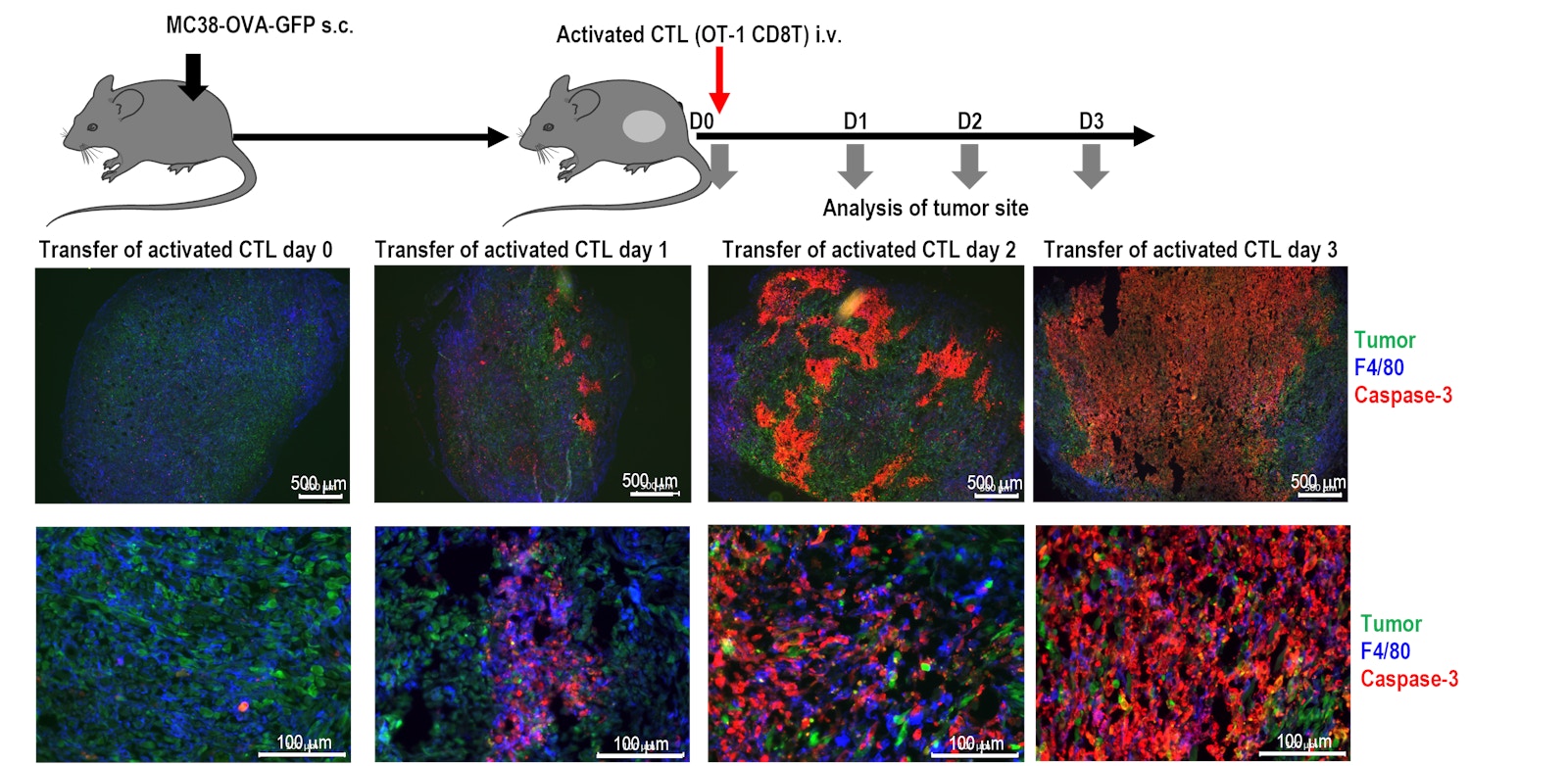
MC38 expressing OVA and GFP (MC38-OVA-GFP) were inoculated into mice. When tumors reached a large size,activated OVA-specific CD8⁺ T cells were adoptively transferred (day 0). Tumor tissues were harvested on day 1, 2, and 3and subjected to immunofluorescence staining using antibodies against GFP (green), F4/80 (blue), and caspase-3). Apoptotic TAMs were detected from early day 1. These findings suggest that CTLs targeted not only tumor cells, but also TAMs.
Recent Major Publications
Shimizu K, Sanpei A, Nakazato H, Shinga J, Ueda S, Liu Y, Iyoda T, Yamasaki S, Nakabayashi J, Fujii S. Distinct TAM subset with cross-dressing capability determines the bifurcation of tumor immunity. Cell Rep 44(6), 115800 (2025)
Invited Presentations
Fujii S. Next-Generation Killer T Cell-Inducing Vaccine: aAVC (Artificial Adjuvant Vector Cells). AMED Seeds Acceleration Pitch (Japan Healthcare Venture Summit 2025), Yokohama, Japan, October 8–10 (2025)