Lab Activities
Laboratory for Inflammatory Immune Metabolism
Research Activities

Team Director
Sonia Sharma
Immune checkpoint blockade (ICB) therapy targeting the PD-1/PD-L1 pathway has revolutionized cancer treatment by inducing durable antitumor responses across a wide range of malignancies. Antibodies against PD-1 have become a standard of care in oncology; however, their clinical application is frequently complicated by immune-related adverse events (irAEs), which arise from excessive or dysregulated immune activation. Despite their clinical importance, the mechanisms underlying irAEs remain incompletely understood, largely due to the lack of appropriate preclinical models that faithfully recapitulate human PD-1 biology.
To address this critical gap, we have successfully established a humanized PD-1 knock-in mouse in which the endogenous mouse Pdcd1 gene is replaced with human PDCD1 by state-of-the-art technique, CRSPR/Cas9 system. This model enables physiological expression and regulation of human PD-1 under native promoter control, thereby allowing accurate evaluation of clinically relevant anti–human PD-1 antibodies in vivo. Unlike conventional mouse models, this system permits direct assessment of both therapeutic efficacy and immune modulation mediated by human-specific ICB agents.
Importantly, the establishment of this humanized PD-1 knock-in mouse provides an essential platform for studying irAEs. Since irAEs are driven by the same immune mechanisms that underlie antitumor efficacy, an integrated model that captures both aspects is indispensable. Our model allows systematic investigation of tissue-specific immune toxicity, identification of cellular and molecular drivers of irAEs, and evaluation of strategies to mitigate adverse events without compromising antitumor immunity.
In summary, the humanized PD-1 knock-in mouse represents a critical and enabling technology for advancing ICB research. It offers a robust preclinical foundation for mechanistic studies of irAEs and for the development of safer and more effective immunotherapies.
Human PD-1 expression in activated CD8 T cells from humanized PD-1 mouse
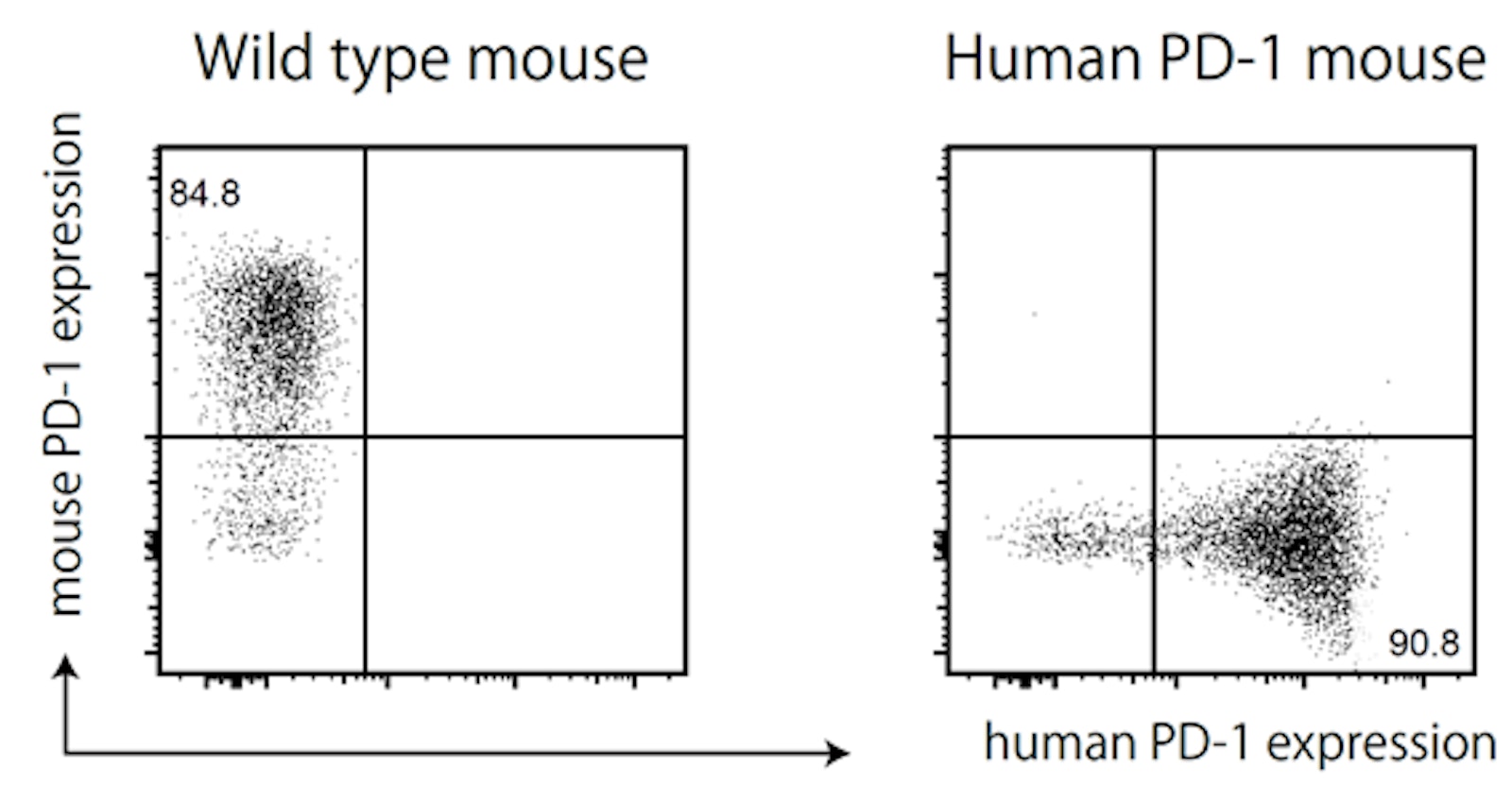
Purified CD8 positive T cells from spleen cells were stimulated with anti-CD3/CD28 antibody for 24 hours. Then expression of mouse PD-1 and human PD-1 were measured by flow cytometry.
Recent Major Publications
Saminathan P, Mathews IT, Alimadadi A, Fung K, Kakugawa K, Joosten LA, Netea MG, Jain M, Cheng S, Hedrick CC, Sharma S. Sex differences in adenosine deaminase activity associate with disparities in SARS-CoV-2 innate immunity. iScience 28(5), 112418 (2025)
Invited Presentations
Sharma S. Bio-active Lipids Regulate Response to Immune Checkpoint Blockade Therapy. MD Anderson Cancer Center Seminar Series, United States, January (2025)
Sharma S. Immune-Related Adverse Events in Cancer Immunotherapy. University of California San Diego Department of Rheumatology Grand Rounds, United States, February (2025)
Sharma S. The Auto-Immune Primer. La Jolla Institute for Immunology Live From the Lab Webinar Series, United States, March (2025)
Sharma S. Metabolites and Cancer Immunotherapy. Immunology Center of Georgia at Augusta University Seminar Series, United States, April (2025)
Sharma S. Bio-active Lipids Regulate Response to Immune Checkpoint Blockade Therapy. Japanese Society for Immunology-RIKEN IMS Joint Symposium, Japan, June (2025)
Sharma S. Lysophosphatadylcholines Modulate Immune Related Adverse Events after Anti-CTLA-4 and Anti-PD1 Therapy. University of California San Diego Moores Cancer Center Seminar Series, United States, December (2025)