Lab Activities
Laboratory for Cellular Function Conversion Technology
Research Activities
Team Director
Harukazu Suzuki
Transcription factor (TF)-dependent DNA demethylation is associated with generation of specific DNA methylation profiles in normal cellular development and disease, although only a small fraction of TFs are known to promote DNA demethylation. Experiments with deletion mutants of the TFs RUNX1 and SPI1 revealed that this activity is associated with an intrinsically disordered region (IDR). We constructed a Random Forest classifier based on 25 numeric physicochemical features extracted from length-controlled 26 positive and 32 negative IDRs. Four key features— aromaticity, aliphatic index, fractional charge ratio (fcr), and side chain hydrophobic density (shd)—were identified as the most informative contributors to prediction of positive IDRs. A model achieved an area under the receiver operating characteristic curve (AUC) of 0.84. Applying this model to all TFs, we predicted 959 of 2364 IDRs to be positive, corresponding to 825 of 1308 TFs. The predicted positive TFs showed significant enrichment of Gene Ontology terms related to morphogenesis and development and may be clinically relevant to certain cancer types. The proto-oncogene MYCN encodes a basic helix-loop-helix TF that regulates cell growth and differentiation during embryonic development. We defined the oncogenic function of MYCN and uncovered its distinct role from MYC in specifying HCC cell fate. We also developed a MYCN niche score that predicts recurrence risk and identifies precancerous microenvironments in non-tumor liver tissue, and demonstrated its clinical applicability using a PCR-based assay in patient cohorts. In parallel, we established a high-throughput platform to screen MYCN transcriptional inhibitors, supporting the feasibility of MYCN-targeted preventive strategies for liver cancer. In the epithelial-to-mesenchymal transition (EMT), we identified that ZEB1, a EMT-promoting TF, is tightly regulated at the protein level by the ubiquitin-proteasome pathway in space- and cell density-dependent manners.
Machine-learning-based prediction of DNA-demethylation-promoting activity in TF IDRs using physicochemical features.
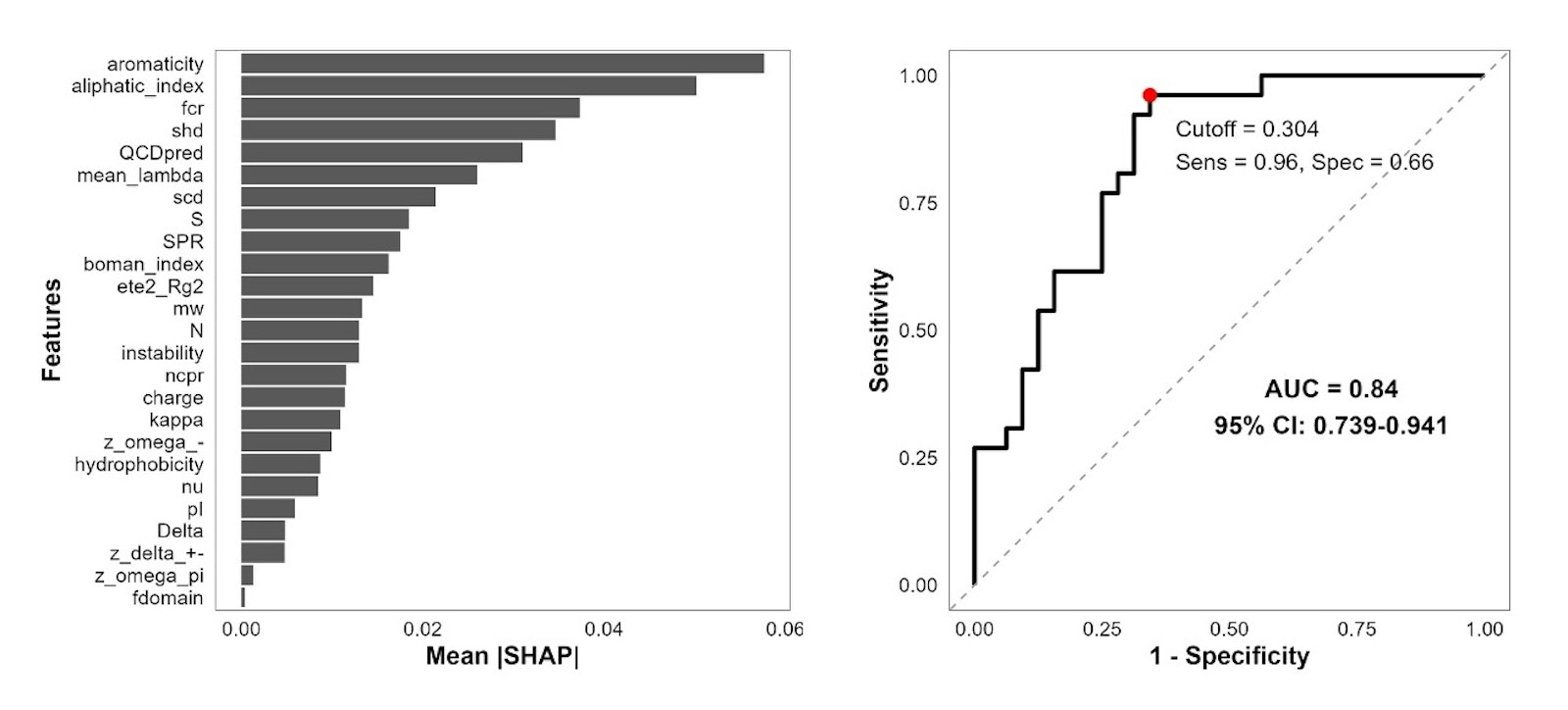
Left: Feature importance ranked by mean absolute SHAP values. Right: Receiver operating characteristic curve of the final RF model trained using the top four features. The model achieved an AUC of 0.84, with the optimal classification threshold determined by Youden’s index (cutoff = 0.304; sensitivity = 0.96, specificity = 0.66). Sens, sensitivity; Spec, specificity.
Recent Major Publications
Qin X, Sakamoto Y, Wei F, Nishimura H, Nakanishi Y, Maeda S, Suzuki H. Physicochemical features of intrinsically disordered regions predict DNA-demethylation-promoting activity of transcription factors. Epigenetics Chromatin 19, 1 (2025)
Sakamoto Y, Takahashi M, Nishimura H, Watanabe K, Suzuki H. Regulation of divergent epithelial-to-mesenchymal transition responses via the CDK4/6-USP51 pathway through ZEB1 protein stabilization. Sci Rep 15, 1–12 (2025)
Hongen T, Ito T, Qin X, Sone H. Impact of lead (Pb)-induced neurotoxicity on protein synthesis and cellular stress responses in LUHMES cells. J Trace Elem Med Biol 92, 127759 (2025)
Gailhouste L, Furutani Y, Qin X, Higuchi S, Toguchi M, Yanaka K, Watashi K, Wakita T, Kojima S. miRNA-29b-1-5p mediates an antiviral activity by targeting the HBV entry receptor in human hepatocytes. Sci Rep 15, 23725 (2025)
Yamaguchi H, González-Duarte RJ, Qin X, Abe Y, Takada I, Charroy B, Cázares-Ordoñez V, Uno S, Makishima M, Esumi M. Transglutaminase 2 Stimulates Cell Proliferation and Modulates Transforming Growth Factor-Beta Signaling Pathway Independently of Epithelial–Mesenchymal Transition in Hepatocellular Carcinoma Cells. Int J Mol Sci 26, 5497 (2025)
Xu Y, Mishra H, Furutani Y, Yanaka K, Nishimura H, Furuhata E, Takahashi M, Gailhouste L, Suenaga Y, Hippo Y, Yu W, Matsuura T, Suzuki H, Qin X. A high-throughput screening platform to identify MYCN expression inhibitors for liver cancer therapy. Front Oncol 15, 1486671 (2025)
Invited Presentations
Qin X. "Role of TG2-mediated proteostasis in liver inflammation." The 98th Annual Meeting of the Japanese Biochemical Society, Kyoto, Japan, November 3–5 (2025)
Qin XY. “Targeting MYCN in liver cancer.” International Cancer Symposium 2025 in Okinawa, Okinawa, Japan, March 23, (2025)
Suzuki H. “Physicochemical features of intrinsically disordered regions predict DNA-demethylation-promoting activity of transcription factors.” Seminar at Cape Town University (Cape Town, South Africa) February 2026