Lab Activities
Laboratory for Dynamic Biomolecule Design
Research Activities

Team Director
Ai Niitsu
Membrane proteins are key molecules that transport ions and small molecules and trigger signal transduction at cell membranes. These functions are realised through protein folding of their linear amino acid sequences into three-dimensional structures and, most importantly, through their dynamic structural changes. However, capturing the accurate structural dynamics of membrane proteins, particularly, remains challenging due to their broad, hierarchical spatio-temporal scales and another dynamic factor, the lipid bilayers. Our team adopts a bottom-up approach using rationally designed proteins to address the question: how do protein structural dynamics contribute within the context of biological functions? Our ultimate goal is to elucidate the molecular mechanisms, especially of neuronal and immune signal transduction.
As a research outcome this year, we reported amino acid sequence design rules that precisely control the association number of artificially designed peptide channels to 5, 6, or 7, achieved through computational design. Furthermore, we discovered that these peptide channels undergo voltage-dependent structural changes through single-channel current recordings. Combining these experimental findings with molecular dynamics simulations under external electric fields, we proposed the underlying molecular mechanism of the kinetic structural dynamics. This achievement is anticipated to lead to the bottom-up design of voltage-gated ion channels and, ultimately, the reconstruction of neural signal transduction systems.
Also, in our first year at IMS, we started several collaborations within the centre. We will actively seek further opportunities to apply designed proteins to life and medical science within IMS.
Rational design and characterisation of peptide-based channels
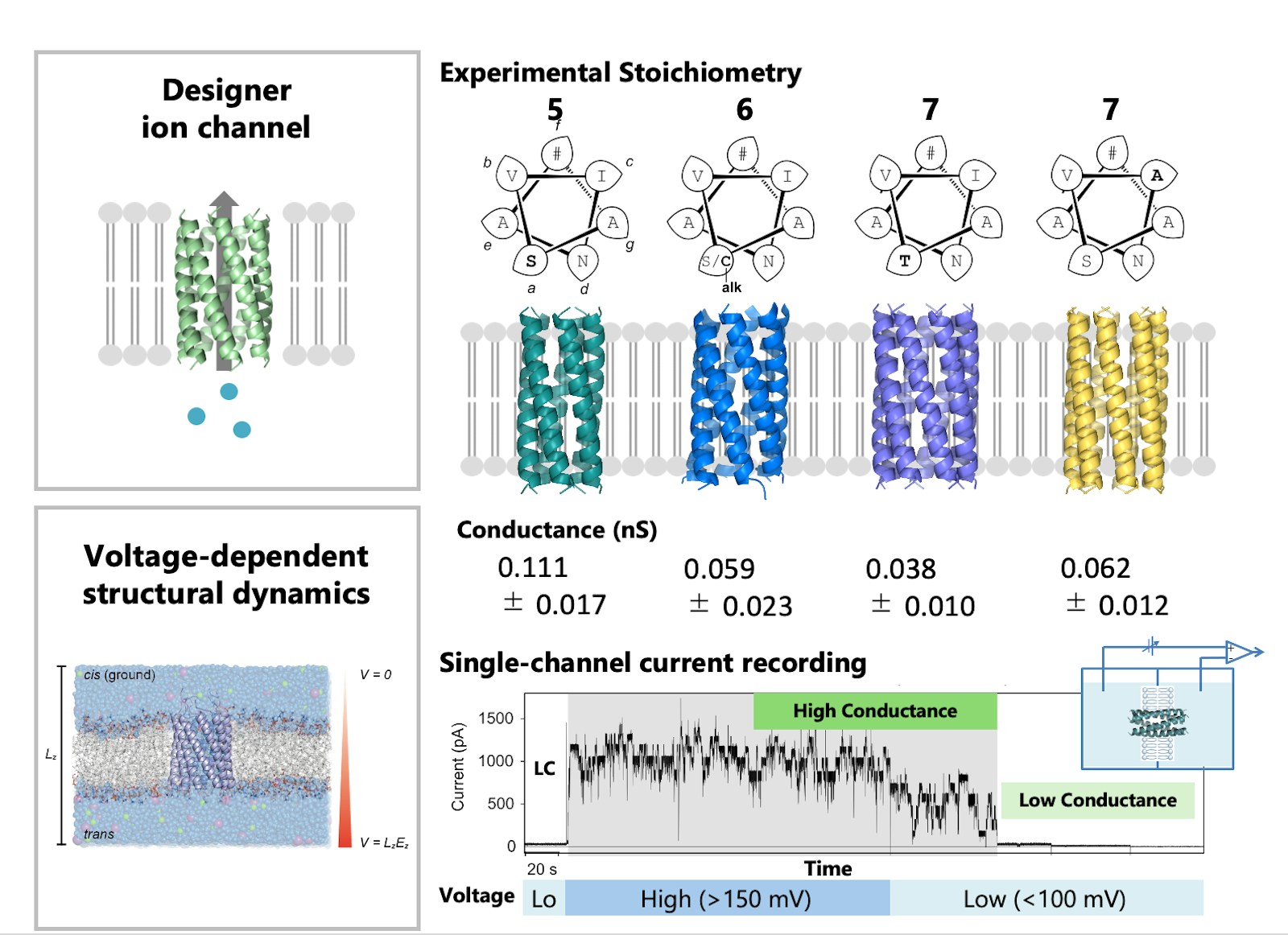
(top) Helical wheels of designed peptide sequences, experimental stoichiometry based on analytical ultracentrifugation, and optimised models of parallel barrel structures. (bottom left) Molecular dynamics simulation setup with an external electric field. (bottom right) Ion conductance of peptide channels and voltage-dependent behaviour based on single-channel current recordings.
Recent Major Publications
Niitsu A, Thomson AR, Scott AJ, Sengel JT, Jung J, Mahendran KR, Sodeoka M, Bayley H, Sugita Y, Woolfson DN, Wallace MI. Rational Design Principles for <i>De Novo</i> α-Helical Peptide Barrels with Dynamic Conductive Channels. J Am Chem Soc 147, 11741–11753 (2025)
Invited Presentations
Niitsu A. Towards dynamics-driven designs of membrane alpha-helix assemblies: peptide-based barrels and beyond. PACIFICHEM2025, Hawaii, United States, Dec (2025)
Niitsu A. Rational design principles for peptide-based ion channels. The 55th NIPS International Symposium, Okazaki, Japan, Dec (2025)
Niitsu A. Designer membrane proteins towards engineering the signalling frontier. 9th Alpbach Workshop coiled-coil, fibrous and repeat proteins, Alpbach, Austria, Sep (2025)
Niitsu A. Exploring membrane protein structures and dynamics through design. Tsukuba Conference, Tsukuba, Japan, Oct (2025)
Niitsu A. Towards Understanding & Creating Membrane Proteins in Action. The 2000th Commemorative Symposium of the Department of Chemistry Zasshikai Seminar, School of Science (Related Events of the Utokyo 150th Anniversary), Tokyo, Japan, Sep (2025)
Niitsu A. Design strategies for transmembrane α-helical peptide assemblies. International IPR seminar 2025, Osaka, Japan, Apr (2025)