Lab Activities
Laboratory for Functional Non-coding Genomics
Research Activities

Team Director
Yuka W. Iwasaki
The human genome is much more than a collection of protein-coding genes. Over 98% of our DNA consists of non-coding regions that were once dismissed by many as junk DNA. A large fraction of this genetic landscape is made up of transposable elements, which are sequences capable of moving to different locations within the genome. Traditionally, transposable elements were viewed solely as threats to genome stability and were linked to mutations and disease. Our research takes a more nuanced view and asks how transposable elements can also act as dynamic regulatory units that contribute to genome plasticity and environmental adaptation.
The Laboratory for Functional Non-coding Genomics explores the surveillance systems that manage these mobile elements across life stages. We are particularly interested in the mechanisms that allow cells to distinguish harmful activity from beneficial functions. One major focus is the HUSH complex, an epigenetic regulator that silences specific transposable elements. Our recent findings suggest that during fetal development, HUSH activity naturally decreases, allowing a temporary increase in the expression of certain elements. This controlled fluctuation appears important because disrupting it can lead to substantial fertility defects in animal models.
Beyond development, we also explore how transposable elements respond to external stressors such as viral infections. Our goal is to clarify the big picture of genome regulation by understanding how interactions between transposable elements and the pathways that restrain them shape phenotypic diversity and evolutionary change. By defining this flexible control network, we aim to offer new insights into the fundamental logic of life and into molecular mechanisms that contribute to complex conditions such as infertility and age-related decline.
Dynamic balance of transposable elements during development and environmental response
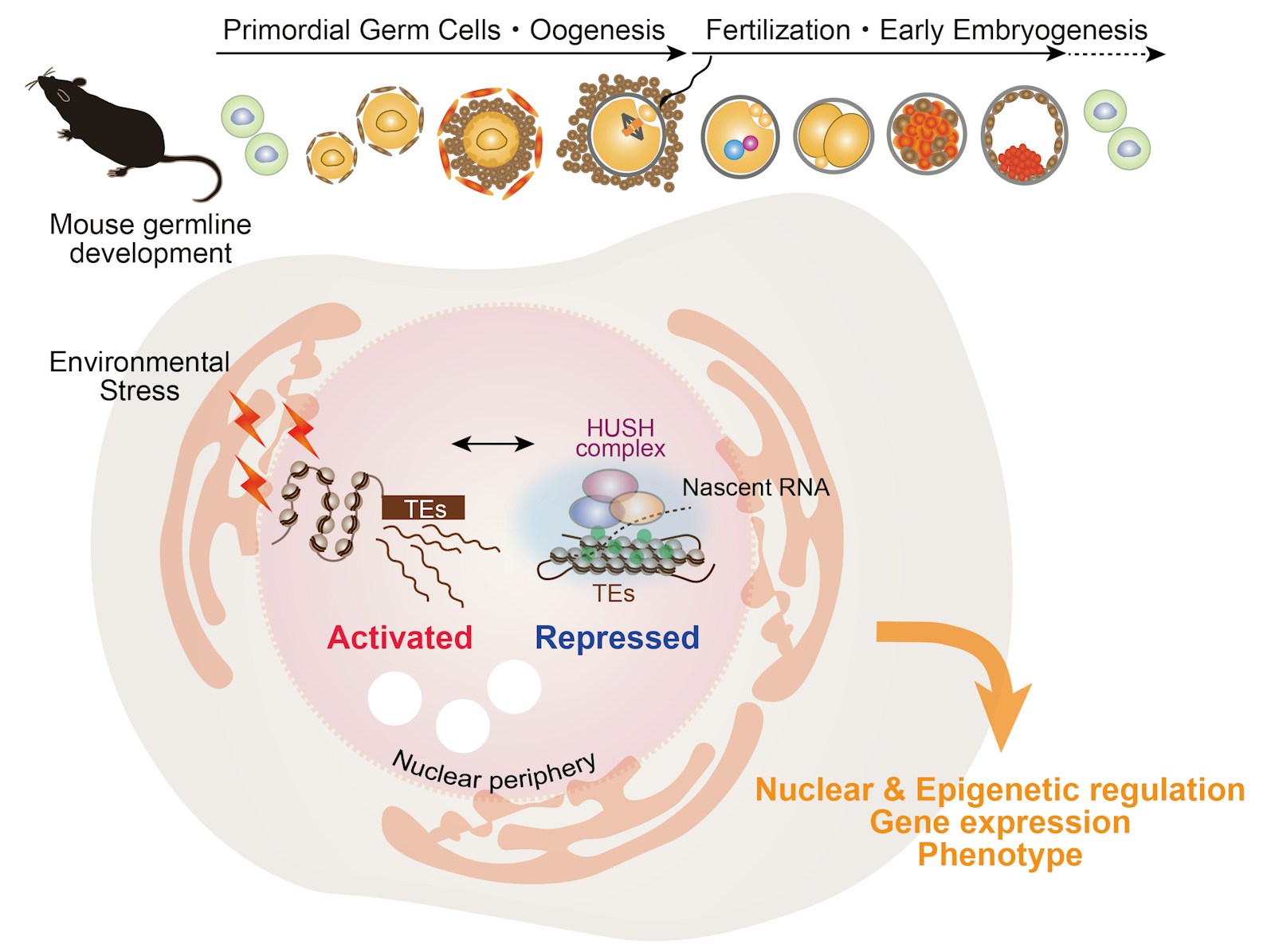
Schematic overview of how transposable elements are regulated in a context dependent manner. During mouse germline development from primordial germ cells through oogenesis, fertilization, and early embryogenesis, transposable elements can shift between activated and repressed states. Repression involves nuclear and epigenetic mechanisms including the HUSH complex, which is linked to nascent RNA associated with target elements. External stress such as viral infection can also modulate this balance. These dynamics influence nuclear and epigenetic regulation, gene expression programs, and ultimately phenotype.
Recent Major Publications
Iwasaki YW, Shoji K, Nakagawa S, Miyoshi T, Tomari Y. Transposon-host arms race: a saga of genome evolution. Trends in Genetics 41(5), 369-389 (2025)
Yamada Y, Sadahiro T, Nakano K, Honda S, Abe Y, Akiyama T, Fujita R, Nakamura M, Maeda T, Kuze Y, Onishi M, Seki M, Suzuki Y, Takeuchi C, Iwasaki YW, Murano K, Sakata-Yanagimoto M, Chiba S, Kato H, Sakamoto H, Hiramatsu Y, Ieda M. Cardiac Reprogramming and Gata4 Overexpression Reduce Fibrosis and Improve Diastolic Dysfunction in Heart Failure With Preserved Ejection Fraction. Circulation 151(6), 379-395 (2025)
Gorochowski TE, Brockhurst MA, Ceroni F, Iwasaki YW, Yachie N. The Japan-UK Synthetic Biology Conference, Spring 2025: Strengthening Global Links to Engineer Biology. ACS Synth Biol 14(6), 1837–1878 (2025)
Asamitsu S, Iwasaki YW. Biomolecular liquid‒liquid phase separation associated with repetitive genomic elements. Polym J 57, 785-797 (2025)
Invited Presentations
Iwasaki YW. Transcriptional silencing by small non-coding RNAs. The Japan-UK Synthetic Biology Conference, Osaka, Japan, February (2025)
Iwasaki YW. Transposon silencing by SPIN1 in germline and somatic cells. RNA Tokyo Workshop, Tokyo, Japan, July (2025)
Iwasaki YW. Epigenetic regulation of transposons in germline and somatic cells. 2025 Croucher Advanced Study Institutes "Retrotransposons", Hong Kong, China, August (2025)
Iwasaki YW. Transposon regulation and its impact on the epigenetic landscape. International Symposium: Genome Architecture and Function, Yokohama, Japan, November (2025)
Yamada H, Takeuchi C, Imami K, Iwasaki YW. Regulation of transposons by SPIN1 via MIWI2-piRNA independent mechanism. The 48th Annual Meeting of the Molecular Biology Society of Japan, Yokohama, Japan, December 3–5 (2025)