Lab Activities
Laboratory for Tissue Dynamics
Research Activities

Team Director
Takaharu Okada
The goal of the laboratory is to understand the mechanisms that underlie tissue homeostasis and its breakdown during disease development. As a recent focus, we have been studying the mechanisms by which sensory nerves are activated to induce pathogenic pruritus in inflammatory skin conditions such as atopic dermatitis. It has been suggested that epidermal innervation by sensory neurons is exaggerated in the skin of atopic dermatitis patients although there are also reports showing conflicting results. The reduction of Sema3A, a nerve repulsion factor, and the increase of NGF, a nerve growth factor, expressed in the epidermis have been suggested to be involved in the exaggerated innervation. However, the precise contributions of these moleculer changes to dysregulated sensations in the pathological conditions are not known. We have found that other molecules than Sema3A and NGF also regulate epidermal innervation. Epidermis-selective genetic ablations of these molecules profoundly augment the density of epidermal nerve fibers and exaggerated touch and itch sensations. Furthermore, their expression is decreased in the epidermis of atopic dermatitis patients, suggesting a therapeutic potential of the molecules.
Regulators of epidermal innervation in normal and pathological conditions.
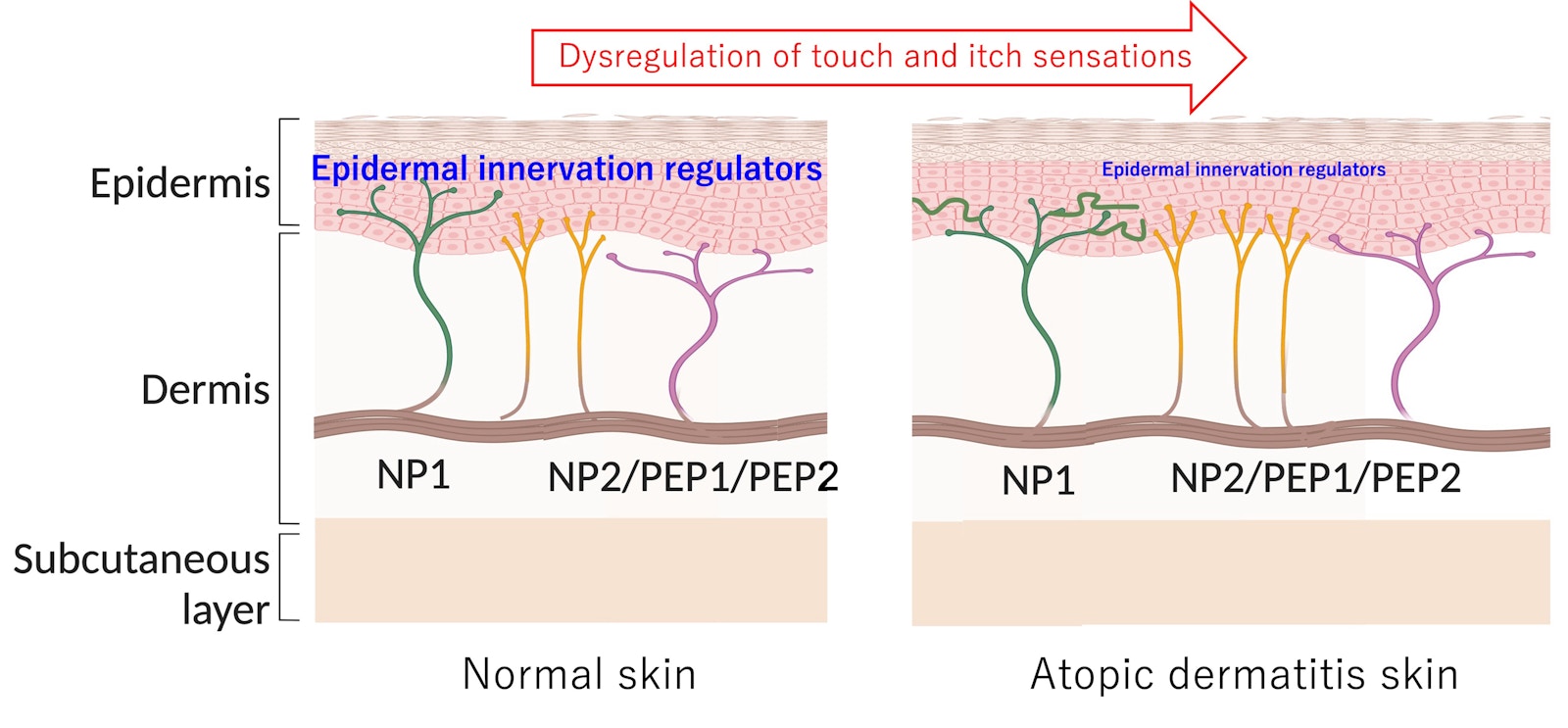
Molecules that regulate sensory innervation are expressed in the epidermis. Their expression is reduced in the epidermis of atopic dermatitis patients, which dysregulates touch and itch sensations.
Invited Presentations
Okada T. Skin sensory neurons transmitting itch of atopic dermatitis. The 32nd Korean Society for Investigative Dermatology (KSID) Annual Meeting, Seoul, Korea, March 28–29 (2025)