Lab Activities
Data Science and Design Special Team
Research Activities
Team Director
Masayuki Ihara
Toward establishing a methodology for designing data-driven and person-centered solutions, we conducted joint research with two eldercare facilities. By implementing design thinking processes directly within care settings, we designed, validated, and refined services from the stakeholders' perspectives. Through these initiatives, we examined individualized healthcare and well-being from the diverse lenses of cognitive science, behavioral science, psychology, and design studies.
Regarding the online rehabilitation service, we collaborated with local communities to conduct experiments aimed at verifying user motivation, cognitive shifts, and behavioral changes to prevent physical and social frailty. For the "Narrative AI" care support service, we performed field experiments where we collected narratives by strolling through familiar neighborhoods with individuals living with dementia. By structuring and analyzing this narrative data, we gained critical insights for developing.
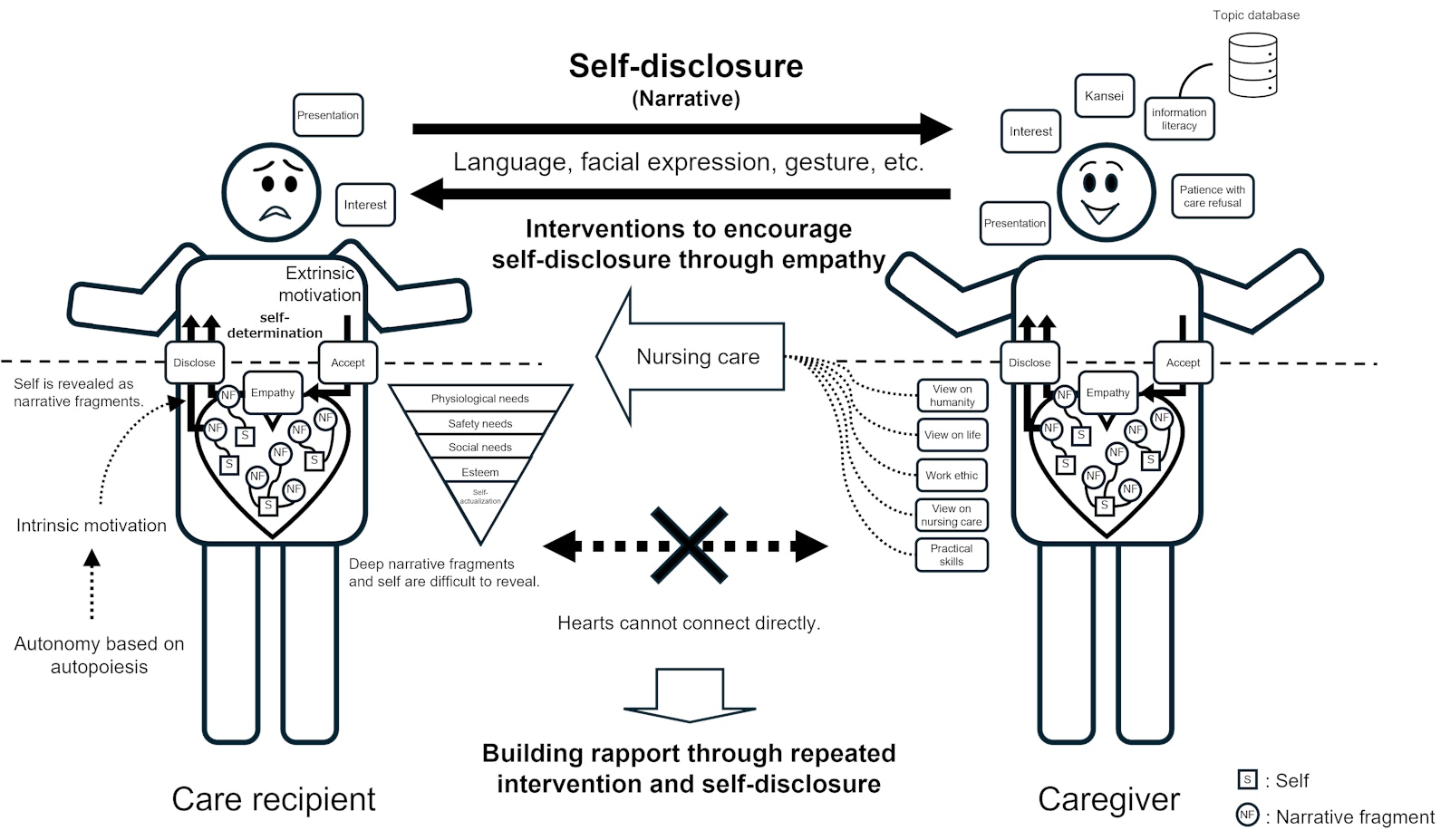
Based on insights gained from these experiments, we created an interaction model focusing on caregivers' empathy-based intervention and care recipients' narrative disclosure. Viewing human beings as autonomous and open systems, we modeled the self-determination process, incorporating the acceptance of extrinsic motivation, empathy, and disclosure, alongside disclosure driven by intrinsic motivation. This comprehensive approach aims to bridge technological innovation with the deeply human aspects of care, ensuring that data-driven insights enhance rather than replace the personal connections essential to well-being in aging societies.
Interaction model of care recipient and caregiver
Invited Presentations
Ihara M, Tokunaga H, Koga A, Yukihira T, Motoe M. Experimental Design for Participants, Not for Ethics Review. 27TH INTERNATIONAL CONFERENCE ON HUMAN-COMPUTER INTERACTION, Gothenburg, Sweden, June 22–27 (2025)