Lab Activities
Laboratory for Translation Structural Biology
Research Activities
Team Director
Takuhiro Ito
Our laboratory aims to elucidate the molecular mechanisms underlying complex biological systems through three-dimensional structural analyses using cryo-electron microscopy (cryo-EM) and cryo-electron tomography (cryo-ET), with a particular focus on eukaryotic translation.
Hepatitis C virus (HCV) initiates protein synthesis through an internal ribosome entry site (IRES), allowing viral translation independently of the 5′ cap structure used by host mRNAs. A key host factor involved in this process is eukaryotic initiation factor 3 (eIF3), although its precise role has remained unclear. We combined in vitro reconstituted translation, cryo-electron microscopy (cryo-EM), cross-linking mass spectrometry, and biochemical analyses to elucidate how eIF3 functions during HCV IRES-mediated translation.
We determined multiple cryo-EM structures representing successive stages of HCV IRES-mediated translation, from initiation to elongation. These structures revealed that the HCV IRES binds simultaneously to the ribosome and eIF3 throughout translation. Unlike canonical cap-dependent initiation, in which the eIF3 core binds directly to the 40S ribosomal subunit, the HCV IRES sequesters the eIF3 core by interacting with subdomain IIIb of the IRES. This rearrangement allows viral RNA to occupy the ribosomal binding site normally used by host mRNAs while retaining the functional contribution of eIF3.
A particularly notable finding is that the N-terminal domain of the eIF3c subunit binds directly to the 60S large ribosomal subunit during elongation. Biochemical experiments confirmed this interaction and suggested that it stabilizes the 80S ribosome, facilitating large subunit joining during initiation and potentially promoting efficient translation reinitiation after termination. Furthermore, cross-linking mass spectrometry indicated that the noncore eIF3 subunits remain positioned similarly to those in canonical translation, despite the displacement of the eIF3 core by the HCV IRES.
Functional translation assays demonstrated that eIF3 markedly enhances HCV IRES-dependent translation, particularly under eIF2-limited conditions that mimic the integrated stress response induced during HCV infection. This mechanism enables efficient viral protein synthesis even when host cap-dependent translation is suppressed.
Overall, we provided the first structural view of eIF3 throughout HCV IRES-mediated translation and revealed previously unrecognized roles of eIF3 during elongation and reinitiation. These findings substantially advance our understanding of viral translation mechanisms and suggest that eIF3 dynamics may represent a potential target for antiviral intervention and broader translational regulation. (Iwasaki et al., Proc Natl Acad Sci U S A, 2025).
Recent achievements from the Ito laboratory
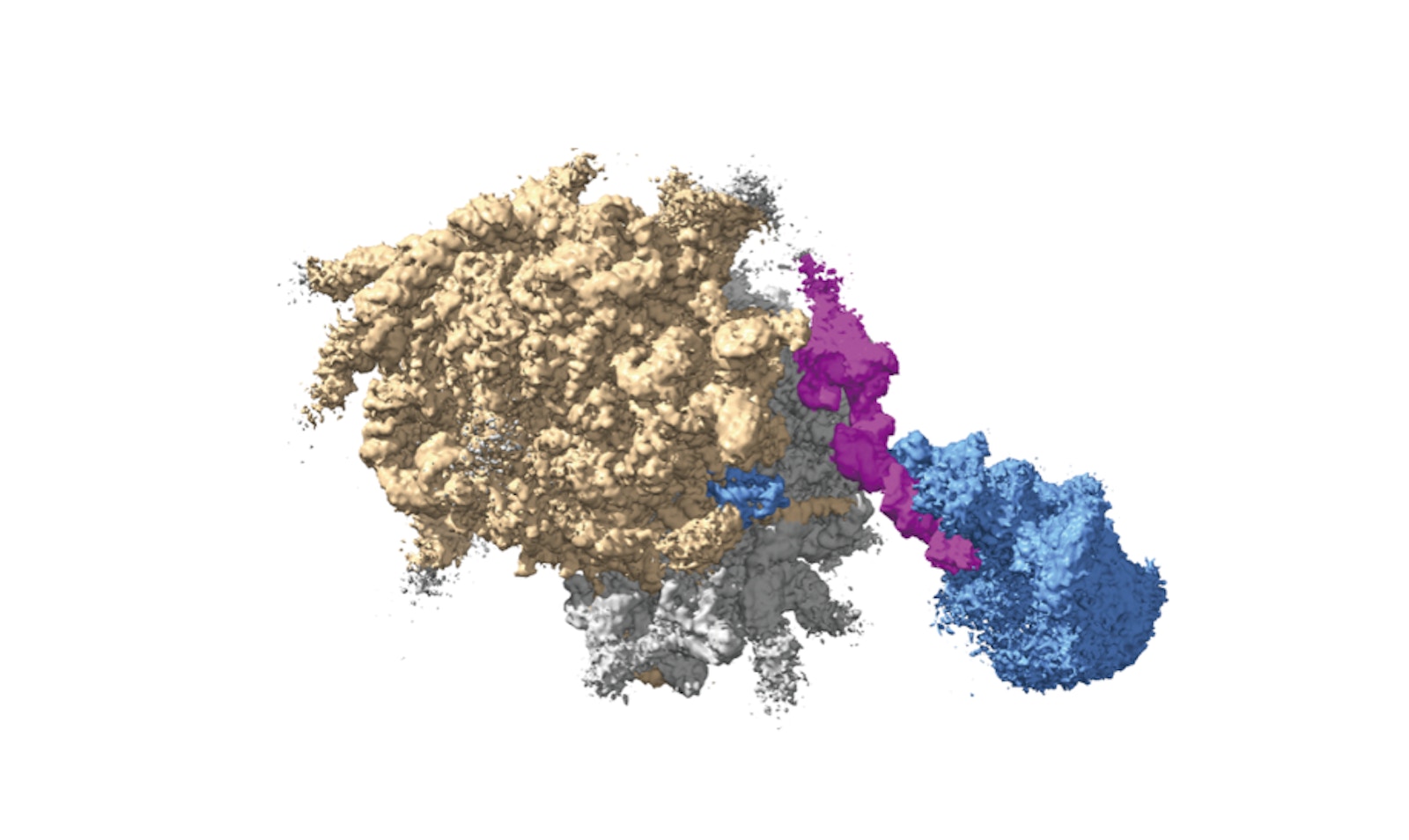
Cryo-EM structure of the human 80S ribosome•HCV IRES•eIF3 complex. The 60S and 40S ribosomal subunits, the HCV IRES, and eIF3 are colored dark yellow, gray, magenta, and blue, respectively (Iwasaki et al., Proc Natl Acad Sci U S A, 2025).
Recent Major Publications
Iwasaki W, Kashiwagi K, Sakamoto A, Nishimoto M, Takahashi M, Machida K, Imataka H, Matsumoto A, Shichino Y, Iwasaki S, Imami K, Ito T. Structural insights into the role of eIF3 in translation mediated by the HCV IRES. Proc Natl Acad Sci U S A 122, e2505538122 (2025)
Ichihara K, Shiraishi T, Chadani Y, Kito Y, Shiraishi C, Hirata M, Takahashi Y, Kobo A, Hatano A, Matsumoto M, Machida K, Imataka H, Toyoda A, Mishiro-Sato E, Nojima T, Ito T, Taguchi H, Nakayama KI, Matsumoto A. eIF2D promotes 40S ribosomal subunit recycling during intrinsic ribosome destabilization. Nucleic Acids Res 53, gkaf1322 (2025)
Okada M, Tateishi Y, Nojiri E, Mikawa T, Rajesh S, Ogasa H, Ueda T, Yagi H, Kohno T, Kigawa T, Shimada I, Guntert P, Ito Y, Ikeya T. Multistate Structure Determination and Dynamics Analysis Reveals a Unique Ubiquitin-Recognition Mechanism in Ubiquitin C-terminal Hydrolase. J Am Chem Soc 147, 29884-29894 (2025)
Shitanda I, Chiba M, Noya L, Yoshizawa H, Motosuke M, Mukaimoto T, Yanagita S, Suzuki T, Mikawa T, Watanabe H, Itagaki M. Wearable Microfluidic Dual Screen-Printed Sensor for Simultaneous Monitoring of Sweat pH and Lactate. Electrochemistry 93, 117001 (2025)
Shitanda I, Samori T, Satake M, Loew N, Motosuke M, Mukaimoto T, Yanagita S, Suzuki T, Mikawa T, Tsujimura S, Watanabe H, Itagaki M. Wearable Self‐Powered Biosensor for Continuous Lactate Monitoring in Sweat. ChemElectroChem 12, e202500222 (2025)
Ariga K, Rezki M, Suzuki-Nagata K, Mikawa T, Tsujimura S. MOF-based hybrid electrodes for multi-enzyme cascade reactions with stabilized mediator immobilization. Chem Commun (Camb) 61, 12309–12312 (2025)
Invited Presentations
Ito T. Mechanisms of Translational Control: From Viral Hijacking to Codon-Dependent mRNA Surveillance. LMB Seminar, Cambridge, United Kingdom, Sep (2025)
Ito T. Structural biology on translation. NMR at the interaction of methods & mechanistic biology, Boston, United States, Jul (2025)