Lab Activities
Laboratory for Metabolic Networks
Research Activities

Team Director
Toshimori Kitami
Mitochondria are dynamic organelles central to energy homeostasis, intermediary metabolism, ion homeostasis, and cell death. Inherited defects in mitochondria cause the most common inborn errors of metabolism, but a growing body of evidence also links mitochondria to more complex diseases, including type 2 diabetes, cardiovascular disease, and neurodegeneration. Despite our basic understanding of mitochondrial functions, the precise mechanisms by which mitochondria participate in disease pathogenesis remain largely unknown. The long-term goal of our laboratory is to use our expertise in chemical biology and genomics to critically evaluate the role of mitochondria in disease pathways and to develop novel therapeutics centered on mitochondria.
Towards our goal, we initiated chemical screens focusing on the role of mitochondria in inflammation and neuronal cell death, both of which converge to accelerate neurodegenerative processes. In macrophages, we identified small molecules that specifically block mitochondrial damage-induced activation of the NLRP3 inflammasome pathway. We also expanded our analysis to understand how small particles induce mitochondrial dysfunction and inflammatory response in macrophage. In neuronal cells, we identified small molecules that block neuronal death triggered by mitochondrial inhibition. We are currently working to test our hit compounds and molecular targets in mouse models of mitochondrial disease. Through these efforts, we hope to generate a catalog of mitochondrial tool compounds that can be used to gain molecular insights and new therapeutic targets for diseases of mitochondrial dysfunction.
In addition, we are examining the role of mitochondria in other complex disease pathways by taking advantage of large-scale omics datasets generated at RIKEN IMS. We hope that our multi-omics and chemical biology efforts will not only help clarify the role of mitochondria in complex diseases but will also point to common therapeutic strategies for a variety of mitochondria-related disorders.
Schematic of our chemical screening strategy for uncovering the role of mitochondria in complex disease pathways
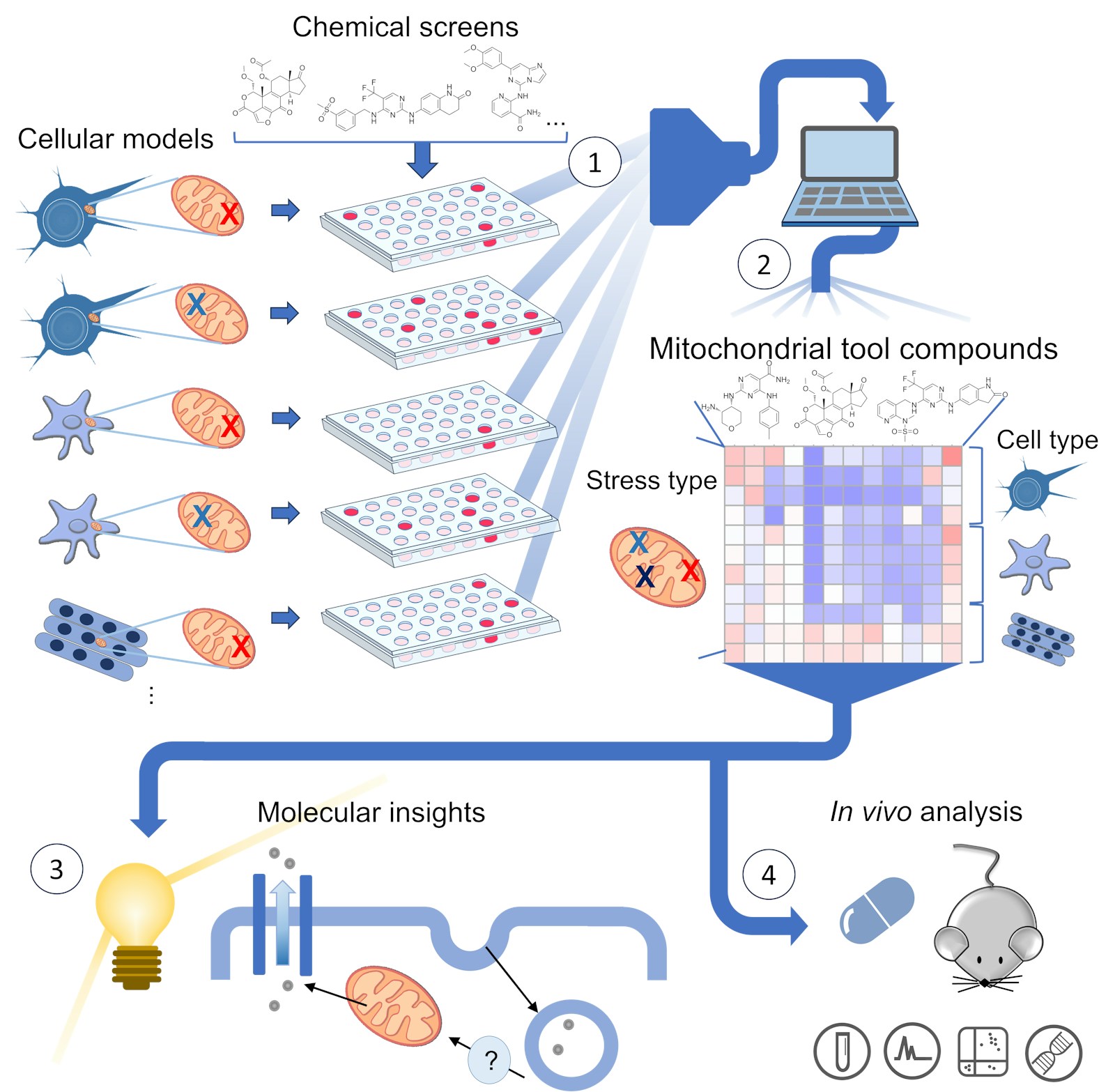
(1) Cell-based chemical screens are performed across cell types involved in mitochondria-related diseases. (2) The resulting datasets are analyzed to identify tool compounds that protect cells from mitochondrial dysfunction across different “stress types” and “cell types”. (3) The datasets are used to generate novel hypotheses regarding molecular mechanisms of mitochondria-related diseases and to (4) test new therapeutic targets in mouse models of human diseases.
Invited Presentations
Kitami T. Dissecting the role of mitochondria in neurodegeneration through chemical genetics & metabolomics. RIKEN-Chiba-Tübingen-Luxembourg Joint Symposium on Data-driven Medical Research for Personalized Medicine, Tokyo, Japan, February 4 (2025)