Lab Activities
Laboratory for Integrated Cellular Systems
Research Activities

Team Director
Katsuyuki Yugi
Metabolism is a biological process involved in various diseases, not only metabolic diseases such as obesity and diabetes, but also autoimmune diseases, psychiatric diseases, and cancer. Biochemical pathways for metabolism consist of myriad feedback loops and branching points, thereby defying simple causation analyses frequently performed in other linear cascades. Furthermore, metabolism undergoes multiplexed regulation from other omic layers: phosphorylation of enzymes by signal transduction (phosphoproteome), transcriptional regulation (transcriptome), translational regulation (expression proteome), etc. Our research interest is to understand intracellular metabolism and its regulatory mechanisms as a system of biochemical reactions in dynamic, macroscopic and quantitative contexts. We employ the methodology of 'trans-omics' to reconstruct global metabolic regulatory networks that traverse multiple omic layers (Figure), not as a group of indirect statistical correlations but as chains of direct mechanistic interactions on the basis of reaction kinetics (Yugi et al., Trends Biotechnol., 2016 [https://doi.org/10.1016/j.tibtech.2015.12.013]; Yugi and Kuroda, Cell Syst., 2017 [https://doi.org/10.1016/j.cels.2017.01.007]; Yugi and Kuroda, Curr. Opin. Syst. Biol., 2018 [https://doi.org/10.1016/j.coisb.2017.12.002]; Yugi et al., Curr. Opin. Syst. Biol., 2019 [https://doi.org/10.1016/j.coisb.2019.04.005]; Okamoto et al., Neurosci. Res. 2022 [https://doi.org/10.1016/j.neures.2021.12.006] ; Nishida et al., npj Syst. Biol. Appl. 2024 [https://doi.org/10.1038/s41540-024-00342-8]). Interdisciplinary approaches, such as 'wet' biology experiments, and 'dry' data analyses, such as mathematical models and statistical methods, are utilized to characterize the global metabolic regulatory networks. The network reconstruction is performed based on comprehensive measurement data, public databases, and a kinetic picture of the cellular processes. The comprehensive data of multiple omic layers should be measured under identical conditions, preferably in a time-series manner, so that one can construct mathematical models of the multi-layered network for subsequent systems biological analyses. We eventually aim to reveal the chain of logic from individual biochemical reactions to omics-scale metabolic regulatory systems.
The trans-omic network of the responses to glucose challenge in the liver of WT and obese (ob/ob) mice automatically generated by transomics2cytoscape (Nishida et al., 2024).
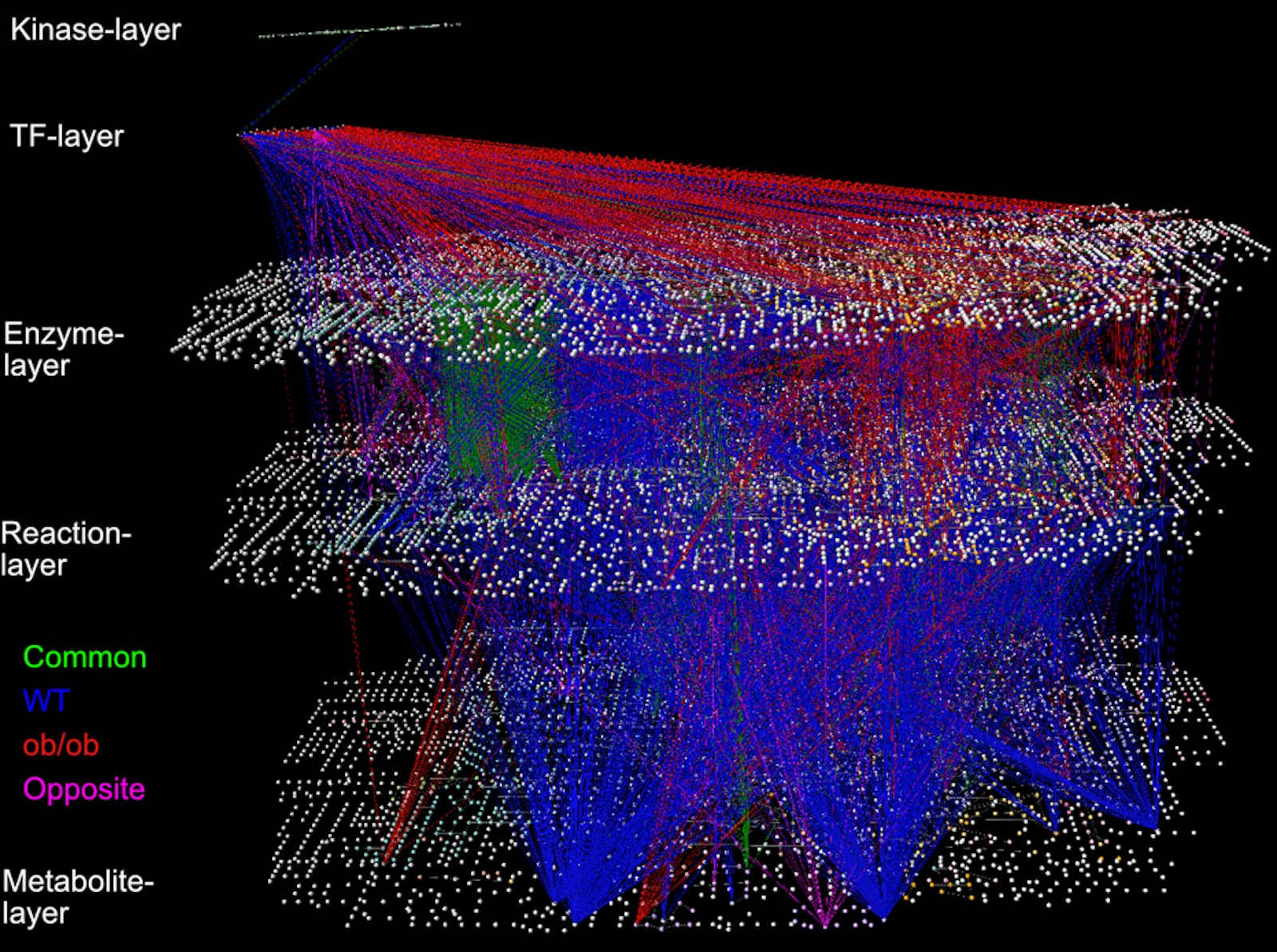
The top layer is the insulin signaling pathway. The second layer is for transcription factors (TFs). The third to fifth layers are the global metabolic pathways of mice from KEGG, representing enzyme genes, metabolic reactions, and metabolites, respectively. The edges between each layer are trans-omic interactions from signaling molecules to transcription factors (between layers 1 and 2), from TFs to target enzyme genes (between layers 2 and 3), from enzyme genes to metabolic reactions (between layers 3 and 4), and from metabolites to metabolic reactions (between layers 5 and 4). The edges indicate regulation functioning: only in WT (blue), only in ob/ob (red), in similar ways both in WT and ob/ob (green), and in opposite ways in WT and ob/ob (magenta).
Recent Major Publications
Jua S, Lysenko A, Boroevich KA, Sharma A, Tsunoda T. scHDeepInsight: a hierarchical deep learning framework for precise immune cell annotation in single-cell RNA-seq data. Brief Bioinform 26(5), (2025)
Akita R, Lysenko A, Boroevich KA, Yokota T, Kawai D, Iizuka R, Tsunoda T, Uemura S. Voltage-matrix nanopore profiling for the discrimination of protein mixtures. Chemical Science, (2025)
Invited Presentations
Yugi K. A trans-omic analysis of metformin action in the liver. Anatomy-Physiology-Pharmacology Week in 2025, Chiba, Japan, March 17–19 (2025)