Lab Activities
Laboratory for Mucosal Immunity
Research Activities

Team Director
Sidonia Fagarasan
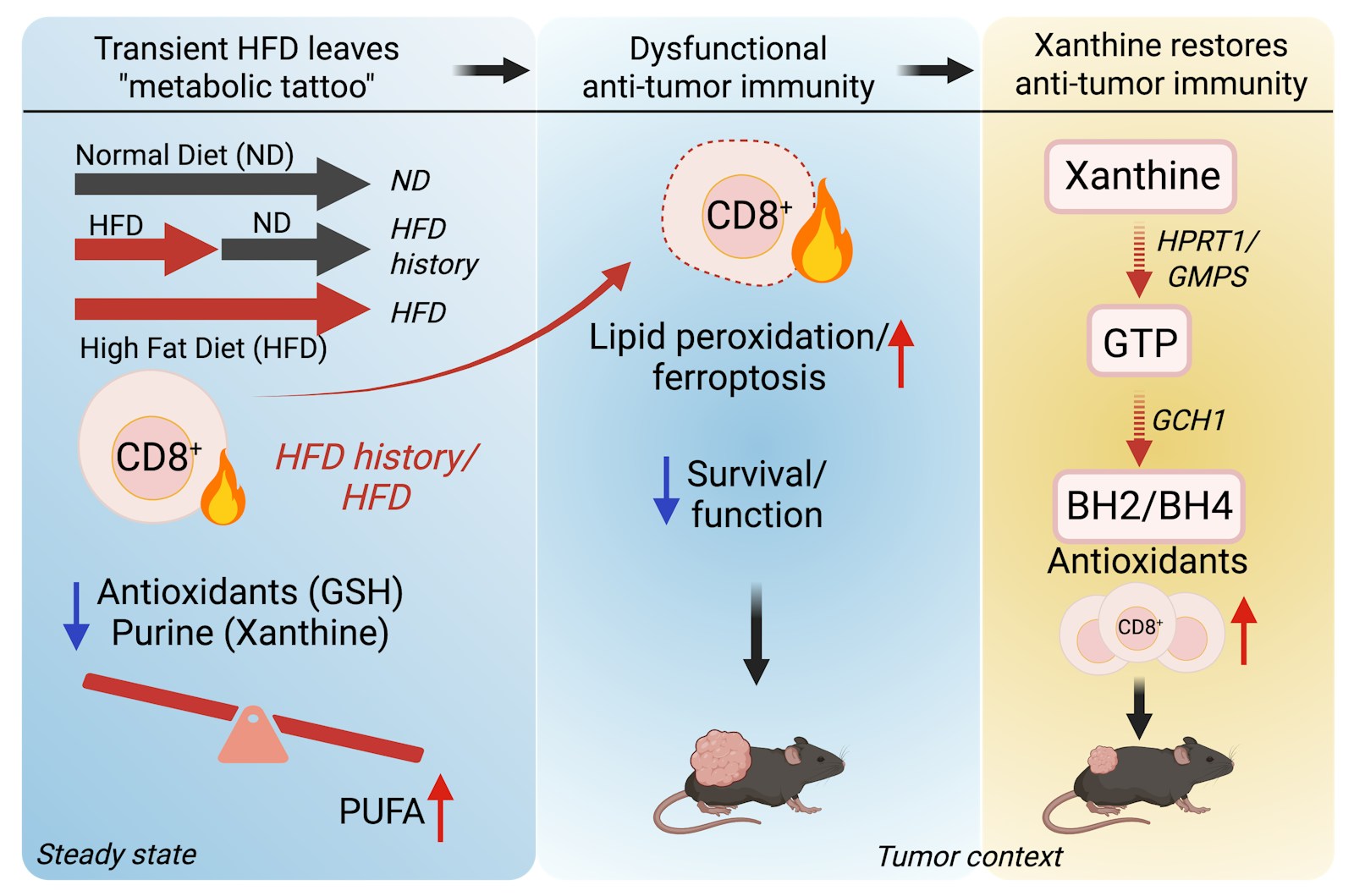
Most chronic illnesses are caused by both genetic and environmental factors. Dietary changes associated with modern life drive systemic perturbations, from changes in the microbiome, to chronic inflammatory and degenerative diseases and cancers. Obesity is a risk factor for many types of cancers. Also, a history of obesity can have a lasting glycemic risk long after reverting to normal weight, by yet unknown mechanisms. We found that a transient exposure to HFD impairs anti-tumor immunity even 3 months after reversion to a normal diet. This was due to lasting metabolome changes that included enrichment in polyunsaturated fatty acids sensitive to peroxidation and depletion of antioxidants, such as glutathione and xanthine, affecting the survival and function of CD8+ T cells. We demonstrate that under oxidative stress, CD8 T cells utilize the xanthine salvage pathway via hypoxanthine phosphoribosyl transferase (HPRT1) and guanosine monophosphate synthetase (GMPS) to fuel the synthesis of guanosine triphosphate (GTP) (Figure). GTP via GTP cyclohydrolase 1 (GCH1) is used to boost the pool of tetrahydrobiopterin (BH4) and its oxidized form, dihydrobiopterin (BH2). In vitro, xanthine and biopterins rescue CD8 T cells from ferroptosis. In vivo, xanthine or BH2 administration reduces the lipid peroxidation in tumor draining lymph nodes and improves anti-tumor immunity in mice that have experienced HFD. Conversely, CD8 T cells deficient in Gch1, the rate limiting enzyme for BH4 synthesis from GTP, show an impaired ability to control the tumor growth unless supplemented with BH2. Our data indicate that in CD8 T cells, metabolic stress extends long after a balanced diet has been restored, manifesting as vulnerability to oxidative stress and ferroptosis, that can be mitigated by replenishing the pool of biopterins by xanthine and its salvage pathway.
Metabolic tattoo induced by high fat diet: rewiring of CD8+ T cell metabolism toward antioxidant generation via xanthine salvage pathway
Recent Major Publications
Matsuoka Y, Katsumata Y, Chu P, Morikawa R, Nakamoto N, Iguchi K, Takahashi K, Kou T, Ito R, Taura K, Yazumi S, Terajima H, Honjo G, Ichihara G, Muramoto Y, Sato K, Maeda R, Hata K, Toriu N, Yanagita M, Tajima M, Fagarasan S, Yamada K, Sugiura Y. Monitoring ferroptosis in vivo: Iron-driven volatile oxidized lipids as breath biomarkers. Redox Biol 86, 103858 (2025)
Arai N, Sugiura Y, Nakajima S, Wada M, Moriyama S, Mimura Y, Niinomi K, Takayama K, Maeda R, Kitada S, Fagarasan S, Tajima M, Boku S, Takebayashi M, Kato J, Kitago M, Kitagawa Y, Takahashi T, Shimizu H, Uchida H, Suematsu M, Mimura M, Noda Y. Prediction of postoperative delirium by blood metabolome analysis. J Psychiatr Res 184, 500–514 (2025)
Ohtani M, Fujii H, Watanabe T, Ohara O, Maruya M, Fagarasan S, Hoshii T, Hirao A, Koyasu S, Kubo M, Matsuda S. mTORC1-independent IgA production: a unique pathway for gut immune homeostasis. Int Immunol, dxaf063 (2025)
Carvalho T, Fagarasan S, Muramatsu M. Activation-induced cytidine deaminase: The missing piece of many puzzles. Cell 188(24), 6691–6695 (2025)
Koide R, Abe T, Harimoto T, Kamada AJ, Saito Y, Guerrini M, Fujii A, Parrish E, Horie M, Kiyonari H, Yamamoto K, Tomonaga K, Parrish NF. Interferon and TLR genes, but not endogenous bornavirus-like elements, limit BoDV1 replication after intracerebral infection. PLoS Pathog 21(5), e1013165 (2025)
Maskawa R, Takayasu L, Takayasu H, Watanabe K, Takemine S, Kakimoto T, Takeshita K, Narushima S, Suda W, Takayasu M. High-resolution fecal pharmacokinetic modeling in mice with orally administered antibiotics. Sci Rep 15(1), 24441 (2025)
Zhang B, Fagarasan S. Metabolism and metabolites regulating hematopoiesis. Curr Opin Immunol 93(102525), (2025)
Invited Presentations
Fagarasan S. Metabolic regulatory pathways mediating anti-tumor responses. The 3rd Keio University WPI-Bio2Q International Symposium “Integrating Biology, Microbiome, and Immunology for Healthy Longevity, Tokyo, Japan, March 6 (2025)
Fagarasa S. Metabolic regulatory pathways mediating anti-cancer responses. Formosa Immunology Spring School and Symposium 2025, Taipei, China, March 16 (2025)
Fagarasan S. On the biochemical dialog between immune cells mediated anti-cancer responses. IMS-JSI International Symposium, Tokyo, Japan, June 26 (2025)
Fagarasan S. The intersection of adaptive and innate immunity in the lung: Implications for chronic pulmonary insufficiency. EMBO Workshop Adaptive Immunity in Barrier Tissues, Basel, Switzerland, August 27 (2025)
Fagarasan S. Metabolic regulatory pathways mediating anti-tumor responses. The 98th Annual Meeting of the Japanese Society of Biochemistry, Kyoto, Japan, November 3 (2025)