Lab Activities
Laboratory for Infectious Diseases and Immunology
Research Activities

Team Director
Kosuke Miyauchi
Dengue fever is a disease caused by the dengue virus (DENV), which is transmitted by mosquitoes. More than 5 million people worldwide contract the disease annually. The risk of DENV infection is increasing as the habitat of mosquitoes that transmit the virus shifts due to climate change. There are four serotypes of the dengue virus type 1 to 4. Infection with any one serotype induces antibody-dependent enhancement (ADE) antibodies, which enhance infection with other DENV serotypes. Therefore, identification of which DENV serotype an individual was infected with in the past is crucial for assessing future infection risk.
We have designed DENV envelope (E) protein-based probes on multi plat form to examine serotype specific anti-DENV antibodies in serum. The extracellular domains of dengue virus E proteins from DENV types 1, 2, 3, or 4 were conjugated to Phai Code, Dyna Beads, and xMAP systems using Halo technology. Using these systems, anti DENV antibodies were detected in serum form mouse vaccinated with DENV E protein-alum adjuvant conjugates. We obtained serum from mice infected with type 1 and type 2 DENV and analyzed it by the xMAP system. Serum from mice infected with type 1 DENV showed antibody detection only on the type 1’s E protein-binding xMAP, while serum from mice infected with type 2 DENV showed antibody detection only on the type 2’s E prtein-binding xMAP and did not react with the type 3 or type 4’s E-protein binding xMAPs. These results suggest that the system we have established is effective for distinguishing DENV serotypes from past infections. We are currently preparing to conduct studies using sera from DENV infected people.
DENV envelope (E) protein-based probes on multi plat form to examine serotype specific anti-DENV antibodies in serum
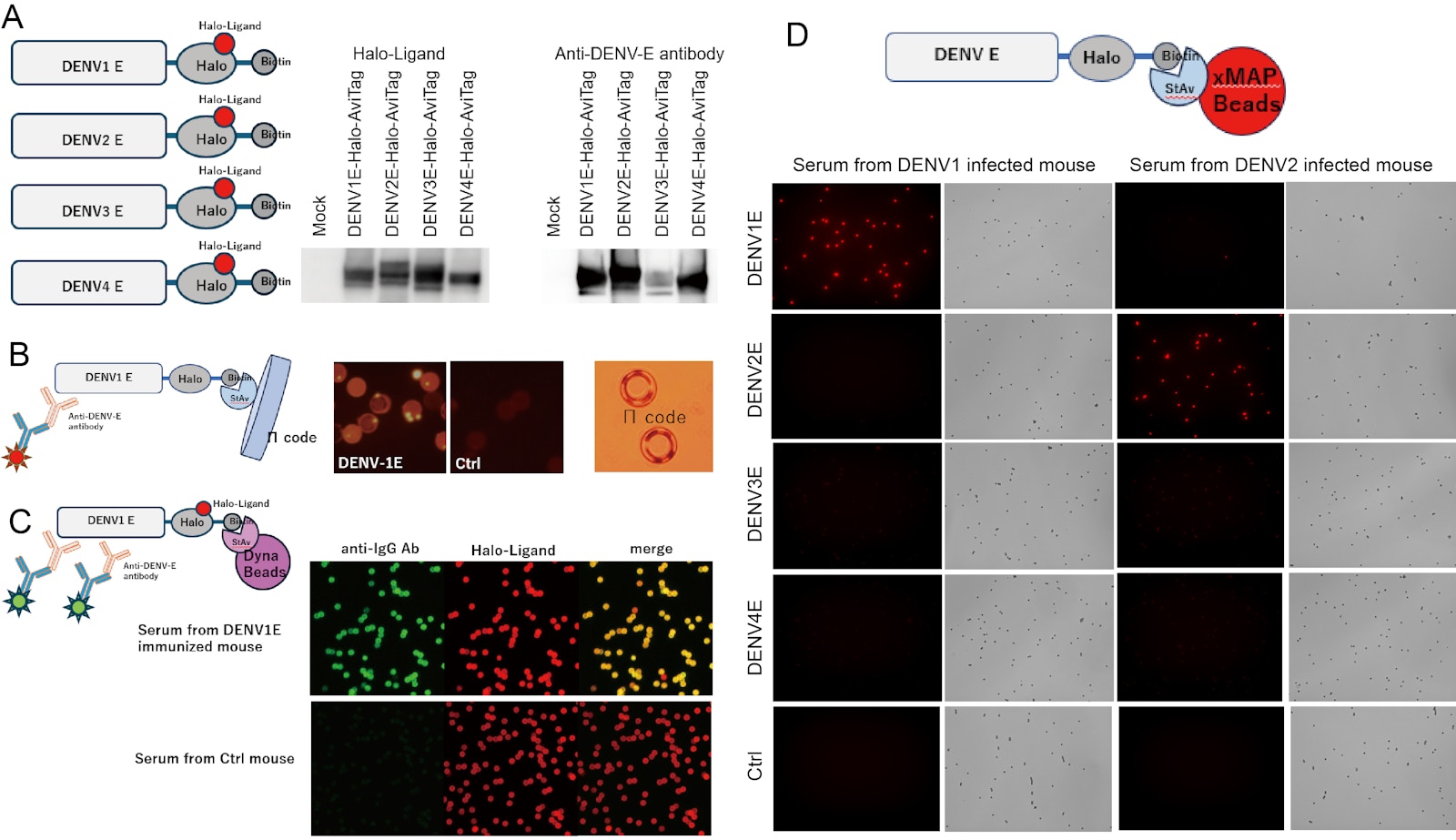
(A) Schematic diagram of DENV E probes for detection of anti-DENV antibodies. Ectodomain of DENV E is linked with Halo-tag and is biotinylated. (B) Detection of anti-DENV antibodies in serum of DENV E antigen immunized mouse on phi code tip. (C) Detection of anti-DENV antibodies in serum of DENV E antigen immunized mouse on Dyna beads. (D) Detection of antibodies specific to DENV type 1and type 2 in virus infected mice. Anti-DENV antibodies in the serum of Ifnar-/- mouse infected with either DENV-1 or DENV-2 were detected using xMAP beads conjugated to the E proteins of DENV-1, -2, -3, or -4.
Recent Major Publications
Harada M, Matsumoto T, Yamamoto M, Goda J, Idei A, Ohtaki K, Kojima N, Yoneda N, Miyauchi K, Katsura K, Ikeda M, Hanada K, Ishizuka-Katsura Y, Hosaka T, Hisano T, Kaizuka T, Yamamoto T, Matsuda M, Nakayama M, Sugimoto-Ishige A, Sakuma M, Hashimoto R, Takayama K, Nakayama M, Nguyen CT, Ishigaki H, Itoh Y, Hashizume Y, Yoshida M, Kawaguchi Y, Takeda M, Koseki H, Shirouzu M, Inoue J, Saito T. Monoclonal antibodies against human TMPRSS2 prevent infection by any SARS-CoV-2 variant. iScience 28(9), 113424 (2025)
Yanagida N, Tanaka N, Tahara U, Ito Y, Nomura A, Lu H, Tsai F, Momosawa Y, Koseki H, Terao C, Kawasaki H, Amagai M. 0556 SERPINB7 c.796C>T Variant: A genetic risk factor linked to immune dysregulation and skin microbiota alterations in atopic dermatitis. J Invest Dermatol 145(8), s96 (2025)
Abdelnaser RA, Hiyoshi M, Takahashi N, Kimura S, Hase K, Ohno H, Monde K, Ono A, Suzu S. TNFAIP2 increases macrophage response to CSF-1 through multiple effects on CSF-1 receptor. J Leukoc Biol 117(11), qiaf151 (2025)
Yamano H, Horike H, Taguchi Y, Inabu Y, Miyamoto H, Kurotani A, Suzuki N, Moriya S, Nakaguma T, Ishii C, Matsuura M, Tsuji N, Etoh T, Shiotsuka Y, Fujino R, Wada S, Kikuchi J, Ohno H, Takahashi H. Maternal administration of octanoate, a medium-chain fatty acid, improves feed efficiency of Japanese black calves through influencing gut bacteriome structure. Sci Rep 15(1), 33557 (2025)
Asami S, Ohno H. APOL proteins tune gut immunity via commensal lipid recognition. Cell Res, 1–2 (2025)
van Amerongen RA, Tuit S, Remst DF, Wouters AK, Siekman SL, Hagedoorn RS, van der Steen DM, Kester MG, de Ru AH, van der Horst G, Matsuda M, Ishikawa F, van Veelen PA, Falkenburg JH, Heemskerk MH. TCR-Based Therapy Directed against Kallikrein-Related Peptidase 4 Is Safe and Effective against Prostate Cancer. Cancer Immunol Res 13(8), 1145–1159 (2025)
Ortega-Reyes D, Takeuchi T, Ogata Y, Iwami T, Suda W, Kubota T, Kubota N, Kadowaki T, Tomizuka K, Ohno H, Horikoshi M, Terao C. Interplay between host genetics and gut microbiome composition in the Japanese population. Front Microbiomes 4, 1635907 (2025)
Miyauchi E, Yamazaki K, Tsuboi Y, Nakajima T, Ono S, Mizuno K, Takahashi N, Imamura K, Morita H, Miura N, Okuda S, Kikuchi J, Sasaki N, Ohno H, Yamazaki K. Patients with periodontitis exhibit persistent dysbiosis of the gut microbiota and distinct serum metabolome. J Oral Microbiol 17(1), 2499284 (2025)