Lab Activities
Proteome Homeostasis Research Unit
Research Activities
Unit Leader
Koshi Imami
Our unit aims to reveal how the protein homeostasis (“proteostasis”) is regulated and maintained at the system level. To this end, we develop cutting-edge proteomic technologies to capture protein-specific information, including translation, degradation, post-translational modifications, activity, and protein-protein interactions. Lipids regulate proteostasis through binding covalently or non-covalently to proteins. We previously developed a proteomic methodology for global analysis of endogenous protein N-terminal myristoylation sites based on liquid-liquid extraction of hydrophobic lipidated peptides (Tsumagari et al., Mol. Cell. Proteomics 2023). In FY2025, we have developed new methods for more global, site-resolved analysis of multiple protein lipidations, including myristoylation, palmitoylation and prenylation. (Tsumagari et al., submitted 2026). Using these approaches, we revealed that palmitoylation of a ribosomal protein influences nuclear export of pre-40S ribosomal subunits. These findings suggest a regulatory role for S-acylation in ribosome biology, offering new insights into the modulation of translation machinery through lipid modifications. In addition, we studied and focused on mapping the repertoire of surface proteins and interacting proteins of extracellular vesicles (EVs), which provide deeper insight into their biological, diagnostic, and therapeutic roles. To do this, we developed a genetically encoded proximity labelling probe that displays engineered ascorbate peroxidase, APEX2, on the surface of EVs via fusion to EV-sorting scaffold proteins (Fig) (Zheng et al., Adv. Sci. 2025). This enables the biotinylation of producer-cell-derived surface proteins, corona proteins, and interactors in vitro. After the enrichment by streptavidin bead pulldowns, subpopulation-specific, biotinylated surfaceome and interactome are comprehensively characterized using mass spectrometry-based proteomics. Thus, a genetic tool is introduced for the high-fidelity mapping of the surfaceome and cellular interactome of EVs in vitro. This approach offers a robust framework for dissecting EV biology and has broad applications in biomarker discovery and EV-based therapeutics.
Development of protein probes for the analysis of vesicle surface proteins and interactors
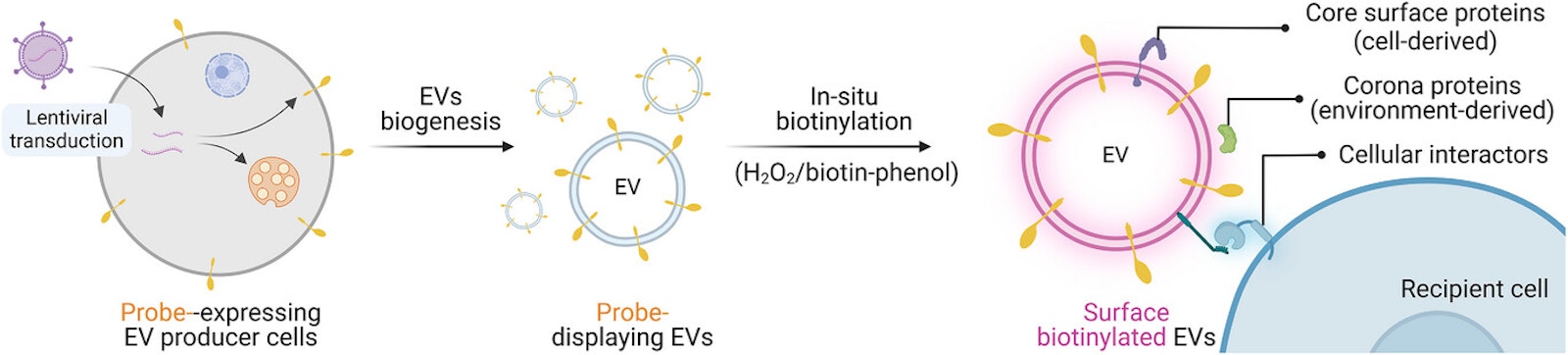
producer cells are genetically engineered to achieve endogenous surface display of the proximity labeling enzyme APEX2 on EVs. Then, APEX2 catalyzes the biotinylation of surface proteins, including cell-derived core components and environment-derived corona components, as well as interactors on recipient cells. DOI: (10.1002/advs.202511414)
Recent Major Publications
Banno A, Mizuno K, Sakamoto M, Komatsubara S, Shirane K, Hayashi K, Hamazaki N, Imami K, Yonemura S, Ishiuchi T. A simple, efficient, and scalable method to generate oocyte-like cells in vitro. Life Sci Alliance 9(2), e202503379 (2025)
Zheng W, Mowoe M, Hou W, Hagey DW, Imami K, Andaloussi SE. Development of Endogenous Protein Probes for Characterizing Surface Proteins and Cellular Interactors of Extracellular Vesicles. Advanced Science, e11414 (2025)
Kiuchi S, Chung MH, Sakai H, Nakaya T, Ohbuchi K, Tsumagari K, Imami K, Otoguro Y, Nitta T, Yamamoto H, Sasaki K, Tsugawa H. Unraveling anti-inflammatory metabolic signatures of Glycyrrhiza uralensis and isoliquiritigenin through multiomics. NPJ Syst Biol Appl, (2025)
Imami K. Proteome analysis of puromycin-labeled nascent polypeptides. Methods Enzymol 719, 1–23 (2025)
Iwasaki W, Kashiwagi K, Sakamoto A, Nishimoto M, Takahashi M, Machida K, Imataka H, Matsumoto A, Shichino Y, Iwasaki S, Imami K, Ito T. Structural insights into the role of eIF3 in translation mediated by the HCV IRES. Proc Natl Acad Sci U S A 122(49), e2505538122 (2025)
Deng K, Isobe Y, Tsumagari K, Kato T, Arai H, Imami K, Arita M. 12/15-Lipoxygenase-Derived Electrophilic Lipid Modifications in Phagocytic Macrophages. ACS Chem Biol, (2025)
Invited Presentations
Imami K. Proteomic characterization of the functional impact of co-/post-translational modifications. The 98th Annual Meeting of the Japanese Biochemical Society. Kyoto, Japan, November 3-5 (2025)
Imami K. Decoding the protein lifetime in health and disease using quantitative proteomics. ISPO2025, Nara, Japan, October 30–November 2 (2025)