Lab Activities
Laboratory for Symbiotic Microbiome Sciences
Research Activities
Team Director
Wataru Suda
The gut microbiome plays a crucial role in maintaining the host’s physiological state, making it essential to understand its ecosystem and to develop strategies for its regulation and control. The Laboratory for Symbiotic Microbiome Sciences focuses on advancing technologies for high-resolution observation of the microbiome, including metagenomic analysis. By leveraging these approaches, we aim to identify symbiotic microbiomes involved in disease pathogenesis and the regulation of host homeostasis, elucidate their underlying mechanisms, and ultimately achieve a comprehensive understanding of the symbiotic microbiome.
Despite substantial progress in the field, most microbiome studies still rely on cross-sectional comparisons or sparse pre- and post-event sampling. Such approaches provide only static snapshots and fail to capture rapid and coordinated microbial responses over time. To address this limitation, we developed an automated device capable of continuously collecting fecal samples from individual mice at minute- to hour-scale intervals. This year, we combined this platform with full-length 16S rRNA gene sequencing and long-read metagenomic sequencing to reconstruct genome- and function-resolved microbiome trajectories over a two-week period. By exploiting the ability of long-read assemblies to retain complete 16S rRNA genes, we directly linked amplicon variants to metagenome-assembled genomes, enabling strain-level tracking together with time-resolved functional gene profiling.
Using a newly developed non-parametric phase-analysis framework, we revealed that many oscillatory microbial genomes synchronize into two coherent circadian modes, peaking during the light and dark phases. These two-phase groups exhibited distinct ecological strategies: light-phase taxa were enriched in pathways related to mucosal carbohydrate utilization, whereas dark-phase taxa preferentially utilized and stored diet-derived carbohydrates, reflecting host feeding rhythms and metabolic cycles.
In parallel, we are refining long-read metagenomic workflows and computational pipelines for human gut samples, with the goal of extending genome-resolved and time-aware microbiome profiling to translational and clinical research applications.
Strain-level time-resolved genome tracking and phase analysis identify two synchronized microbial modes.
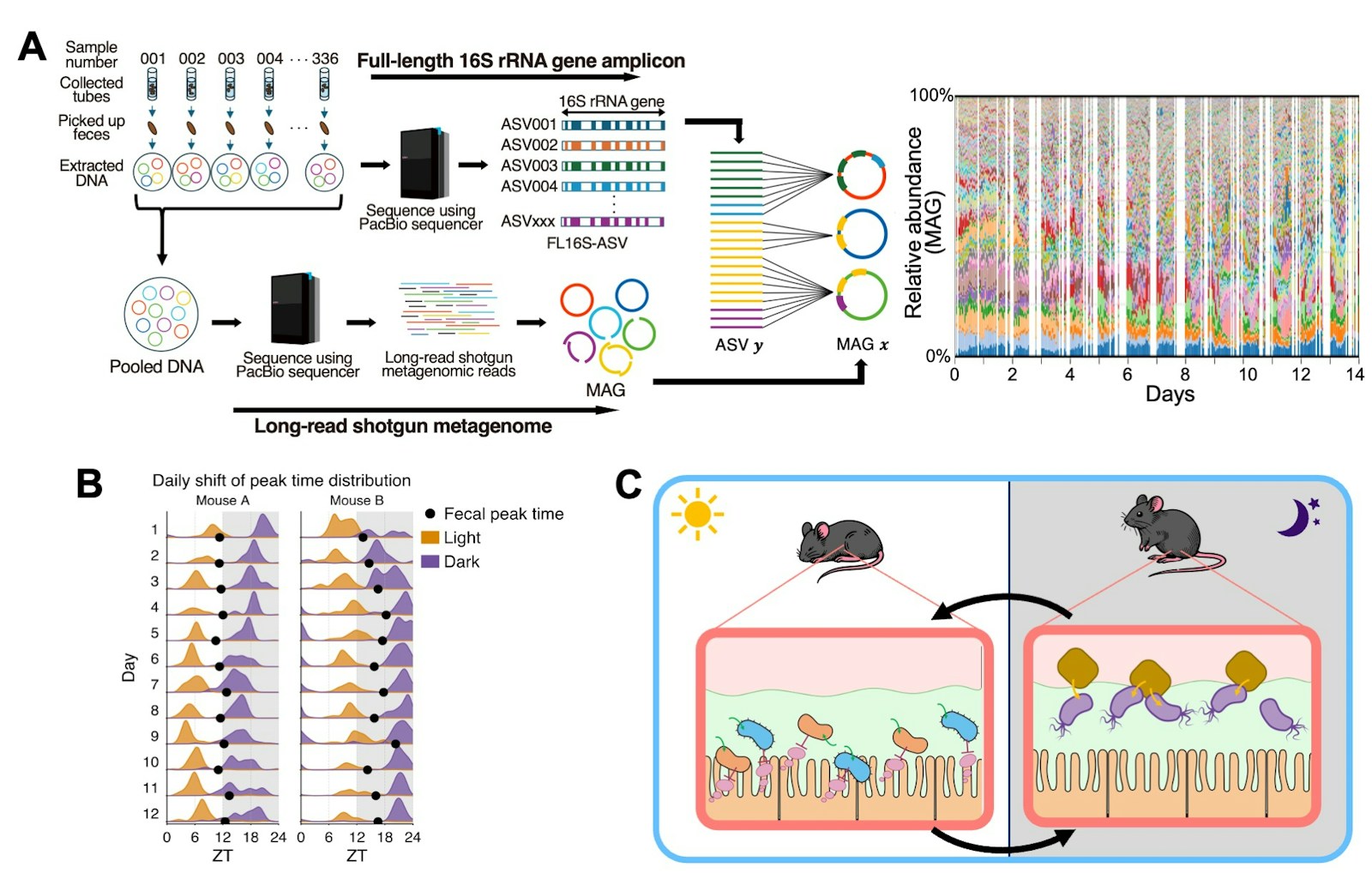
(A) Workflow for strain-level time-resolved genome tracking. (B) Daily peak-time distributions of genomes assigned to the Light (orange) and Dark (purple) synchronized modes. Black dots denote fecal excretion peaks. (C) Conceptual model illustrating a hypothesis for functional and ecological differences between the two synchronized microbial modes.
Recent Major Publications
Ortega-Reyes D, Takeuchi T, Ogata Y, Iwami T, Suda W, Kubota T, Kubota N, Kadowaki T, Tomizuka K, Ohno H, Horikoshi M, Terao C. Interplay between host genetics and gut microbiome composition in the Japanese population. Front Microbiomes 4, 1635907 (2025)
Maskawa R, Takayasu H, Takayasu L, Suda W, Takayasu M. Stochastic spatiotemporal growth model reproducing the universal statistical laws of the gut microbiome. Phys Rev Res 7(1), 013269 (2025)
Maskawa R, Takayasu L, Takayasu H, Watanabe K, Takemine S, Kakimoto T, Takeshita K, Narushima S, Suda W, Takayasu M. High-resolution fecal pharmacokinetic modeling in mice with orally administered antibiotics. Sci Rep 15, 24441 (2025)
Ono N, Ito Y, Aoki S, Shiohama A, Sasaki T, Kurokawa R, Suda W, Amagai M, Kubo A. Microbial Dysbiosis and Foot Odor in Nagashima-Type Palmoplantar Keratosis: Improvement with Topical Benzoyl Peroxide. J Invest Dermatol (2025)
Futakuchi T, Furuhashi H, Isshi K, Hara Y, Ono S, Kurokawa R, Takayasu L, Suda W, Sumiyama K. Ex Vivo Analysis of the Effect of Endoscopic Premedications on the Microbiota Profile in Gastric Juice. JGH Open 9, e70141 (2025)
Kurokawa R, Watanabe K, Ogata Y, Takemine S, Takagi M, Shindo C, Suda W. Complete genome sequences of five Limnohabitans strains isolated from two shallow eutrophic lakes in Japan. Microbiol Resour Announc 14, e0094425 (2025)
Maruyama T, Ishikawa D, Kurokawa R, Masuoka H, Nomura K, Haraikawa M, Orikasa M, Odakura R, Koma M, Omori M, Ishino H, Ito K, Shibuya T, Suda W, Nagahara A. Hydrogen Gas Inhalation Improved Intestinal Microbiota in Ulcerative Colitis: A Randomised Double-Blind Placebo-Controlled Trial. Biomedicines 13, 1799 (2025)
Aiyoshi T, Kakihara T, Watanabe E, Tanaka N, Ogata Y, Masuoka H, Kurokawa R, Fujishiro J, Suda W, Masumoto K. Unique microbial profiles and severity-associated alterations in the peritoneal fluid of children with acute appendicitis. J Infect Chemother 31, 102761 (2025)
Wada K, Suda W, Ueno T, Masuoka H, Yamakawa M, Nakashima Y, Sugino M, Mori T, Uchiyama S, Sumoto Y, Kiguchi Y, Hattori M, Nagata C. Gut microbiota associated with equol production in school-age children. Eur J Nutr 64, 174 (2025)
Hisamatsu D, Masuoka H, Takeshige-Amano H, Kurokawa R, Ogata Y, Suda W, Hatano T, Asaoka D, Mabuchi Y, Naraoka Y, Sato N, Asada T, Hattori N, Hattori M, Akazawa C. Acetylcholinesterase inhibitors considerably affect the salivary microbiome in patients with Alzheimer’s disease. iScience 28, 112593 (2025)
Yamane T, Masaoka T, Ishii C, Masuoka H, Suda W, Kurokawa S, Kishimoto T, Mikami Y, Fukuda S, Kanai T. Factors contributing to the efficacy of fecal microbiota transplantation for diarrhea-dominant functional bowel disorders. Digestion 106, 469-479 (2025)
Sugawara I, Kawahara Y, Takayasu L, Isshi K, Kato M, Ono S, Hara Y, Futakuchi T, Furuhashi H, Kurokawa R, Sumiyama K, Suda W. Study on the relationship between microbial composition within obstructive biliary stents and the severity of obstruction and duration of stent placement. PLoS One 20, e0317230 (2025)
Invited Presentations
Suda W. "New Methods for Microbiome Analysis." The 17th International Congress of Neuroimmunology, Chiba, Japan, October 5–8 (2025)