Lab Activities
Open Systems Information Science Special Team
Research Activities
Team Director
Kazuhiro Sakurada
In medicine and biology, life phenomena exhibiting properties of non-equilibrium, nonlinear, open systems have been interpreted in terms of causal relationships. However, interpreting things in terms of cause and effect is not a natural law. Rather, it is a means by which humans perceive the external world. The goal of this team is to understand life phenomena through natural laws, specifically the principles of physics. Physics seeks to understand the laws governing the motion of objects. In contrast, medicine and biology seek to understand the laws governing changes in the state of biological systems. Sakurada et al. demonstrated that viewing changes in biological states as motion within a state space allows the framework of physics to be applied to explain life phenomena. This theory is called biomechanics theory. According to this theory, biological systems are viewed as oscillators that interact via messages. This demonstrates that their state changes proceed according to the maximum entropy production principle. It also shows that biological proliferation and movement generate diversity by breaking symmetries.
Building on this concept, we achieved three major research results this year. Sakurada performed a quantum expansion of biomechanics. As illustrated in the figure, he defined kinetic and potential energy in state space and derived the wave function. This paper is currently under peer review. This theory establishes a foundation for interpreting life phenomena using field theory (an extension of quantum field theory). The second achievement is its application in cognitive science. Takeichi has pioneered research into understanding cognition through the relationship between external physical phenomena and psychological processes. This term, in collaboration with a research group at Kyushu University, he contributed to the systematic acquisition of magnetoencephalogram (MEG) data from subjects experiencing hypnagogic hallucinations (also known as "dreams"). The group jointly published a database containing verbal reports of subjective experiences during dreaming alongside corresponding electroencephalogram (EEG) activity (Nat Commun. 2025 Aug 13;16(1):7495.). Takeichi and his colleagues made a unique contribution to this database by adding MEG data, which offers superior signal separation to EEG data. Arata is advancing the elucidation of dynamical systems that govern entire life courses using model organisms. To date, he has developed a large-scale life logger and the Temporal Geometry method. This enables the acquisition of 'complete life course data' for C. elegans, from sexual maturity to death, at both the level of the individual and the statistical population. Building on this technology, modelling of the relationship between ageing trajectories and genetics is advancing, with the expectation that it will lead to new technologies for controlling ageing. Unlike AI-based time-series models that probabilistically express state transitions, Temporal Geometry method allows the essence of ageing to be interpreted from a dynamical systems perspective.
Outline of Organism mechanics Research
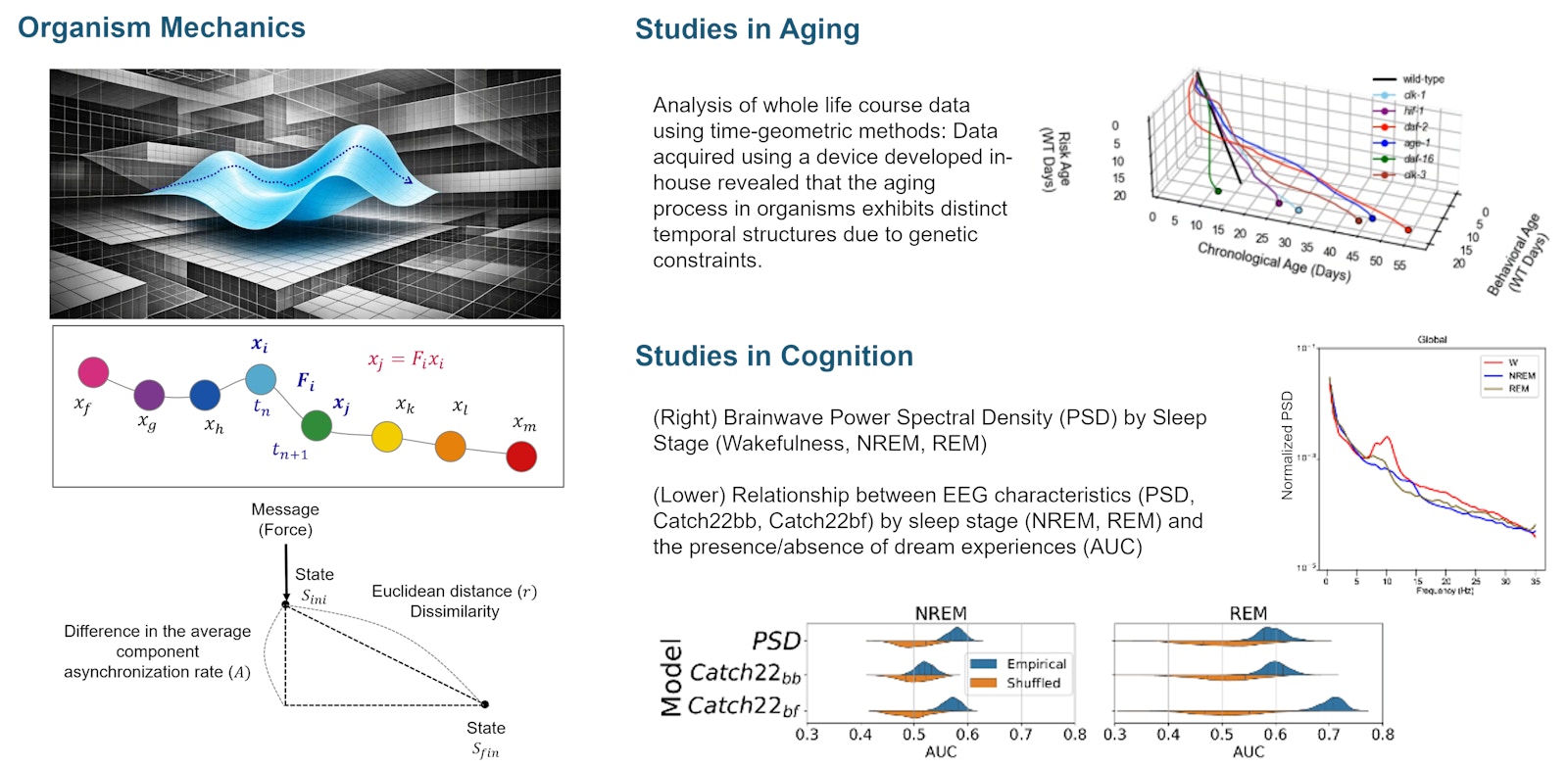
The Laboratory of Open Systems Information Science is engaged in research on the quantum development of organism mechanics and new mechanistic principles explaining aging and cognition.
Recent Major Publications
Kuno M, Osumi H, Udagawa S, Yoshikawa K, Ooki A, Shinozaki E, Ishikawa T, Oba J, Yamaguchi K, Sakurada K. Artificial Intelligence in Clinical Oncology: From Productivity Enhancement to Creative Discovery. Curr Oncol. Oct 22;32(11):588 (2025)
Ishikawa T, Shinoda M, Oya M, Ashizaki K, Ota S, Kamachi K, Sakurada K, Kawakami E, Shinkai M. Explainable Machine Learning Framework for Dynamic Monitoring of Disease Prognostic Risk: Retrospective Cohort Study. JMIR Form Res. Aug 7;9:e65585 (2025)
Fukushima-Nomura A, Kawasaki H, Yashiro K, Obata S, Tanese K, Ebihara T, Saeki H, Etoh T, Hasegawa T, Yazaki J, Seita J, Ohara O, Sekita A, Miyai T, Ashizaki K, Koseki H, Sakurada K, Kawakami E, Amagai M. An unbiased tissue transcriptome analysis identifies potential markers for skin phenotypes and therapeutic responses in atopic dermatitis. Nat Commun. Jun 2;16(1):4981 (2025)
Kato D, Okuno A, Ishikawa T, Itakura S, Oguchi S, Kasahara Y, Kanenishi K, Kitadai Y, Kimura Y, Shimojo N, Nakahara K, Hanai A, Hamada H, Mogami H, Morokuma S, Sakurada K, Konishi Y, Kawakami E. Multilevel Factors and Indicators of Atypical Neurodevelopment During Early Infancy in Japan: Prospective, Longitudinal, Observational Study. JMIR Pediatr Parent. Apr 4;8:e58337 (2025)
Invited Presentations
Sakurada K. ”AI for Medicine” Finland Radical Health Precision Health in Practice: Global Perspectives from Japan and Finland (Helsinki, Finland) January 2026
Sakurada K.” Organism Mechanics for Medicine” The Ernst Strüngmann Forum - The Simplicity behind Absurdity, The Power of Quantum Thinking (Frankfurt, Germany) September 2025
Sakurada K. “Accelerate R&D to address social challenges through international partnerships and collaborations between industry, government, and academia.” The Future of Predictive Healthcare: Showcasing AI and Digital Innovation in Japan and the Netherlands (Osaka, Japan), June 2025
Sakurada K. ”Accelerate R&D to address social challenges through international partnerships and collaborations between industry, government, and academia” and “Life Course Modeling and the Theory of Life for Preemptive Medicine” and “Collaboration between international academia, industry, and government to create individualized digital health twins” Japan France Bilateral Seminar on Health Data (Tokyo, Japan) June 2025