Lab Activities
Medical Data Mathematical Reasoning Special Team
Research Activities
Team Director
Eiryo Kawakami
The Medical Data Mathematical Reasoning Special Team aims to establish predictive and interpretable computational frameworks that bridge large-scale biomedical data and clinical decision-making. Our research focuses on extracting disease-relevant patterns from heterogeneous data sources, including electronic health records, medical imaging, multi-omics profiles, wearable sensor data, and longitudinal cohort studies. By integrating mathematical modeling, machine learning, and systems biology, we seek to elucidate latent disease states, predict future trajectories, and enable early, personalized interventions.
During 2025, our laboratory advanced several key research directions. First, we developed machine learning models for disease risk prediction and outcome forecasting across diverse clinical domains, including metabolic disorders, neurodevelopmental conditions, critical care medicine, spinal cord injury, and ophthalmology. These studies demonstrated that time-resolved modeling substantially improves both predictive accuracy and clinical interpretability. Second, we pursued systematic approaches to characterize disease dynamics, revealing pre-disease states and transition mechanisms in complex conditions such as atopic dermatitis, psychological distress during the COVID-19 pandemic, and nephrotic syndrome. These approaches provide a principled way to move beyond static biomarkers toward dynamic risk assessment.
In parallel, we contributed to foundational methodological advances. We proposed uncertainty-aware inference methods for transcription factor activity and perturbation analysis, as well as practical frameworks for black-box optimization applicable to immunology and broader life science research. We also actively explored the application of large-scale deep learning and foundation models to medical imaging and clinical data analysis, with particular emphasis on transparency, robustness, and clinical usability.
Collectively, these efforts position our laboratory at the intersection of data science, medicine, and biology. By translating advanced computational methods into clinically meaningful tools, we aim to accelerate early diagnosis, patient stratification, and precision medicine across multiple disease areas.
Disease combination–based risk assessment for adult-onset nephrotic syndrome
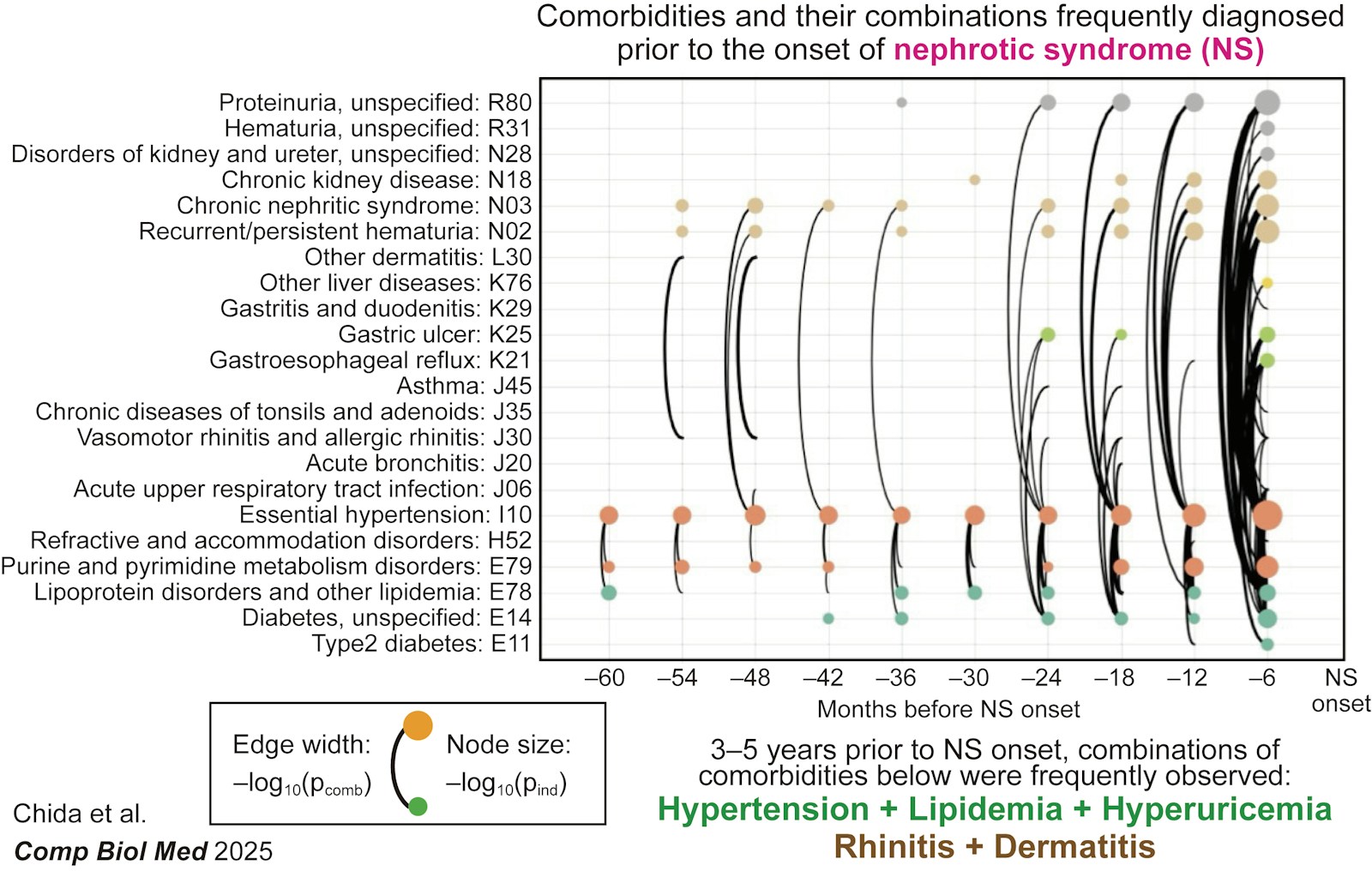
This figure summarizes a data-driven framework to identify combinations of preceding diseases associated with an increased risk of adult-onset nephrotic syndrome using large-scale longitudinal health records. By systematically testing disease combinations with rigorous multiple statistical correction, the analysis reveals higher-order risk patterns that are not detectable by single-disease associations alone. The results highlight combinations of comorbid conditions preceding nephrotic syndrome onset, providing insight into heterogeneous disease pathways and enabling more refined risk stratification beyond conventional univariate approaches.
Recent Major Publications
Nagai T, Homma K, Kawamata Y, Yoshihara M, Kawakami E, Baba T. Leveraging large-scale deep learning models for diagnosis and visual outcome prediction in retinitis pigmentosa. NPJ Digit Med (2026)
Fukushima-Nomura A, Kawasaki H, Yashiro K, Obata S, Tanese K, Ebihara T, Saeki H, Etoh T, Hasegawa T, Yazaki J, Seita J, Ohara O, Sekita A, Miyai T, Ashizaki K, Koseki H, Sakurada K, Kawakami E, Amagai M. An unbiased tissue transcriptome analysis identifies potential markers for skin phenotypes and therapeutic responses in atopic dermatitis. Nat Commun 16(1), 4981 (2025)
Chida K, Ishikawa T, Hanai A, Hananoe A, Kashiwagi Y, Hatakeyama H, Sakai S, Mizui M, Matsui I, Nagasu H, Takeuchi Y, Shinzawa M, Yamamoto R, Kimura T, Kawakami E. Rigorous multiple statistical test unveils combinations of preceding diseases at risk for the development of adult nephrotic syndrome. Comput Biol Med 192(Pt B), 110360 (2025)
Kiuchi M, Nemoto M, Yagyu H, Aoki A, Iwamura C, Sugimoto H, Masuo Y, Morita H, Ma S, Okuno Y, Hishiya T, Tsuji K, Sasaki A, Kokubo K, Ohishi K, Shinmi R, Sonobe Y, Iinuma T, Yonekura S, Yokomizo T, Komatsu N, Onodera A, Okumura S, Ito T, Hatano E, Tsuruyama T, Kurashima Y, Mato N, Suzuki T, Yagi Kimura M, Motohashi S, Kawakami E, Ueno H, Tumes DJ, Hanazawa T, Nakayama T, Hirahara K. Hepatic leukemia factor directs tissue residency of proinflammatory memory CD4+ T cells. Science 390(6778), eadp0714 (2025)
Watanabe-Shimoji K, Tanabe H, Ohsugi M, Kawakami E, Tanaka K, Kazama JJ, Ueki K, Shimabukuro M. Diverse combination of factors associated with the development of diabetic kidney disease among data-driven diabetes subtypes: Analysis of the J-DREAMS registry. Diabetologia (2025)
Kawakami E. Dynamic network biomarker analysis reveals predisease state in atopic dermatitis. J Invest Dermatol (2025)
Kawakami E. Artificial intelligence and big data: Reshaping allergy research and patient care. Allergol Int 74(4), 497–498 (2025)
Yamamoto-Hanada K, Kawakami E, Sato M, Irahara M, Toyokuni K, Hiraide-Kotaki E, Harima-Mizusawa N, Kubota N, Morita H, Matsumoto K, Fukuie T, Ohya Y. Interaction between lifestyle, immunity and gut microbiota in milk allergy children. Clin Exp Allergy 55(10), 960–963 (2025)
Kawabata T, Tsuzuki T, Tatsukawa T, Matsui K, Kawakami E. Black-box optimization in immunology and beyond: A practical guide to algorithms and future directions. Allergol Int 74(4), 549–562 (2025)
Fuse Y, Murphy SN, Ikari H, Takahashi A, Fuse K, Kawakami E. Artificial intelligence in clinical data analysis: A review of large language models, foundation models, digital twins, and allergy applications. Allergol Int 74(4), 499–513 (2025)
Ishikawa T, Shinoda M, Oya M, Ashizaki K, Ota S, Kamachi K, Sakurada K, Kawakami E, Shinkai M. Explainable machine learning framework for dynamic monitoring of disease prognostic risk: Retrospective cohort study. JMIR Form Res 9, e65585 (2025)
Zhao x, Zhao Q, Tanaka T. EpilepsyLLM: Fine-tuning large language models for Japanese epilepsy knowledge representation. Artificial Intelligence in Health, (2025)
Invited Presentations
Kawakami E. Awareness captured through biological signals analysis. SICE FES 2025, Tokyo, Japan, September 10 (2025)
Kawakami E. Innovations in Medical AI: Shaping the Future of Medicine and Healthcare Through Human-AI Synergy. The 129th Annual Meeting of the Japanese Ophthalmological Society, Tokyo, Japan, April 17–20 (2025)