Lab Activities
Laboratory for Gut Homeostasis
Research Activities

Team Director
Kenya Honda
The gut microbiota exerts profound effects on host immunity and metabolism through defined microbial species and their bioactive metabolites. Our laboratory aims to establish causal links between specific commensal bacteria, their metabolic outputs, and host physiological phenotypes by integrating bacterial genetics, metabolomics, and gnotobiotic mouse models. In 2025, we made significant progress in three major research programs.
First, we advanced our studies on microbiota-derived phenylpropionic acid (PPA), a phenylalanine-derived metabolite implicated in colonization resistance and immune regulation. Using genetically defined bacterial strains and dietary manipulation, we demonstrated that intestinal PPA levels can be selectively modulated in vivo and that PPA contributes to resistance against proinflammatory pathobionts, including Enterobacteriaceae, partly through effects on microbial fitness and host inflammatory tone. These findings establish PPA as a context-dependent but functionally relevant mediator of microbial ecosystem stability.
Second, we identified and characterized commensal bacterial strains capable of inducing beige adipocyte differentiation under specific dietary conditions. Through gnotobiotic colonization and metabolic phenotyping, we showed that defined microbial consortia promote thermogenic gene programs in adipose tissue, in part via modulation of host endocrine pathways such as FGF21 signaling. This work provides mechanistic insight into how the gut microbiota links nutrient availability to systemic energy homeostasis.
Third, we discovered a previously unrecognized microbial enzymatic reaction: the conjugation of phosphoethanolamine to host sterols, including cholesterol. We identified bacterial enzymes responsible for this modification and demonstrated that phosphoethanolamine–sterol conjugates exhibit distinct biochemical properties and are associated with specific gut bacterial taxa. Ongoing in vivo studies suggest that this pathway influences host sterol metabolism and intestinal fitness of commensal bacteria.
Together, these studies highlight how discrete microbial metabolic activities shape host immunity and metabolism, and they provide a foundation for developing mechanism-guided microbiota-based therapeutic strategies.
Low-protein diets induce browning in a microbiota-dependent manner
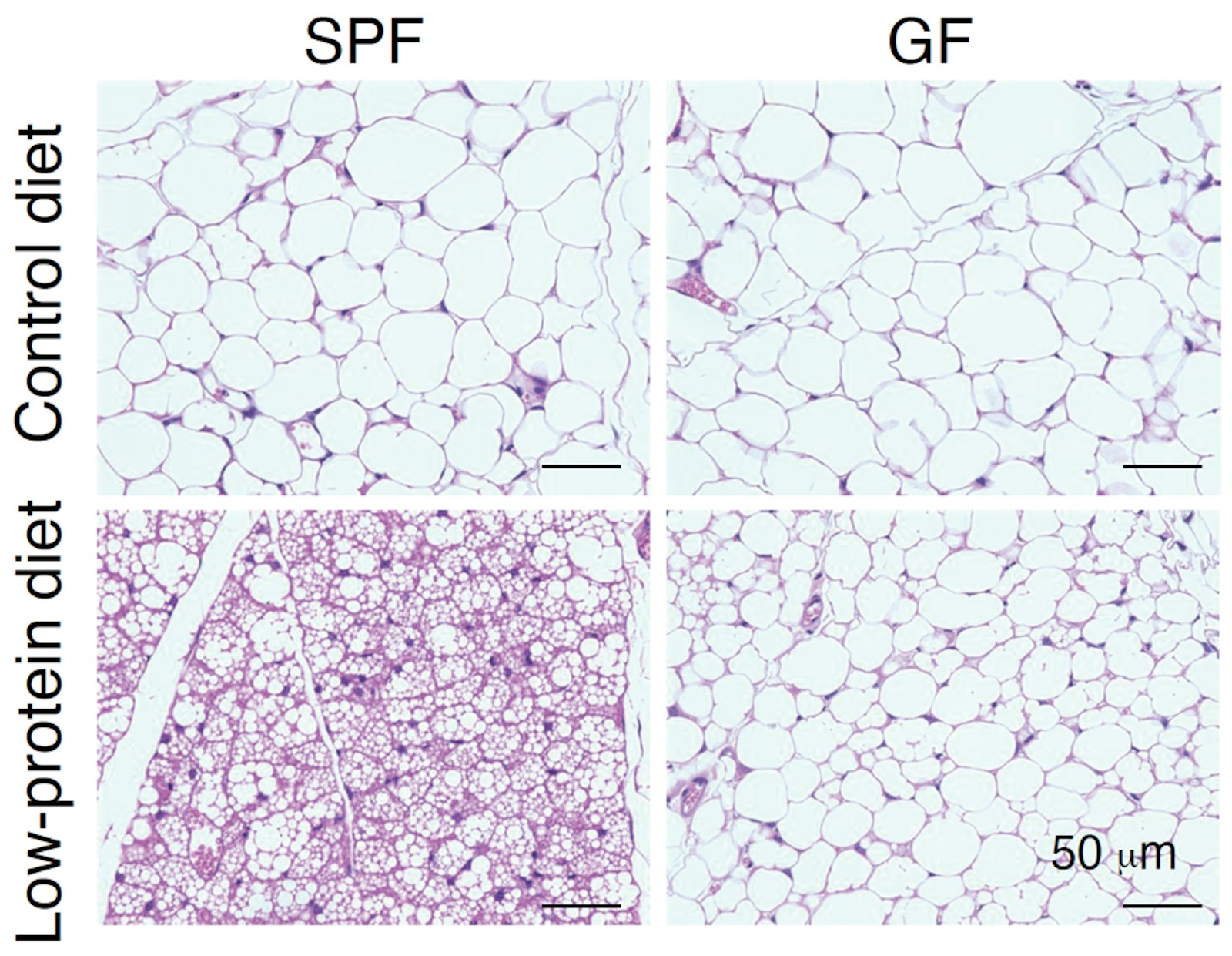
Germ-free (GF) and specific-pathogen-free (SPF) B6 male mice were fed a control or low-protein diet for 6 weeks. Representative H&E-stained inguinal white adipose tissue sections are shown.
Recent Major Publications
Valdés-Mas R, Leshem A, Zheng D, Cohen Y, Kern L, Zmora N, He Y, Katina C, Eliyahu-Miller S, Yosef-Hevroni T, Richman L, Raykhel B, Allswang S, Better R, Shmueli M, Saftien A, Cullin N, Slamovitz F, Ciocan D, Ouyang KS, Mor U, Dori-Bachash M, Molina S, Levin Y, Atarashi K, Jona G, Puschhof J, Harmelin A, Stettner N, Chen M, Suez J, Honda K, Lieb W, Bang C, Kori M, Maharshak N, Merbl Y, Shibolet O, Halpern Z, Shouval DS, Shamir R, Franke A, Abdeen SK, Shapiro H, Savidor A, Elinav E. Metagenome-informed metaproteomics of the human gut microbiome, host, and dietary exposome uncovers signatures of health and inflammatory bowel disease. Cell 188(4), 1062–1083.e36 (2025)
Invited Presentations
Honda K. Mining the gut microbiota to develop rationally designed microbial therapeutics. Xplorer Symposia on Human Microbiome: Multidisciplinary Intersection of Microbiome, Chemistry, and Medicine, Hong Kong, China, February 19–22 (2025)