Lab Activities
Laboratory for Immune Homeostasis
Research Activities

Team Director
Taishin Akiyama
Our laboratory investigates how medullary thymic epithelial cells (mTECs) safeguard immunological self-tolerance by expressing a broad repertoire of tissue-specific antigens (TSAs). A key mediator of this process is the transcription factor AIRE, which enables mTECs to display otherwise hidden self-antigens to developing T cells, thereby eliminating self-reactive clones and preventing autoimmunity. However, AIRE controls only a subset of TSAs, indicating that additional mechanisms must contribute to this process. During the reporting period, we completed two mechanistic studies that clarify how sequential transcriptional programs in mTECs cooperate to prevent autoimmunity.
In the first study, we identified the transcription factor ASCL1 as a previously unrecognized regulator of mTEC chromatin state and gene expression. Through analysis of human thymoma samples and conditional knockout mouse models, we demonstrated that Ascl1 deficiency disrupts both AIRE-dependent and AIRE-independent TSA expression programs. This disruption resulted in multi-organ autoimmunity despite the absence of tumor development. Furthermore, aged mice lacking both Ascl1 and Aire developed extensive thymic B cell follicle structures resembling pathology observed in myasthenia gravis–associated thymoma, underscoring potential clinical relevance. These findings establish ASCL1 as a central determinant of mTEC identity and thymic tolerance.
The second study focused on ETS-family transcription factors EHF and ELF3, which operate in post-AIRE “mimetic” TECs that maintain TSA expression after AIRE is extinguished. We demonstrated that AIRE first primes distal chromatin regions, enabling EHF and ELF3 to sustain expression of AIRE-induced genes in these AIRE-negative descendants. Dual loss of Ehf and Elf3 impaired these gene programs and led to tissue-selective autoimmunity, revealing a transcriptional relay mechanism that maintains tolerance beyond the AIRE-expressing stage.
Together, these studies advance understanding of how mTECs coordinate chromatin remodeling and transcription factor hierarchies to establish central tolerance, with implications for thymus-associated autoimmune diseases in humans.
Detection of autoantibodies in sera from mice deficient in Ascl1 and Aire in thymic epithelial cells
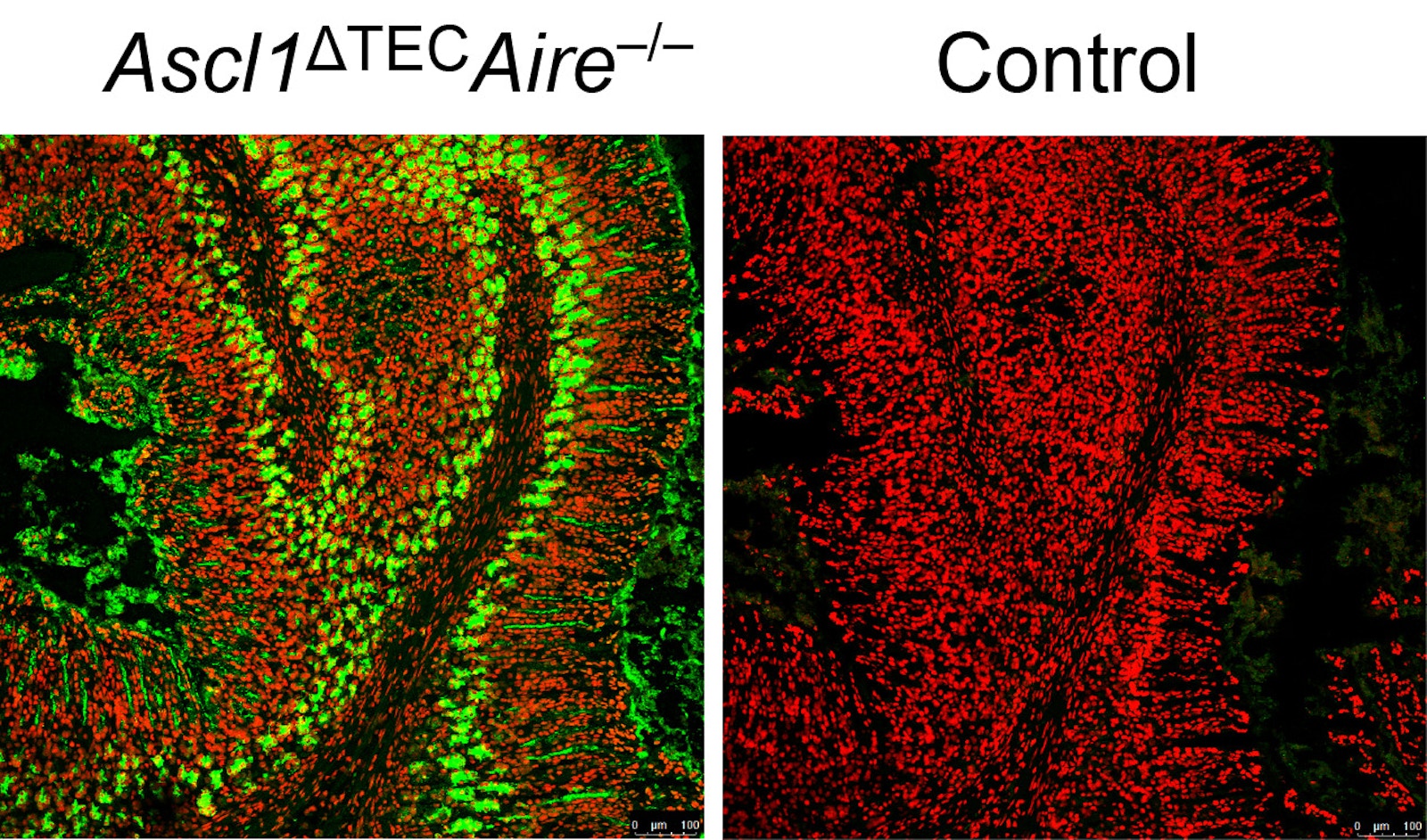
Stomach tissue sections were incubated with sera from mutant (left) and control (right) mice. Green: autoantibody staining; Red: nuclear staining.
Recent Major Publications
Muramatsu W, Maryanovich M, Akiyama T, Karagiannis GS. Thymus ad astra, or spaceflight-induced thymic involution. Front Immunol 15, 1534444 (2025)
Invited Presentations
Akiyama T. "A Snapshot of the Human Blood Immune Landscape During Spaceflight.” Cryopreservation Conference 2025, Tsukuba, Japan, November 11-12 (2025)