Lab Activities
Laboratory for Transcriptional Regulation
Research Activities

Team Director
Ichiro Taniuchi
Primary development of the immune system at an early life stage requires appropriate differentiation and configuration of a variety of immune cells, such as lymphocytes. Decoding from the genome of the developmental program of each immune cell is controlled mainly by the functions of transcription factors. My laboratory has been addressing how transcription factors regulate lymphocyte development.
The quality of T lymphocytes in the thymus monitored through processes known as positive and negative selection, in which environmental cues sensed by T cell antigen receptors (TCR) are coupled to a nuclear program by an as-yet uncharacterized mechanism. My laboratory has been attempting to elucidate this mechanism using the helper versus cytotoxic lineage choice as a model, in which repression of Zbtb7b and Cd4 genes is a key event. The WRPY peptide motif at the C-terminus of the Runx protein is essential for repression of Zbtb7b and Cd4 genes in cytotoxic lineage cells by recruiting TLE/Groucho corepressor family proteins. Our current study revealed that 1) the terminal residue in Runx protein must be tyrosine. 2) the terminal tyrosine in the WRPY motif is phosphorylated, 3) this phosphorylation occurs more abundantly in cytotoxic-lineage cells than in helper-lineage cells and is essential for Runx-TLE interaction. 4) the non-receptor tyrosine kinase Lck is involved in the phosphorylation of the terminal tyrosine. 5) Lck and Zap70 kinases associate with Runx proteins in the cytoplasmic compartment. Thus, we propose a new model in which the phosphorylation status of Runx proteins acts as a key regulator of helper versus cytotoxic lineage decision and serves as a molecular switch linking MHC-specificity with lineage choice in the thymus.
Distinct phosphorylation status at the terminal tyrosine in Runx1 and its association with Lck between CD4 SP and CD8 SP thymocytes A
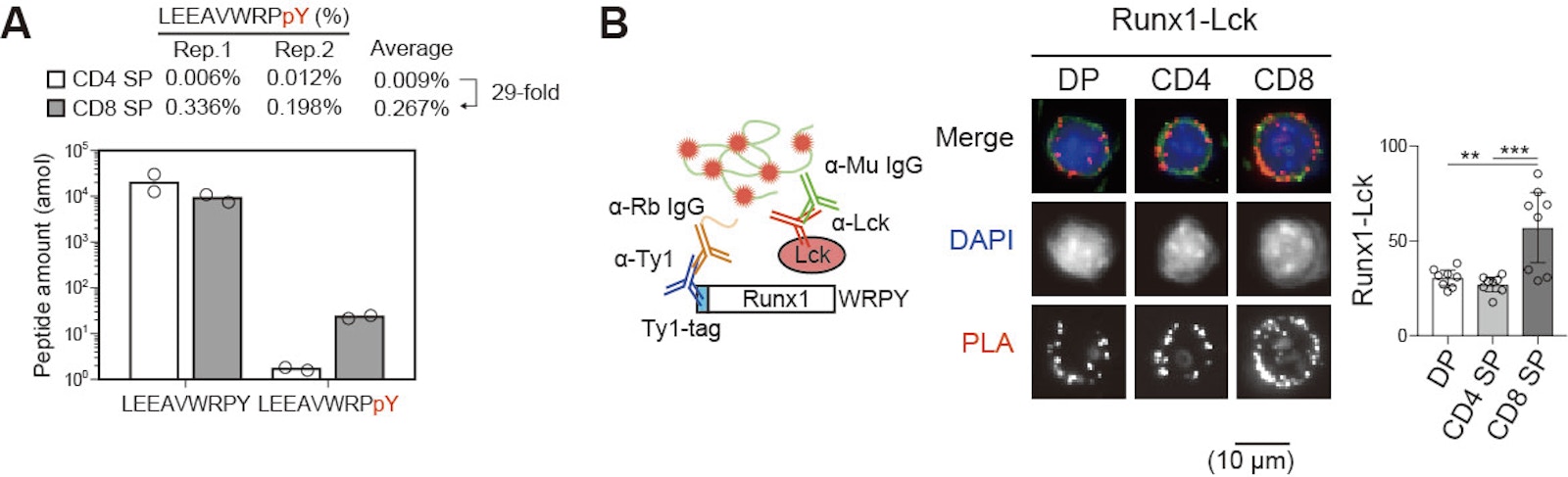
Graph showing quantification of LEEAVWRPY and LEEAVWRPpY peptides in CD4 SP and CD8 SP thymocytes. The ratio of LEEAVWRPpY to LEEAVWRPY was approximately 30-fold higher in CD8 SP than in CD4 SP thymocytes. B. The diagram (left) shows the principle of the in situ Proximity Ligation Assay (PLA). The association of Runx1 with Lck is higher in in CD8 SP thymocytes than in DP and CD4 SP thymocytes.
Recent Major Publications
Yamashita M, An Y, Bhattarai D, Eng-Binas VW, Homvises S, Ismail IH, Jamee M, Jeong DC, McNaughton P, Muktiarti D, Okada S, Van Quang V, Rawat A, Sarmin M, de Silva R, Tenzin P, Try L, Zhong Y, Yu H, Wong JC, Kim Y, Duque JS, Lau YL, Kanegane H. Healthcare resources for inborn errors of immunity in the Asia-Pacific region. Journal of Human Immunity 1(2), e20250023 (2025)
Yamashita M, Morio T. IKZF-associated inborn errors of immunity. Journal of Human Immunity 1(3), e20250063 (2025)
Yamashita M, Kamiya T, Kanegane H. Hematopoietic cell transplantation for leukocyte adhesion deficiency: prevention of graft-versus-host-disease. Expert Rev Hematol 18(11), 883–891 (2025)
Kohwi Y, Wong X, Grange M, Sexton T, Richards HW, Kitagawa Y, Sakaguchi S, Liang Y, Chuong C, Botchkarev VA, Taniuchi I, Reddy KL, Kohwi-Shigematsu T. Genome organization by SATB1 binding to base-unpairing regions (BURs) provides a scaffold for SATB1-regulated gene expression. Elife 14, rp105915 (2025)
Schiele P, Japp AS, Stark R, Sattelberg JJ, Nikolaou C, Kornhuber G, Abbasi P, Ding N, Rosnev S, Meinke S, Mühle K, Loyal L, Braun J, Dingeldey M, Durlanik S, Matzmohr N, Ponikwicka-Tyszko D, Wolczynski S, Rahman NA, Taniuchi I, Schlickeiser S, Giesecke-Thiel C, Blankenstein T, Na I, Thiel A, Frentsch M. CD8+ T cell–derived CD40L mediates noncanonical cytotoxicity in CD40-expressing cancer cells. Sci Adv 11(21), eadr9331 (2025)
Nah GS, Matsuo J, Bahirvani AG, Kimura S, Chin DW, Ng P, Koh CP, Mok MM, Wang CQ, Tergaonkar V, Voon DC, Kohu K, Muroi S, Shi J, Yu S, Hossain Z, Liau W, Phuong CT, Sanda T, Marsman J, Horsfield J, Cheroutre H, Chan YH, Pang B, Chong PY, Soong R, Tenen DG, Maekawa Y, Venkatesh B, Ito Y, Taniuchi I, Osato M. An Upstream RUNX3 Enhancer, eR3 (−18m/−28h), Regulates the Development of Gut‐Associated Anti‐Tumorigenic CD8+CD103+ Cytotoxic T Lymphocytes in Mouse and Human. Genes to Cells 30(6), e70052 (2025)
Metwally H, Elbrashy MM, Kayama H, Okuyama K, Taniuchi I, Takeda K, Kishimoto T. Threonine phosphorylation of STAT1 safeguards gut epithelial integrity and restricts interferon-mediated cytotoxicity. PNAS 122(30), e2511957122 (2025)
Invited Presentations
Taniuchi I. Unraveling of protein interactomes during thymocyte differentiation by a proximity-dependent labeling. ThymUS2025, Hawaii, United States, April 27–May 1 (2025)
Taniuchi I. Roles of Runx3 in gut immune tolerance. Thai Symposium & Workshop on Genomic Medicine, Therapeutics and Health, Bangkok, Thailand, June 9–10 (2025)
Taniuchi I. Roles of Runx tyrosine phosphorylation in thymocyte fate decision. The 54th Annual Meeting of the Japanese Society for Immunology, Himeji, Japan, December 10–12 (2025)