Lab Activities
Laboratory for Retrotransposon Dynamics
Research Activities

Team Director
Tomoichiro Miyoshi
Genomic alterations drive evolution but also pose a threat to genomic integrity, potentially leading to disease-associated genome variations. LINE-1 (L1) and Alu retrotransposons continue to mobilize within genomes via a "copy-and-paste" mechanism known as retrotransposition, causing genomic instability.
While retrotransposons have evolved within host genomes over millions of years, hosts have developed defense mechanisms to suppress their uncontrolled mobilization. However, the specific mechanisms underlying this host-retrotransposon arms race remain unclear. We discovered that the innate immune system, mediated primarily by type I interferons, establishes an extensive defense network that suppresses L1 (Luqman-Fatah A. et al., Nat Commun. 2023). Within this network, we identified human HERC5, an interferon-stimulated gene (ISG) product, as a key suppressor. Human HERC5 specifically suppresses L1 by interacting with ribosomes to inhibit L1 translation, thereby significantly reducing L1 protein levels (Nishimori K. et al., bioRxiv 2025). Intriguingly, while the evolutionarily related human HERC6 lacks this activity, mouse HERC6 possesses it, compensating for the absence of HERC5 in the mouse genome. This highlights the arms race as an ongoing and dynamic evolutionary struggle.
Unlike L1, which encodes its own reverse transcriptase (RT) to retrotranspose autonomously, the non-coding element Alu relies on L1 RT for mobilization. However, defense mechanisms against Alu remain largely unknown, primarily due to the lack of effective reporters to visualize its retrotransposition. To address this, we developed a novel Alu-EGFP reporter to monitor Alu mobilization as a fluorescent protein. Using this reporter, we conducted a genetic screen and successfully identified a distinct set of defense factors separate from those targeting L1.
By elucidating the full landscape of these retrotransposon suppressors, we aim to uncover the comprehensive evolutionary strategy: how hosts suppress retrotransposons while simultaneously harnessing their potential to drive evolution.
The ISG product HERC5 potently inhibits L1 retrotransposition, and a novel EGFP reporter visualizes Alu activity.
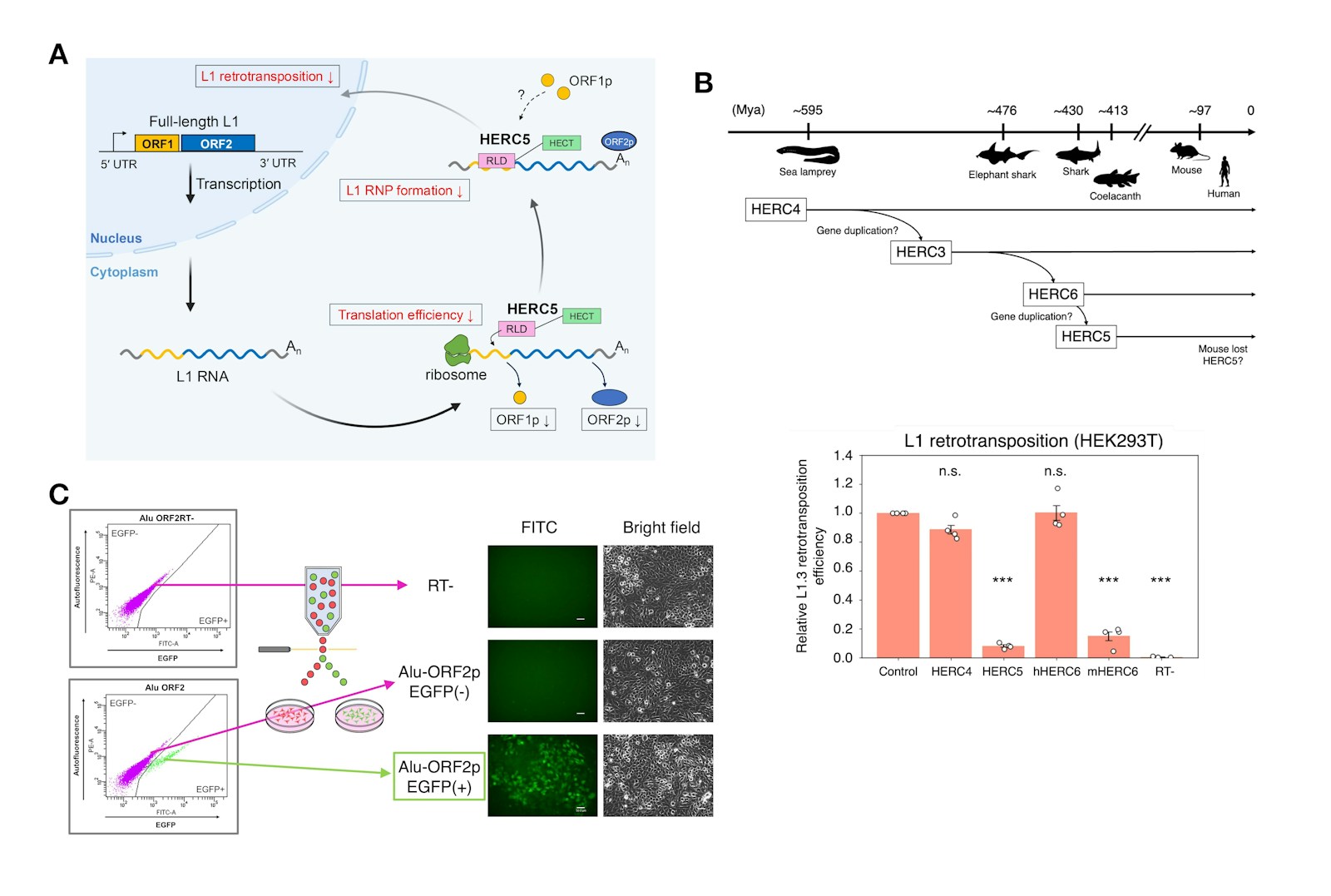
(A) Model of L1 suppression by human HERC5. HERC5 specifically interacts with ribosomes to inhibit L1 translational capacity, thereby blocking L1 retrotransposition (Figure modified from Nishimori K. et al bioRxiv 2025).
(B) Evolutionary divergence in L1 suppression. While human HERC5 suppresses L1, its paralogue HERC6 does not. Conversely, in mice—which lack the HERC5 gene—HERC6 suppresses L1. This contrast exemplifies the dynamic evolutionary arms race between hosts and retrotransposons.
(C) Visualization of Alu mobilization. We developed a novel Alu-EGFP reporter to visualize Alu retrotransposition. This tool facilitates elucidation of defense mechanisms that suppress non-coding Alu elements.
Recent Major Publications
Iwasaki YW, Shoji K, Nakagawa S, Miyoshi T, Tomari Y. Transposon-host arms race: a saga of genome evolution. Trends Genet 41, 369-389 (2025)
Invited Presentations
Amano S, Ohnishi K, Ishikawa F, Miyoshi T. "A novel tool for visualization of Alu retrotransposition." Mobile DNA: Mechanisms and Health Impact. FASEB Science Research Conference, Porto, Portugal, July 20–24 (2025)
Miyoshi T. "Interferon-stimulated genes regulate human L1 retrotransposition." The 48th Annual Meeting of the Japan Neuroscience Society, Niigata, Japan, July 27 (2025)
Nishimori K, Luqman-Fatah A, Watanabe Y, Ishikawa F, Miyoshi T. "Interferon-stimulated genes regulate human L1 retrotransposition." The 97th Annual Meeting of the Genetics Society of Japan, Kobe, Japan, September 11 (2025)
Fumoto Y, Ahmad L, Miyoshi T. "Mechanisms of human retrotransposon inhibition during cellular senescence." The 48th Annual Meeting of the Molecular Biology Society of Japan, Yokohama, Japan, December 3 (2025)