Lab Activities
Precision Immune Regulation RIKEN ECL Research Unit
Research Activities

ECL Unit Leader
Naoko Satoh-Takayama
The aim of our research is to understand the cell-to-cell interactions that regulate responses during inflammation and disease induction, with a particular focus on innate lymphoid cells (ILCs). ILCs are the counterparts of helper T cells and are play roles in the direct or indirect regulation of many diseases; however, the mechanisms by which ILCs coordinate immune regulation during disease remains incompletely understood. To address this issue, we analyze spatial transcriptomic analysis and single-cell RNAseq data obtained from human tissue of patients with Crohn’s disease or eosinophilic gastrointestinal disease. In parallel, we employ disease models and genetically modified mice to further dissect the underlying immune mechanisms.
Recently, we identified a unique function of adipose tissue-resident ILC1 in the regulation of acute peritonitis. In addition, through the collaboration with the Center for Brain Science, we successfully isolate a commensal bacterium, which can colonize in the highly acidic environment of stomach. We demonstrated a novel regulatory mechanism in which specific commensal bacteria activate group 2 innate lymphoid cells (ILC2) via fibroblasts in the stomach, contributing to host protection against H. pylori. Furthermore, in collaboration with Tsumura Co. Ltd., we also continue to investigate immunity of mice treated with the traditional Japanese Kampo medicines.
Regarding international collaborations, two joint research projects are currently ongoing: (1) “Analysis of type 2 diabetes, diet-induced obesity, and gut microbe” conducted in collaboration with the Institut Pasteur New Caledonia, through the RIKEN-Pasteur Institute network. (2) “Immune cell analysis using advanced imaging technology, ‘Raman microscope”, a joint project with Dr. Hamideh Salehi, the University of Strasbourg (UNISTRA) and Dr. Michalina Gora-Gioux, Wyss Geneva.
Involvement of ILCs in defense against H. pylori in the stomach
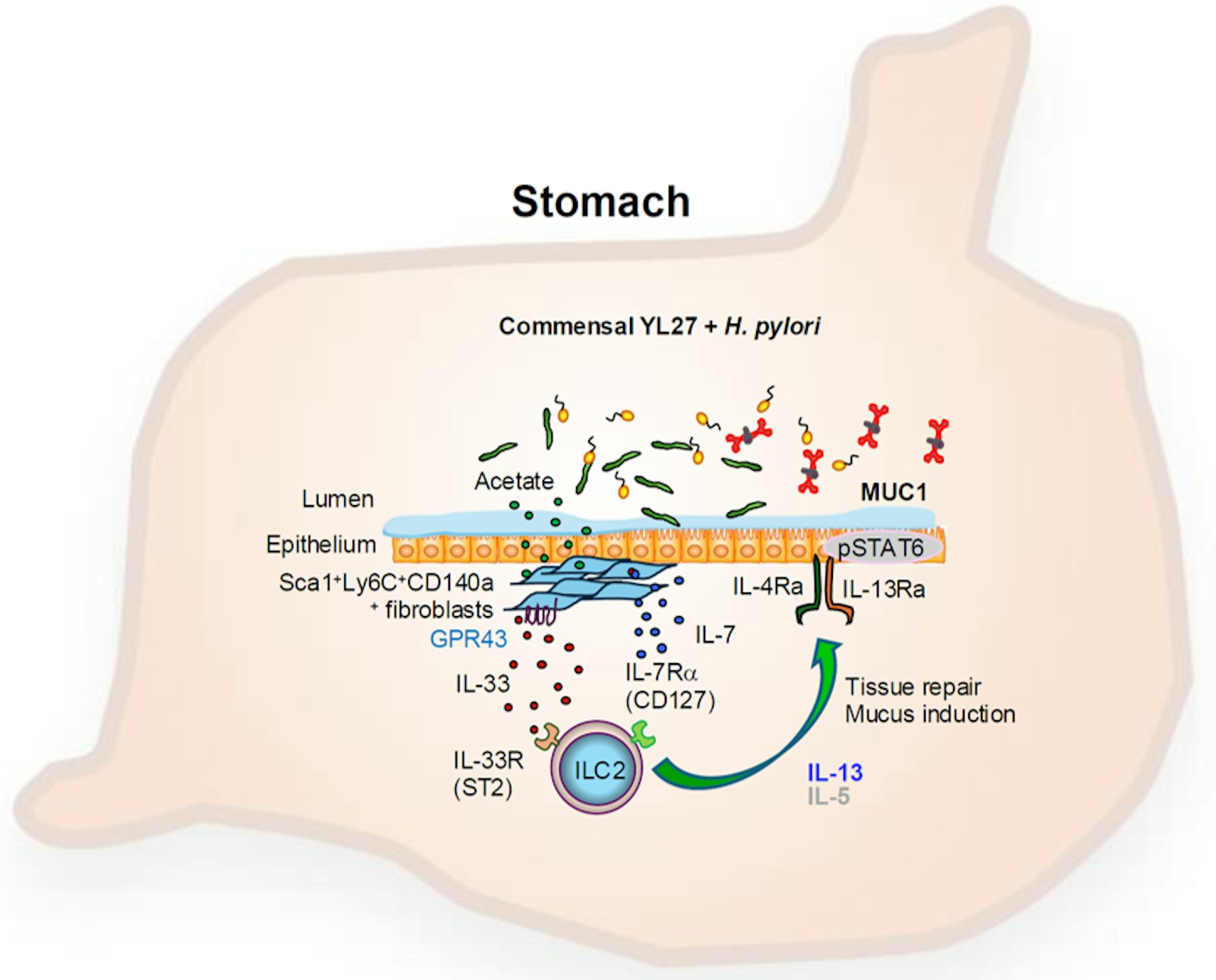
A gastric commensal bacterium (YL27) activates fibroblast–ILC2 signaling via acetate–GPR43–IL-33, inducing epithelial Muc1 expression and protecting against Helicobacter pylori infection.
Recent Major Publications
Wang L, He D, Satoh-Takayama N, Zheng C, Xing J. Regulation of antiviral and antimicrobial innate immunity and immune evasion. Cell Mol Life Sci 82(1), 326 (2025)
Yan Y, Satoh-Takayama N. New perspectives on gastric disorders: the relationship between innate lymphoid cells and microbes in the stomach. Cell Mol Life Sci 82(1), 113 (2025)
Ito M, Yan Y, Satoh-Takayama N. Functional diversity and tissue-specific regulation of Group 2 innate lymphoid cells in barrier immunity. Int Immunol, dxaf062 (2025)
Invited Presentations
Satoh-Takayama N. Between lab and life: Seeking balance in Science and Career. RIKEN BDR Mirai Alliance, Kobe, Japan, November 17 (2025)
Satoh-Takayama N. Deciphering disease pathogenesis via spatial profiling of immune cells. AMED International Symposium 2025 The Early-Life Nexus: Molecular Keys to Health and Disease, Tokyo, Japan, November 10 (2025)
Satoh-Takayama N. Innate lymphoid cells in tumor immunity and therapeutic potential. The 84th Annual Meeting of the Japanese Center Association, Kanazawa, Japan. September 25 (2025)