Lab Activities
Laboratory for Skin Homeostasis
Research Activities

Team Director
Masayuki Amagai
The epidermis, the outer layer of the skin, has two sets of protective barriers: the stratum corneum (SC) and tight junctions (TJs). These two barriers prevent the easy penetration of external antigens into the body. The SC is unique, as it can maintain its homeostasis, even if it consists of dead keratinocytes (corneocytes). In addition, SC is known as a habitat for skin microbiota, and alteration of skin microbiota composition, termed dysbiosis, has been associated with chronic inflammatory conditions, such as atopic dermatitis (AD).
Our group aims to elucidate (1) how SC homeostasis is established and maintained under normal conditions and disrupted during inflammation, and (2) how interactions between skin microbiota and the host epidermis worsens the inflammatory state. To address these questions, we employ an integrative experimental approach that combines molecular biology, intravital live imaging, microbiology, and data-driven clinical research.
Using intravital pH imaging of mouse SC, we demonstrated that corneocytes undergo differentiation and develop three-tiered zonationin the SC: the lower-moderately acidic (pH 6.0), middle-acidic (pH 5.4), and upper-nearly neutral (pH 6.7) zones. Intriguingly, the upper SC-pH zone possesses acclimation capacity, changing its pH according to the external environment. Furthermore, we found that the bottom of the upper-nearly neutral SC-pH zone acts as a niche for S. aureus colonization and that the middle SC-pH zone serves as a protective barrier against S. aureus. In parallel, we established long-term continuous measurement of skin electrical resistance using nanomesh electrodes with excellent elasticity, durability, and air permeability, which enables us to measure dynamic change patterns of SC barrier functions of the mouse and human skin. By integrating these experimntal tools and going back and forth between our essential science findings in mice with large-scale clinical multi-omics analyses−including gene expression profiling, mutational analysis, and microbiota characterization)−in patients with inflammatory skin dieases, we aim to develop more targeted therapeutic approaches with fewer side effects for conditions such as AD.
Comprehensive analysis of skin barrier homeostasis
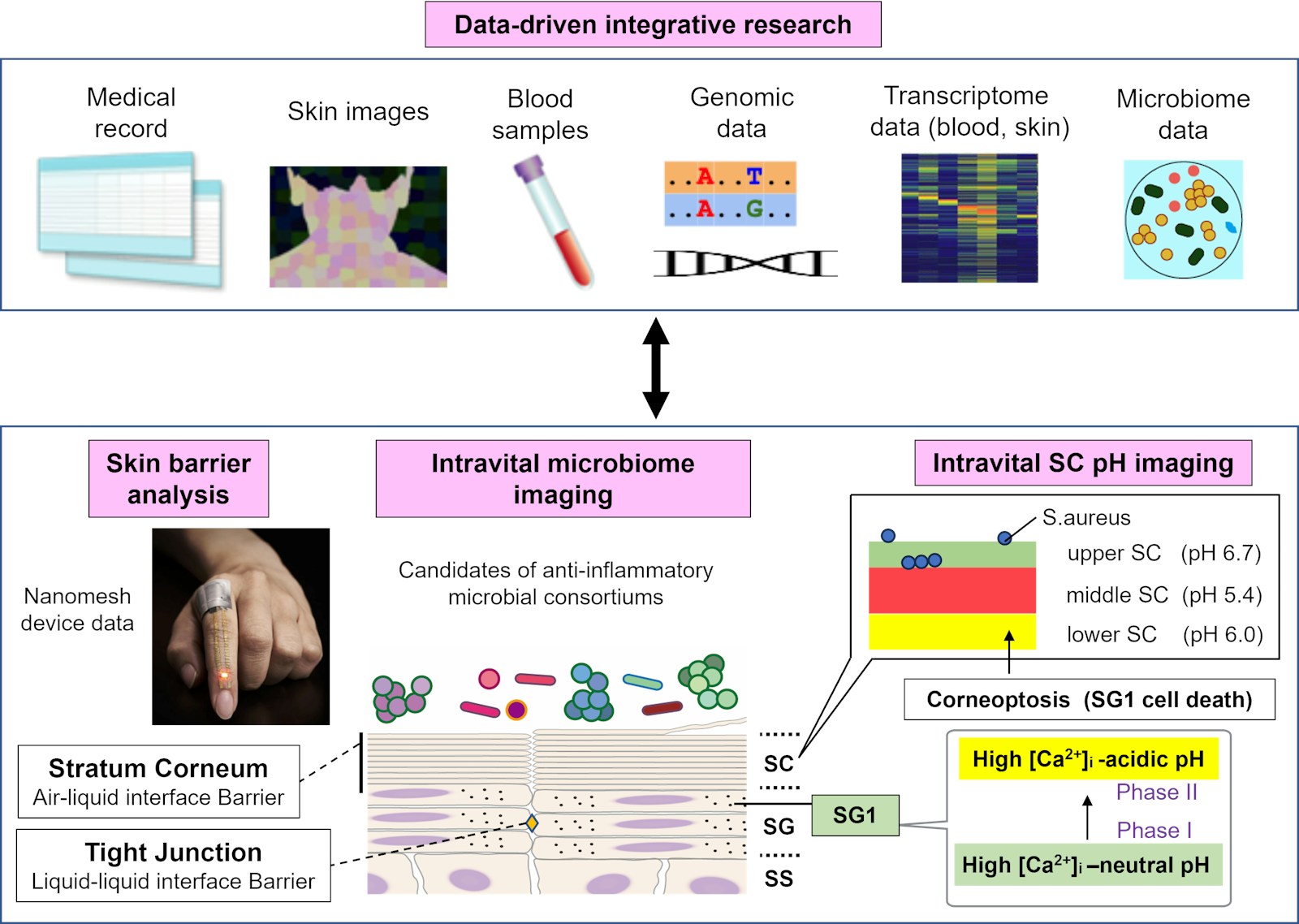
Our team investigates skin barrier homeostasis by focusing on the stratum corneum (SC), tight junctions (TJs), and SG1 cells. We established a live-imaging platform to analyze unique SG1 cell death, termed corneoptosis, and pH dynamics within the SC. Using an optimized plasmid injection method in mice, we demonstrated that corneoptosis proceeds through two distinct phases. We further identified a three-stepwise SC-pH zonation, in which the middle acidic zone functions as a protective barrier against S.aureus. In parallel, we are exploring host–microbe interactions and intracellular pH regulation in inflammatory skin conditions. By integrating these experimental approaches with large-scale clinical multi-omics analyses, we aim to identify novel therapeutic targets with fewer side effects for inflammatory skin diseases.
Recent Major Publications
Fukushima-Nomura A, Kawasaki H, Yashiro K, Obata S, Tanese K, Ebihara T, Saeki H, Etoh T, Hasegawa T, Yazaki J, Seita J, Ohara O, Sekita A, Miyai T, Ashizaki K, Koseki H, Sakurada K, Kawakami E, Amagai M. An unbiased tissue transcriptome analysis identifies potential markers for skin phenotypes and therapeutic responses in atopic dermatitis. Nat Commun 16(1), 4981 (2025)
Mukai M, Takahashi H, Kubo Y, Asahina Y, Iriki H, Nomura H, Kamata A, Ito H, Kurebayashi Y, Yamagami J, Mikami N, Sakaguchi S, Amagai M. Conversion of pathogenic T cells into functionally stabilized Treg cells for antigen-specific immunosuppression in pemphigus vulgaris. Sci Transl Med 17(821), eadq9913 (2025)
Takahashi H, Fukuda K, Ito Y, Amagai M. Antigen-specific immune responses and microbiota interactions in skin: Insights into autoimmune skin diseases and emerging therapeutic strategies. J Allergy Clin Immunol 156(3), 557–567 (2025)
Fukushima-Nomura A, Kawasaki H, Amagai M. Integrative omics redefining allergy mechanisms and precision medicine. Allergol Intl 74(4), 514–524 (2025)
Fukuda K, Ito Y, Amagai M. The Acid Mantle Reimagined: Unveiling the Role of Stepwise pH Zonation in the Stratum Corneum. J Invest Dermatol 145(9), 2147–2152 (2025)
Fukuda K, Ito Y, Amagai M. Barrier Integrity and Immunity: Exploring the Cutaneous Front Line in Health and Disease. Annu Rev Immunol 43(1), 219–252 (2025)
Invited Presentations
Amagai M. Converting Pathogenic Autoimmune T Cells into Antigen-Specific Regulartory T Cells as a Novel Therapeutic Strategy for Pemphigus. Montagna Symposium on the Biology of Skin - Mechanistic Insights into Emerging Therapeutic Platforms, Oregon, United States, October 16–20 (2025)
Amagai M. From tolerance to therapy: Harnessing inducible regulatory T-cells for precision control of autoimmune disease. 34th Congress of European Academy of Dermatology and Venereology, Paris, France, September 17–20 (2025)
Amagai M. Decoding the Skin Barrier: Insights into Tight Junctions, Stratum Corneum, and Immune Modulation. Gordon Research Conference - Epithelial Differentiation and Keratinization, Ventura, United States, June 1–6 (2025)
Amagai M. Antigen-specific iTreg therapy for pemphigus. Vitiligo Center of Research Translation 2025 Research Symposium, Worcester, United States, April 10–11 (2025)
Amagai M. Decoding the Homeostatic Mechanisms of Tight Junctions and Stratum Corneum In the Skin. 32nd KSID Annual Meeting, Seoul, Korea, March 28–29 (2025)