Lab Activities
Laboratory for Epigenome Inheritance
Research Activities

Team Director
Azusa Inoue
Genetic information is passed on to the offspring through oocytes and sperms (gametes) and greatly contributes to their phenotypes and disease susceptibility. Recent studies have revealed that the parental genomes are accompanied by epigenetic information that is also passed on to the next generation. Defects in epigenetic inheritance lead to various phenotypes in prenatal and postnatal growth in mice. This raises the possibility that epigenetic changes in gametes, possibly induced by the parental environment, might influence disease susceptibility in the offspring via an epigenetic inheritance cascade.
Our laboratory is studying the mechanisms and functions of intergenerational inheritance of histone post-translational modifications (hPTMs) in mammals. Our specific aims are as follows (Figure): (1) To understand the molecular basis and functions of hPTM establishment and inheritance during gametogenesis and early embryogenesis. (2) To link hPTM inheritance to the pre- and peri-conceptional parental environment; (3) To understand how the parental environment might influence disease susceptibility in the offspring. To address these questions, we integrate cutting-edge low-input epigenomic technologies, reproductive engineering techniques, and various genome/epigenome-modified mouse models. This study will not only reveal how parental lifestyle influences epigenetic memory and gene expression in germ cells but will also call for an evaluation of the contribution of epigenetic mechanisms to hereditary diseases. It will provide a basis for new approaches to preventive and predictive medicine.
Parental programming hypothesis
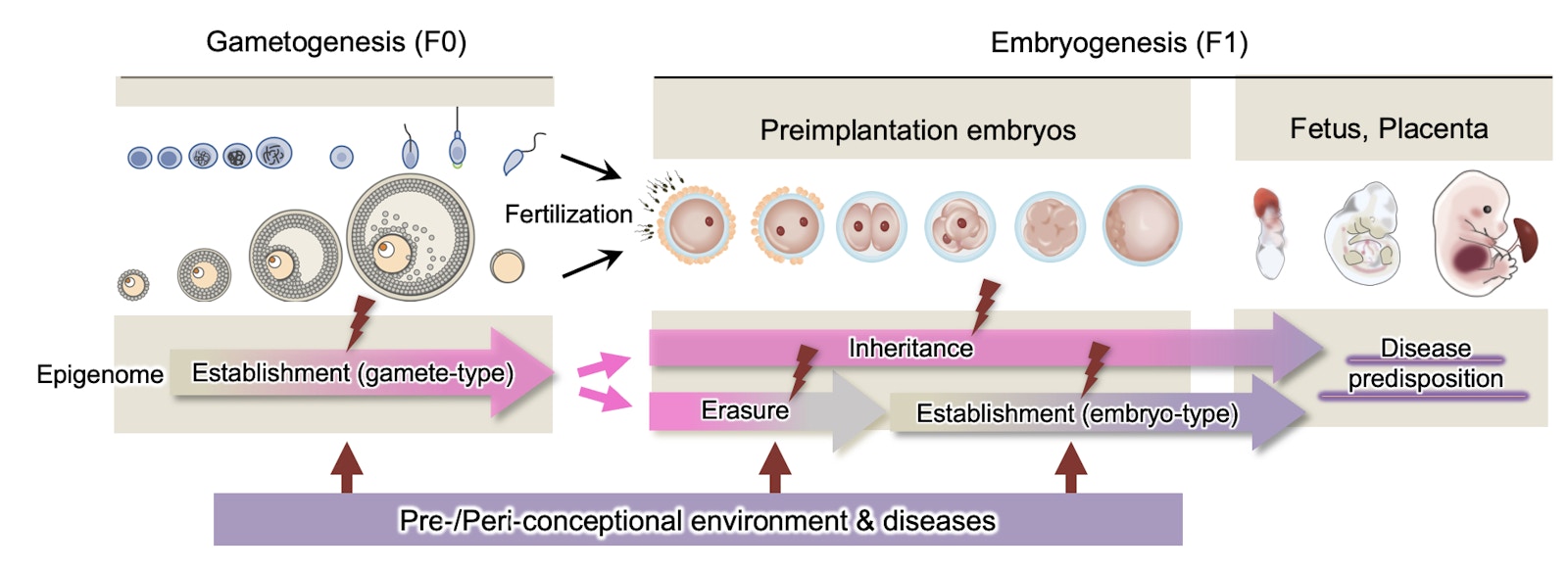
Parental epigenomes are established during gametogenesis, and partially inherited by embryos to regulate gene expression in the fetus and placenta. Our lab investigates the mechanisms and functions of histone modification inheritance and the effects of the pre-/peri-conceptional parental environment on epigenetic inheritance and disease predisposition in the offspring.
Recent Major Publications
Mei H, Hayashi R, Kozuka C, Kumon M, Koseki H, Inoue A. H2A.Z reinforces maternal H3K4me3 formation and is essential for meiotic progression in mouse oocytes. Nat Struct Mol Biol 32(10), 1883–1893 (2025)
Horii T, Morita S, Hino S, Hino Y, Fukushima HS, Kobayashi R, Kimura M, Nakao M, Mizukami Y, Inoue A, Hatada I. Germline epigenome editing identifies H3K9me3 as a mediator of intergenerational DNA methylation recovery in mice. Nat Commun 16(1), 11200 (2025)
Kozuka C. Genome-Independent Transmission of Obesity and Type 2 Diabetes Risk: From Gametes to Early-Life Programming. J Biochem, mvaf070 (2025)
Nosaka Y, Nagano M, Yabuta Y, Nakakita B, Nagaoka SI, Okamoto I, Sasada H, Mizuta K, Umemura F, Kuma H, Okochi Y, Katou Y, de Massy B, Inoue A, Horie A, Mandai M, Ohta H, Saitou M. Generation of germinal-vesicle oocytes from mouse embryonic stem cells under an ovarian soma-free condition. Dev Cell 60(21), 2976–2994.e13 (2025)
Takao T, Matsui A, Kikutake C, Kan-o K, Inoue A, Suyama M, Okamoto I, Ito M. Maternal asthma imprints fetal lung ILC2s via glucocorticoid signaling leading to worsened allergic airway inflammation in murine adult offspring. Nat Commun 16(1), 631 (2025)
Hiroto S Fukushima, Hiroyuki Takeda. Coordinated action of multiple active histone modifications shapes the zygotic genome activation in teleost embryos. Nat Comm 16(1), (2025)
Invited Presentations
Inoue A. Polycomb regulation in oocytes and early embryos.. Symposium for epigenetics of early mouse development., Germany, April 24–24 (2025)
Inoue A. Non-canonical imprinting: “Continuity” of histone modification across generations.. The 53rd Naito Conference –Germ Cell Biology, uncovering mysteries of continuity and discontinuity–, Sapporo, Japan, July 8–11 (2025)
Inoue A. Establishment of non-canonical imprinting through Polycomb–Trithorax counteraction in oocytes. The 98th Annual Meeting of the Japanese Biochemical Society, Kyoto, Japan, November 3–5 (2025)
Inoue A. Facultative heterochromatin formation in oocytes and early embryos.. Gordon Research Conference –Germinal Stem Cell Biology–, Barcelona, Spain, April 27–May 2 (2025)
Inoue A. De novo establishment of heterochromatin during early development.. International Symposium: Genome Architecture and Function, Japan, November 25–26 (2025)
Mei H, Inoue A. KDM6 promotes maternal genome activation. Chromatin and transcription in germ cells and early embryos 2025, Yokohama, Japan, November 6–6 (2025)
Matsuwaka M, Inoue A. De novo heterochromatin establishment in early mouse embryos. Chromatin and transcription in germ cells and early embryos 2025, Yokohama, Japan, November 6–6 (2025)
Kozuka C. Maternal environment and predisposition to obesity and diabetes. The 98th Annual Meeting of the Japanese Biochemical Society, Kyoto, Japan, November 3–5 (2025)
Hiroto S Fukushima. Function and regulation of active histone modifications during early fish embryogenesis. Chromatin and transcription in germ cells and early embryos, Japan, November 6–6 (2025)