Lab Activities
Laboratory for Protein Functional and Structural Biology
Research Activities
Team Director
Mikako Shirouzu
Our team aims to establish a structural analysis platform that supports life innovation and drug discovery by advancing sample preparation methods for challenging targets, including membrane proteins and biomolecular complexes, and cryo-EM–based structural analysis.
DOCK family proteins function as guanine nucleotide exchange factors that activate the small G proteins Rac1 and/or Cdc42, key regulators of the actin cytoskeleton. Although plasma membrane association is essential for this activation, its molecular mechanism has remained unclear. We developed a cryo-EM technique in which target proteins were reconstituted on lipid membranes attached to cryo-EM grids. Using this method, we determined the cryo-EM structure of a membrane-bound complex composed of DOCK5 and its binding partner ELMO1, in association with the upstream signaling molecule RhoG and the substrate Rac1 (Figure A). Structural and functional analyses revealed that membrane binding induces large conformational changes in DOCK5 and ELMO1, leading to a novel interaction between ELMO1 and the plasma membrane that is critical for actin cytoskeleton regulation and cell motility.
Microbial rhodopsins consist of seven transmembrane helices bound to retinal. Light absorption by retinal drives ion transport (H⁺, Cl⁻, or Na⁺), converting light into chemical energy. Recently, the most widespread rhodopsin, proton-pumping proteorhodopsin (PR), was shown to bind a carotenoid that acts as a light-harvesting antenna by transferring excitation energy to retinal, expanding the usable spectral range and boosting efficiency. We analyzed two rhodopsins from the marine bacterium Nonlabens marinus S1-08ᵀ: a PR variant (NM-R1) and a chloride pump (NM-R3), both of which were found to bind carotenoids. NM-R1 was expressed in E. coli and NM-R3 was produced in an E. coli cell-free system, followed by reconstitution with carotenoids. Cryo-EM structures revealed that NM-R1 binds carotenoids laterally, whereas NM-R3 exhibits a distinct vertical binding mode (Figure B–D).
Cryo-EM structures of membrane-associated signaling complexes and membrane proteins
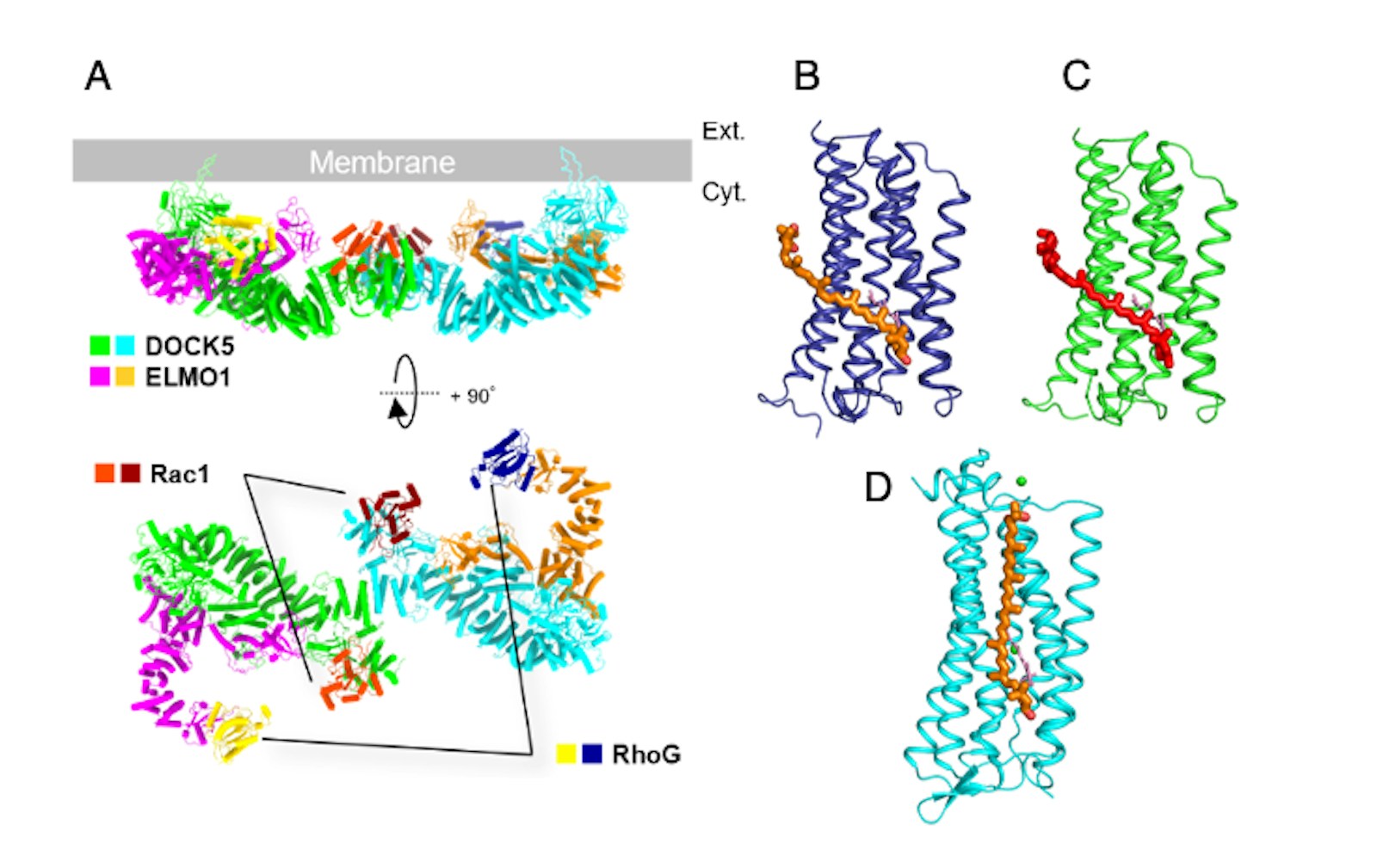
(A) Cryo-EM structure of the extended-open form of the DOCK5•ELMO1 complex associated with RhoG and Rac1 on lipid membranes.
(B, C) Cryo-EM structures of NM-R1 bound to myxol (B) or zeaxanthin (C). (D) Cryo-EM structure of NM-R3 bound to myxol.
Recent Major Publications
Fujiwara T, Hosaka T, Hasegawa-Takano M, Nishimura Y, Tominaga K, Mori K, Nishino S, Takahashi Y, Uchikubo-Kamo T, Hanada K, Maoka T, Takaichi S, Inoue K, Shirouzu M, Yoshizawa S. Carotenoids bind rhodopsins and act as photocycle-accelerating pigments in marine Bacteroidota. Nat Microbiol 10, 2603–2615 (2025)
Shinoda T, Katsura K, Ishizuka-Katsura Y, Hanada K, Yonemochi M, Miyamoto Y, Kukimoto-Niino M, Yamauchi J, Shirouzu M. Conformational alteration of DOCK5•ELMO1 signalosome on lipid membrane. Commun Biol 8, 1523 (2025)
Ishiguro K, Midorikawa K, Shigi N, Kimura S, Liiv A, Yokoyama T, Ito T, Shirouzu M, Remme J, Miyauchi K, Suzuki T. Hypoxia-induced ribosomal RNA modifications in the peptidyl-transferase center contribute to anaerobic growth of bacteria. Mol Cell 86, 78–96 (2025)
Murata Y, Fujisawa M, Watanabe T, Matsubara S, Takase Y, Takahashi T, Namba K, Yamagata A, Terada T. An amino acid transporter in the small intestine mediates basolateral efflux of plant-derived nicotianamine iron complexes. J Biol Chem 301, 110731 (2025)
Hori T, Katsura K, Miyamoto-Kohno S, Uchikubo-Kamo T, Yonemochi M, Shirouzu M. Structural insights into endogenous agonist selectivity of aminergic receptors from the octopamine β2 receptor. PNAS Nexus 4, pgaf376 (2025)
Fukai YT, Kujirai T, Wakamori M, Kanamura S, Yamauchi L, Zeraati S, Morita S, Tanegashima C, Kadota M, Shirouzu M, Kurumizaka H, Umehara T, Kawaguchi K. Gene-scale in vitro reconstitution reveals histone acetylation directly controls chromatin architecture. Sci Adv 11, eadx9282 (2025)
Dang W, Muto Y, He F, Takahashi M, Tsuda K, Nagata T, Tanaka A, Kobayashi N, Kigawa T, Güntert P, Shirouzu M, Yokoyama S, Kuwasako K. 1H, 13C, and 15N resonance assignments and solution structure of the CID domain of SR-related- and CTD-associated factor 8 (SCAF8). Biomol NMR Assign 20, 7 (2025)
Shikimachi R, Matsuzawa S, Onoda H, Konuma T, Yamagata A, Shirouzu M, Yamaguchi K, Arita K. Structural basis for E3 ubiquitin ligase UHRF1 binding to nucleosome core particle and histone H3 ubiquitination. J Biol Chem 301, 110894 (2025)
Goto-Ito S, Kato S, Takahashi M, Sakamoto A, Yamagata A, Lee Y, Ehara H, Sato M, Toyooka K, Ohkuma M, Ito T. Structural analysis of a symbiotic system involving a Nanobdellati archaeon by cryo-electron tomography. J Biochem 179, 21–30 (2025)
Harada M, Matsumoto T, Yamamoto M, Goda J, Idei A, Ohtaki K, Kojima N, Yoneda N, Miyauchi K, Katsura K, Ikeda M, Hanada K, Ishizuka-Katsura Y, Hosaka T, Hisano T, Kaizuka T, Yamamoto T, Matsuda M, Nakayama M, Sugimoto-Ishige A, Sakuma M, Hashimoto R, Takayama K, Nakayama M, Nguyen CT, Ishigaki H, Itoh Y, Hashizume Y, Yoshida M, Kawaguchi Y, Takeda M, Koseki H, Shirouzu M, Inoue J, Saito T. Monoclonal antibodies against human TMPRSS2 prevent infection by any SARS-CoV-2 variant. iScience 28, 113424 (2025)
Ishiguro K, Fujimura A, Shirouzu M. Structural insights into tRNA recognition of the human FTSJ1-THADA complex. Commun Biol 8, 893 (2025)
Invited Presentations
Shirouzu M. Conformational Changing of DOCK Protein Complexes on Lipid Membrane. the SMART Symposium: 2025 Frontier in Computational Chemistry, Biophysics, and Biological Sciences, Shenzhen, China, Oct (2025)
Niino M. Elucidation of the regulation of the Rac1/Cdc42 guanine nucleotide exchange factor DOCK6. The 63rd Annual Meeting of the Biophysical Society of Japan, Nara, Japan, Sep (2025)