Lab Activities
Laboratory for Bottom-up Cell Biology
Research Activities
Team Director
Makito Miyazaki
Cells sustain life through the dynamic assembly and disassembly of diverse subcellular structures, each built from molecular components and endowed with distinct biological functions. A central and non-trivial question in biology is how microscopic molecules sense the vast intracellular space and self-organize, with precise spatial and temporal control, into micrometer-scale structures that regulate cellular functions. Addressing this question requires an integrated understanding of biochemical reactions and physical interactions across multiple length and time scales.
Our laboratory aims to uncover the design principles governing the emergence of cell-scale ordered structures and biological functions from molecular components. Using the cytoskeleton as a model system, we investigate the biochemical and physical conditions under which cytoskeletal architectures and associated functions can be reconstituted in artificial cells. By combining in vitro reconstitution, advanced microscopy, and physical modeling, we seek to bridge molecular-level mechanisms and cellular-scale behaviors.
Recently, we established a novel optogenetic tool that directly manipulates actin network assembly by activating the Arp2/3 complex, and demonstrated that actin network density regulates the activities of actin-binding proteins. We also determined the kinetic scheme of myosin activation through phosphorylation by ZIP kinase, one of the major myosin kinases, providing quantitative insight into the regulation of actomyosin contractility. In addition, we quantitatively analyzed the effects of lipid composition on the production yield of cell-sized liposomes generated using the inverted emulsion technique, which has been extensively utilized to create artificial cells. Building on these findings, we successfully reconstituted an active actin cortex inside cell-sized liposomes that exhibit membrane protrusions known as blebs, providing physical insights into amoeboid cell migration. These studies advance our understanding of how the actin cytoskeleton regulates cellular functions and contribute to the development of experimental platforms and technologies in synthetic biology.
Concept of the bottom-up strategy.
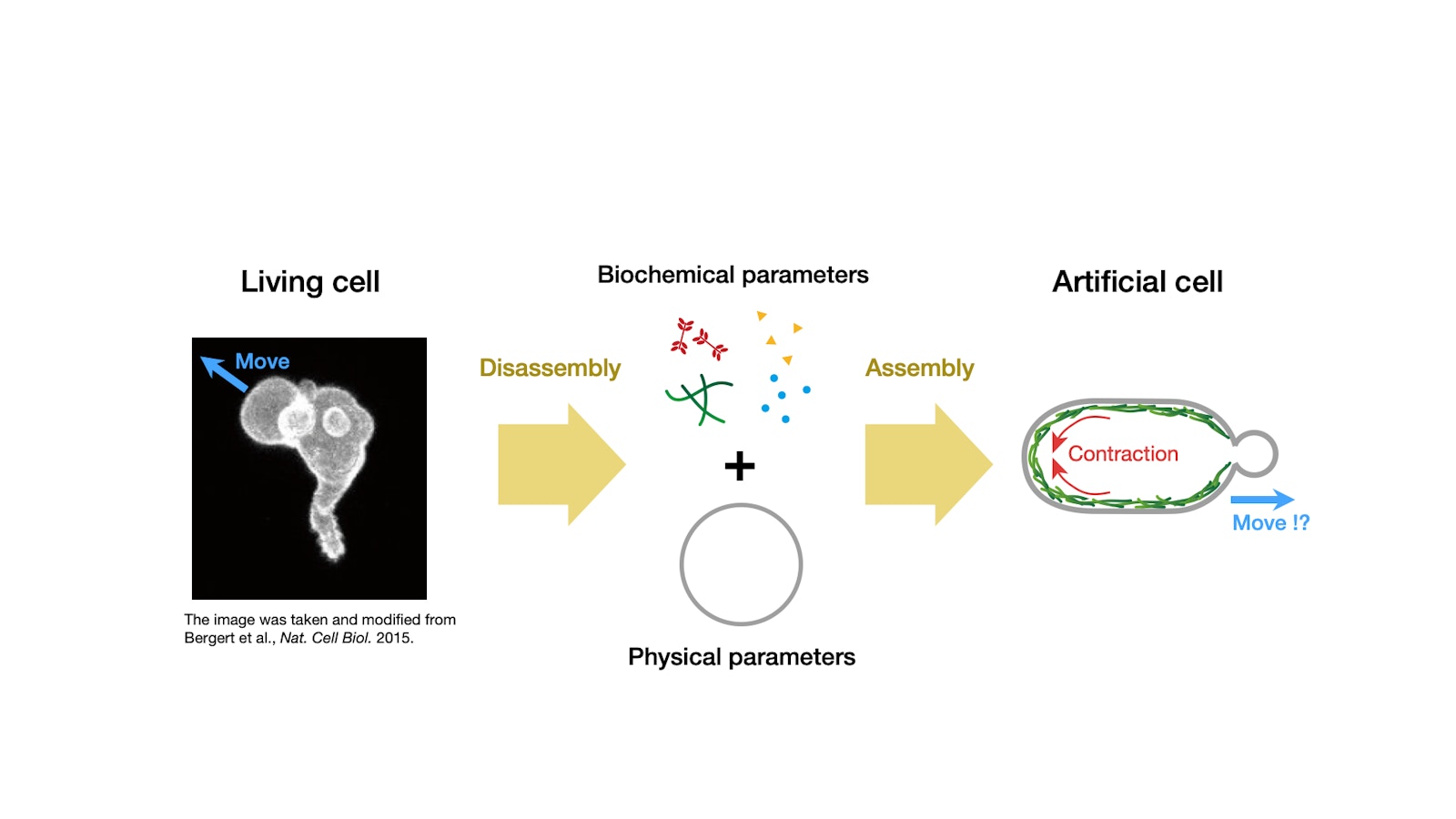
Illustration of our bottom-up approach to understanding how cells self-organize from molecular components. Living cells are disassembled into their constituent parts, and selected essential components are recombined to reconstruct biological phenomena of interest. By systematically controlling biochemical and physical conditions, we aim to reconstitute ordered structures and their associated functions within artificial cells.
Recent Major Publications
Sakata H, Matsubara H, Gomi K, Miyazaki M. Lipid composition effects on the number and size of liposomes formed by the inverted emulsion method. Biophys J 125, 731-744 (2025)
Sasmal P, Miyazaki M, Carlier-Grynkorn F, Tran PT. Chimeras of kinesin-6 and kinesin-14 reveal head-neck-tail domain functions and dysfunctions that lead to aneuploidy in fission yeast. Curr Biol 36, 415-425.e5. (2025)
Yamaguchi M, Nakagawa R, Tran LT, Shimizu Y, Miyazaki M. Kinetic scheme of myosin phosphorylation by ZIP kinase. Biochemistry 64, 4805–4817 (2025)
Negi A, Sakamoto R, Ienaga R, Miyazaki M, Maeda YT. Myosin-driven advection and actin reorganization control the geometry of confined actomyosin gel. Nano Lett 25, 17979–17987 (2025)
Noji M, Sugita Y, Yamazaki Y, Miyazaki M, Suzuki Y. Protein design of two-component tubular assemblies similar to cytoskeletons. Nat Commun 16, 6738 (2025)
Yamamoto K, Miyazaki M. Optogenetic actin network assembly on lipid bilayer uncovers the network density-dependent functions of actin-binding proteins. Nat Commun 16, 7583 (2025)
Invited Presentations
Miyazaki M. Optogenetic control of actin network assembly reveals density-dependent functions of actin binding proteins. The 63rd Annual Meeting of the Biophysical Society of Japan, Nara, Japan, Sep (2025)
Miyazaki M. Optogenetic control of actin cytoskeletal dynamics in reconstituted systems. International Symposium on Cellular Structural Biology, Tokyo, Japan, Sep (2025)
Miyazaki M. Spatiotemporal control of actin network assembly in a reconstituted system. ACMB-JSMB2025, Kyoto, Japan, Jul (2025)