Lab Activities
Laboratory for Immunological Memory
Research Activities
Team Director
Shiki Takamura
CD8⁺ T cells play a central role in antitumor immunity by directly recognizing and eliminating cancer cells. In tumors, however, persistent antigen stimulation induces sustained expression of inhibitory immune checkpoint molecules such as PD-1 and Tim-3, leading to functional impairment known as T cell exhaustion. Immune checkpoint blockade (ICB) therapies can restore antitumor activity in exhausted CD8⁺ T cells and have achieved significant clinical success. Nonetheless, only a subset of patients—approximately 10–30%—benefits from these treatments, highlighting the need to better understand the cellular mechanisms underlying ICB responsiveness.
Under chronic antigen exposure, activated CD8⁺ T cells follow a distinct exhausted T cell differentiation pathway. Within this lineage, progenitor exhausted T cells (TEXprog) retain proliferative and self-renewal capacity despite lacking effector function and serve as the principal responders to ICB therapy. Upon treatment, these cells expand and differentiate into cytotoxic intermediate exhausted T cells (TEXint), thereby mediating antitumor effects. Thus, promoting the generation or maintenance of TEXprog cells is considered key to improving ICB efficacy. In addition, a subset of tumor-infiltrating CD8⁺ T cells acquires tissue-resident memory–like (TRM-like) properties within the tumor microenvironment. These TRM-like tumor-infiltrating lymphocytes (TILs) exhibit strong antitumor activity and respond to ICB therapy, yet their differentiation mechanisms remain largely unclear.
Our ongoing studies aim to elucidate the developmental pathways of these ICB-responsive CD8⁺ T cell populations. We have identified that CD8⁺ T cells expressing a specific Runx3 mutant maintain a progenitor-like exhausted phenotype without upregulating canonical exhaustion markers. Remarkably, these cells also retain strong effector activity, representing a hybrid progenitor state. We are currently exploring the translational potential of this finding for adoptive T cell therapies. Furthermore, histological analyses revealed that TRM-like TILs preferentially differentiate within tumor-associated stromal regions, indicating that they arise through mechanisms distinct from those governing progenitor exhausted T cells. Ongoing spatial transcriptomic analyses are being used to further characterize these differentiation niches.
Differentiation pathways of CD8⁺ T cells under chronic antigen stimulation
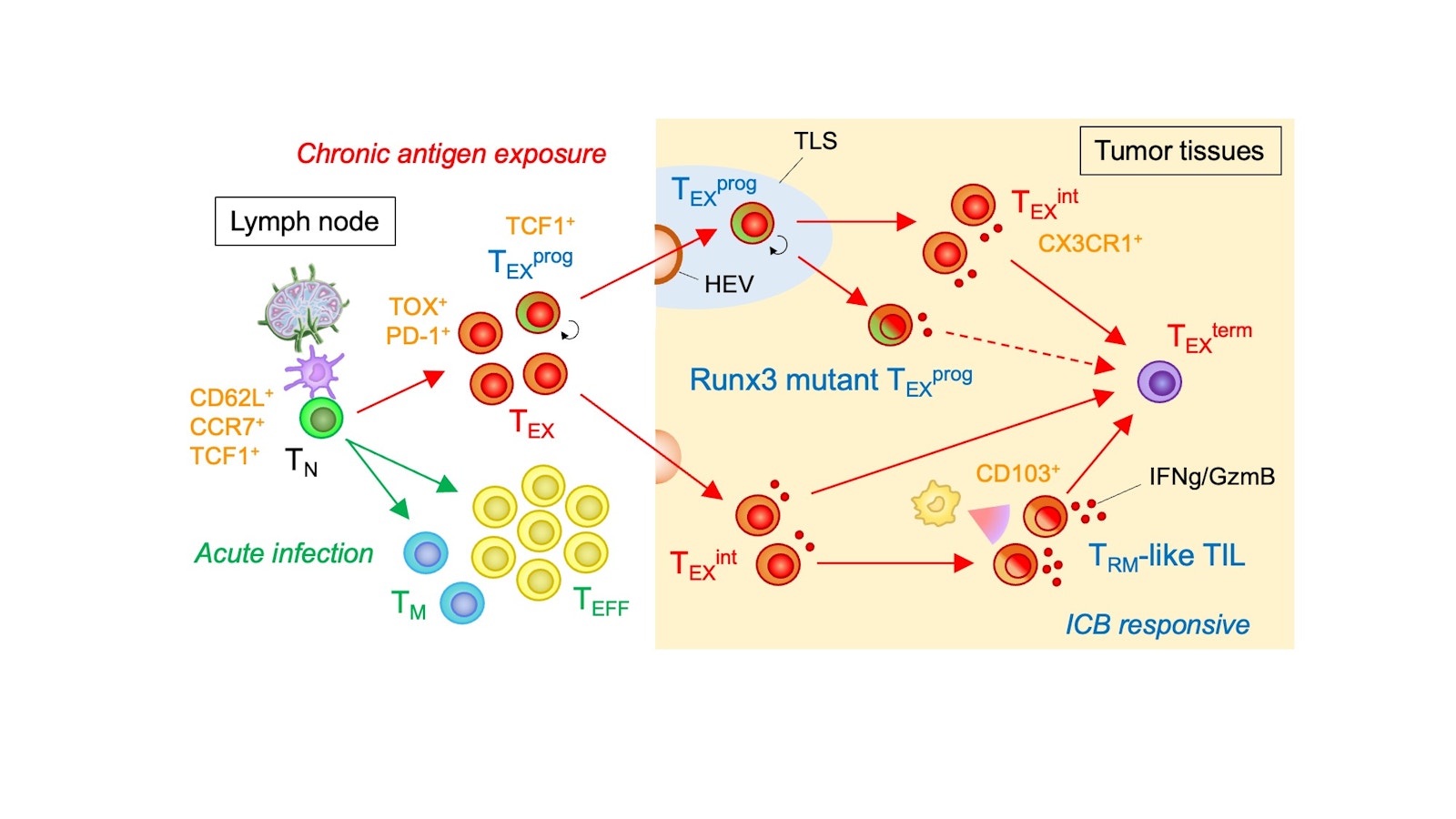
Under conditions of persistent antigen stimulation, CD8⁺ T cells preferentially follow an exhaustion-associated differentiation pathway (red). After initial priming in the lymph nodes, a subset of activated CD8⁺ T cells differentiates into TEXprog and migrates from high endothelial venules (HEVs) into tertiary lymphoid structures (TLS), where they are maintained. In contrast, the majority of cells progress through a functionally active intermediate exhausted state (TEXint) before differentiating into terminally exhausted T cells (TEXterm), which exhibit severely impaired effector function. CD8⁺ T cells carrying a Runx3 mutant retain a TEXprog-like state while simultaneously preserving effector activity. In addition, CD8⁺ T cells that receive specific local signals within the tumor microenvironment differentiate into TRM-like TILs with high effector potential. Cell populations responsive to immune checkpoint blockade are indicated in blue.
Recent Major Publications
Yonesaka K, Kurosaki T, Tanizaki J, Kawakami H, Tanaka K, Maenishi O, Takamura S, Sakai K, Chiba Y, Teramura T, Goto H, Otsuka E, Okida H, Funabashi M, Hashimoto Y, Hirotani K, Kamai Y, Kagari T, Nishio K, Kakimi K, Hayashi H. Chromosomal instability is associated with cGAS-STING activation in EGFR-TKI refractory non-small-cell lung cancer. Cells 14(6), 447 (2025)
Ohtani H, Fujiki Y, Takamura S, Miyazawa M. Identification of proliferating CD103+ CD8+ tissue-resident memory-like T-cells in villitis of unknown etiology in human placenta. Virchows Archiv, (2025)
Murakami K, Takamura S, Kakimi K, Matsumura N. Tumor immunology and immunotherapy for endometrial cancer. Expert Opin Investig Drugs 34(1-2), 37–48 (2025)
Invited Presentations
Takamura S. Overcoming the short-lived nature of tissue-resident memory CD8+ T cells in the lung. U.S.-Japan Cooperative Medical Sciences Program (USJCMSP) International Conference on Emerging Infectious Diseases (EID) in the Pacific Rim, Tokyo, Japan, March 11–15 (2025)
Takamura S. Generation and maintenance of tissue-resident memory CD8+ T cells in the lung. Seminar, Westlake University, Hangzhou, China, October 9–9 (2025)